
Dog Training Motivation Is Personal
- A reward only works if your dog values it in that moment. Food, toys, sniffing, praise, and play can all reinforce behavior, but their value changes between dogs and situations.
- Test, do not guess. A short reward-preference audit reveals what earns your dog's quickest, happiest response.
- Match reward value to difficulty. Kibble may work in the kitchen; a more valuable reward may be needed around squirrels, visitors, or other dogs.
- Low engagement is useful information. It can reflect pain, illness, fear, over-arousal, fatigue, satiety, an overly difficult task, or a reward that is not valuable enough for the setting.
- Start below your dog's threshold. Build focus in an easy environment before asking for it in busy Loudoun County parks, on trails, or around neighborhood distractions.
- Reward-based training is the evidence-based standard. The American Veterinary Society of Animal Behavior recommends reward-based methods for all training and behavior modification.
What Does “Motivation” Mean in Dog Training?
What Can Count as a Reward?
Reward Category | Examples | Best Used When |
Food | Soft meat, cheese, freeze-dried treats, kibble | Teaching new skills, practicing calm focus, building value for a cue |
Play | Tug, fetch, chase games, a favorite squeaky toy | Dogs who become more animated through movement or toy interaction |
Social connection | Praise, petting, a happy verbal response, access to you | Dogs that seek close interaction with their person and are not overwhelmed |
Life rewards | Sniffing, going outside, greeting a person, getting on the couch, moving forward on a walk | Practicing useful skills in everyday situations |
Access to activities | A short training break, a swim, a trail walk, a chance to investigate | Reinforcing behavior for active or environmentally focused dogs |
What Should You Check Before Trying to Increase Motivation?
Could a Health Issue Be Affecting My Dog’s Engagement?
Is My Dog Too Stressed or Overstimulated to Learn?
What You Notice | What It May Mean | Better Next Step |
Dog eats treats at home but refuses them outside | Distraction or stress exceeds the reward’s value | Increase distance from the distraction and use an easier exercise |
Dog takes food roughly, whines, or cannot settle | Over-arousal or frustration | Lower the intensity, shorten the session, and reward calm behavior |
Dog ignores food and toys everywhere | Pain, illness, fatigue, or a significant emotional concern may be involved | Pause training demands and consult a veterinarian if the change is new or persistent |
Dog works for a few repetitions, then wanders off | Session may be too long, too repetitive, or under-rewarded | End sooner, vary the exercise, or adjust the reward |
How Do You Find the Reward Your Dog Really Values?
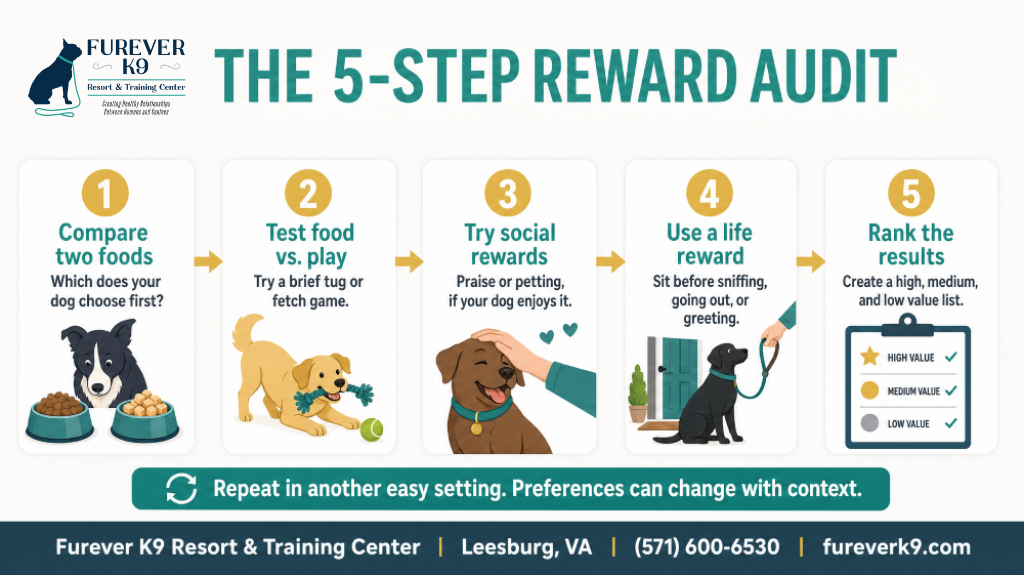
The 5-Step Reward Audit
Should You Use the Same Reward Every Time?
Training Situation | Appropriate Reward Strategy |
Your dog is learning a new cue in the living room | Reinforce frequently with a reward they enjoy, often food or play |
Your dog is practicing a familiar cue in the yard | Use medium-value rewards, with occasional higher-value surprises |
Your dog is near a major distraction | Increase distance first, then use your highest-value available reward for achievable responses |
Your dog is working for a real-life privilege | Use safe access to sniff, move forward, greet, or play as the reward |
Why Won’t My Dog Work for Treats or Toys Outside?
How Can You Build Engagement Without Creating Dependence on Treats?
When Should You Get Professional Help With a Disengaged Dog?
Motivation Is a Training Plan, Not a Personality Test
FAQs
Dog training motivation is the reason a dog chooses to repeat a behavior. It depends on what the dog finds rewarding in that moment, such as food, play, praise, sniffing, or access to an activity they enjoy.
First, test several safe foods in an easy, low-distraction environment. If food consistently has little value, explore play, social interaction, or life rewards. A sudden appetite change or refusal of all rewards is a reason to speak with your veterinarian.
Avoid training immediately after a large meal if food motivation is usually low, but do not restrict food inappropriately or use hunger to force engagement. Use a portion of your dog’s normal meal or small treats, and factor training calories into their daily intake.
For some dogs, yes. Research shows that dogs differ in their relative response to praise and food, so test your dog’s preference rather than assuming one reward works best for every dog.
Your dog may be too distracted, over-aroused, or uncomfortable to eat. Move farther from the trigger, reduce the difficulty, and practice an easy skill in a calmer location before expecting focus in a busier setting.