
timing in dog training
Author picture

Timing in Dog Training: How to Sharpen Your Cues and Rewards

Good timing is what separates a training session that clicks from one that confuses your dog. Here's how to mark behavior and deliver rewards within the one-to-two-second window that actually builds understanding — plus the most common timing mistakes to fix first.

The Quick Guide to Timing in Dog Training

Timing is the invisible thread that connects your command to your dog’s understanding. Without precise timing, even the best training methods fail.

  • The 1-to-3 Second Rule: A dog connects a reward to whatever behavior it is performing the exact instant that reward arrives. If you delay praise by just three seconds, you are likely rewarding the wrong behavior.
  • Consistency is the Foundation: Timing only works when built on a foundation of consistent communication. Mixed signals and unpredictable rules make precise timing impossible.
  • Hand Signals Matter: Dogs read physical cues and body language significantly faster than spoken words. Pairing a verbal command with a consistent hand signal tightens the communication loop.
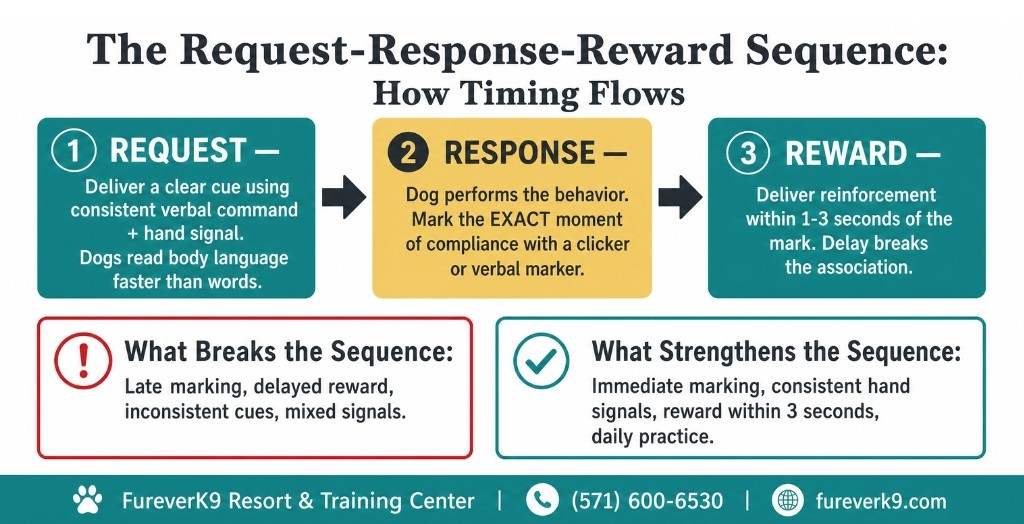
  • The Request-Response-Reward Sequence: This three-step cycle must flow seamlessly. Stalling at any point breaks the association and confuses the dog.
  • Professional Guidance Accelerates Progress: Learning mechanical timing is difficult through trial and error. Professional coaching helps handlers recognize exactly when a signal lands and how the dog interprets it.
Timing is one of the most overlooked skills in dog training, and it is also one of the easiest to fix. A dog connects a reward or correction to whatever it is doing the instant that signal arrives, not to what happened five seconds earlier. Marking the right behavior within one to two seconds, then following through with reinforcement right away, is what turns a confused dog into one that clearly understands what earned the reward. FureverK9’s trainers in Leesburg, VA build this skill into every session, teaching clients to read subtle cues, rehearse timing drills daily, and reinforce instantly so dogs form a clear association between action and reward.
 
Consistency and body language are the foundation precise timing is built on, since dogs read hand signals and posture faster than words. FureverK9 trainers teach clients to mark behavior within one to two seconds and reinforce the Request-Response-Reward sequence, using consistent hand signals and body language so dogs get a clear, unmixed signal every time.

What Do You Need Before Fixing Your Timing?

Correcting timing in dog training requires groundwork, not guesswork. Owners who skip preparation often make timing worse, not better, because rushed corrections confuse dogs further. Three prerequisites set the stage for real progress.
 

The Value of Professional Guidance

Novice and intermediate trainers benefit from hands-on instruction rather than trial and error at home. FureverK9’s Leesburg, VA facility gives owners a structured setting to observe correct mechanics before attempting self-correction. Watching a professional demonstrate proper cue delivery prevents owners from practicing the same mistakes on repeat.
 

Establishing Consistent Communication Habits

A consistent communication style matters more than any single correction. Owners should establish clear signals, humane handling, and predictable responses before fine-tuning reward timing or consequence timing. Research-backed methods built on consistency produce stronger, more reliable outcomes than inconsistent, reactive handling.
 
Before adjusting mechanics, confirm these three prerequisites are in place. First, ensure you have access to hands-on instruction, whether through a facility or a qualified trainer. Second, establish a consistent, humane communication style that is already practiced daily. Third, develop a clear grasp of the Request-Response-Reward sequence that underlies every training moment. Skipping any one of these steps undermines the mechanical skill timing depends on.

How Do You Sharpen Reward Timing Step by Step?

Sharpening reward timing takes practice, not talent. Owners who fix their mechanics see faster progress and fewer frustrated training sessions. Below is the sequence FureverK9 trainers use to help clients tighten up their delivery.
 
Step
Action Required
Why It Matters
1. Mark the exact moment
A sit, a recall, or a release of a chewed shoe requires the marker to land the instant the behavior happens.
The dog needs an immediate signal that they have performed the correct action.
2. Deliver the reward quickly
Provide the reinforcement within one to three seconds of the marked behavior.
As , immediate delivery is the key to success in operant conditioning because it creates a positive association linking the action with the reward.
3. Pair a physical cue
Combine a repeated gesture, such as a hand drop or a clicker click, with the reward.
Dogs read hand signals and body language better than spoken words, sharpening their understanding faster than verbal praise alone.
4. Practice until automatic
Rehearse the cue, behavior, and reward sequence in structured sessions until it requires no conscious thought.
Muscle memory prevents hesitation, ensuring the reward window never closes before delivery.
5. Reinforce outside lessons
Weave positive reinforcement into daily enrichment to provide extra repetitions.
Consistent application in real-world scenarios solidifies the dog’s understanding of the timing sequence.

Why Reward Timing Matters More Than the Reward Itself

A late reward, even a high-value one, reinforces whatever the dog was doing when it arrived, not the behavior that was requested. As noted in a , associative learning through operant conditioning relies entirely on the dog connecting the action to the consequence.
 
Precision beats bribery every time. Furthermore, as emphasizes, the true power of marker training comes from correct timing; mistakes in timing inevitably end up confusing the dog.

What Timing Mistakes Should You Troubleshoot?

Three errors account for most stalled progress: late corrections, inconsistent cues, and delayed rewards. Each one breaks the communication loop between handler and dog, and each one is fixable once identified. Timing issues in dog training rarely stem from a lack of effort; they stem from a lack of awareness about when a signal actually lands.
 
Owners troubleshooting these issues should work through a specific sequence. Begin by recording a short training session on video. Next, note the exact moment a cue, correction, or reward occurs relative to the behavior. Then, compare that moment against when the dog’s behavior actually changed. Finally, adjust the delay until the signal and the behavior align within a second or two.
 

Understanding Corrections During High-Drive Moments

High-drive behavior can override a dog’s ability to process commands entirely. Instinct hijacks the brain so completely that a correction delivered even a few seconds late accomplishes nothing. The dog is not defying anyone; it simply cannot hear past the impulse. This extreme form of mistimed correction explains why leash reactivity toward squirrels, joggers, or other dogs can feel impossible to interrupt.
 

The Consequences of Slipped Reward Timing

Delayed praise teaches the dog the wrong lesson, rewarding whatever it did the instant the treat arrived instead of the intended behavior. Handlers dealing with sloppy reward timing often grow impatient without realizing why, which breeds inconsistency and sends the dog mixed signals. FureverK9’s trainers routinely help owners identify these split-second gaps behind leash aggression, jumping, and similar frustrations.
 
Getting timing right is often the difference between a training plan that stalls and one that clicks almost overnight. If you would like a trainer to watch your mechanics in real time and tighten up your timing, FureverK9’s private lessons in Leesburg are built around exactly that kind of hands-on coaching. Call (571) 600-6530 or fill out our contact form to get started.
 

How Board & Train Accelerates Timing Development
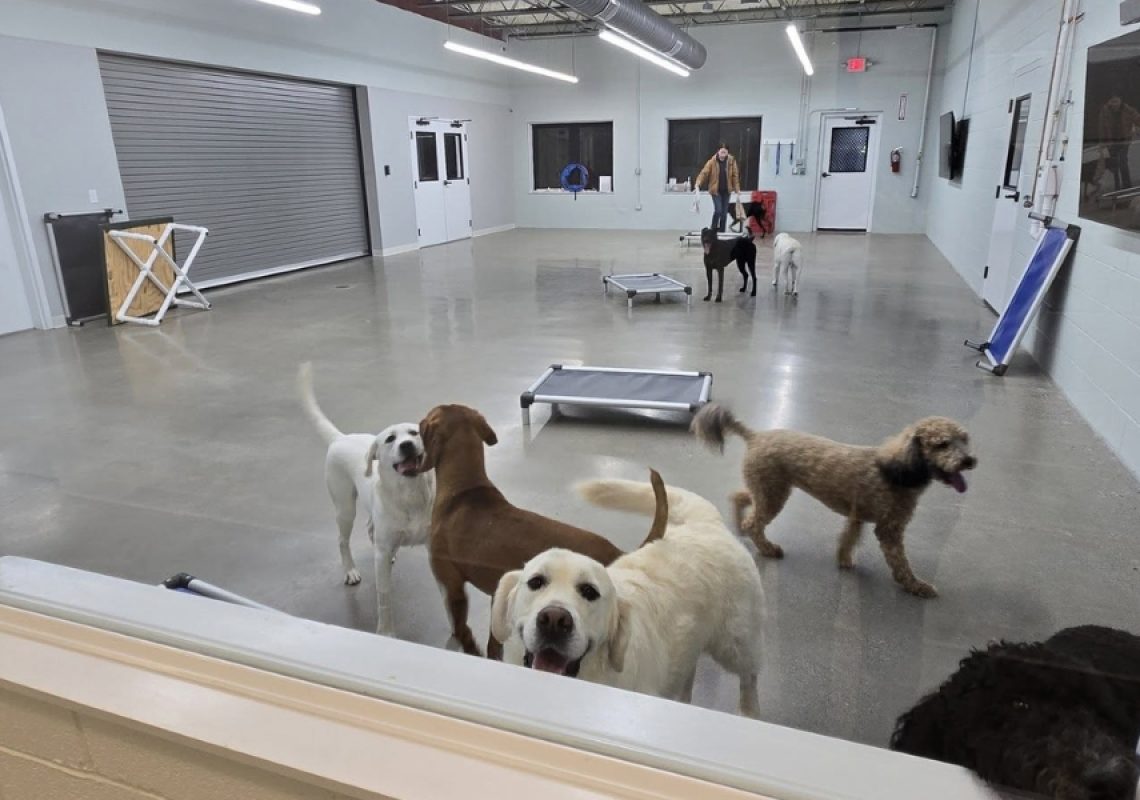
For many dog owners, the hardest part of improving timing is not understanding the concept — it is building the mechanical habit under real-world pressure. This is where FureverK9’s offers a distinct advantage that weekly private lessons alone cannot replicate.
 
When a dog lives at FureverK9’s Leesburg facility during a Board & Train stay, every interaction throughout the day — feeding, play, exercise, and structured training sessions — is governed by precise, consistent timing. The dog receives hundreds of correctly timed repetitions each day, far more than any owner can realistically deliver during a single weekly lesson or a few minutes of backyard practice. This volume of correctly timed reinforcement is what builds deep, reliable behavioral associations at a speed that part-time training cannot match.
 
Board & Train also solves a problem that is unique to owner-led timing work: the dog never gets to practice the wrong association. At home, a dog may receive a delayed reward dozens of times before the owner realizes their timing is off. During a Board & Train stay, a professional trainer is delivering every cue, mark, and reward with precision from day one. The dog’s nervous system learns what correct timing feels like before any bad habits have a chance to take root.
 
When the dog returns home, FureverK9’s trainers conduct a thorough handoff session, teaching the owner the exact timing mechanics the dog has learned to respond to. This means the owner inherits a dog that already understands the Request-Response-Reward sequence, making it significantly easier to maintain timing consistency at home. Rather than learning timing and teaching the dog simultaneously, the owner only needs to focus on one skill: matching the timing standard the dog already knows.
 
Board & Train is particularly valuable for dogs with established behavioral challenges — leash reactivity, jumping, or ignoring commands in high-distraction environments — where mistimed corrections have already created confusion. A concentrated, professionally managed stay resets the communication pattern and gives both dog and owner a clean foundation to build on.
 
Ready to give your dog the benefit of professionally timed training from day one? Learn more about FureverK9’s or call (571) 600-6530 to discuss whether it is the right fit for your dog.

FAQs

Mark the exact moment the dog complies, then deliver the reward within one to three seconds. Waiting longer teaches the dog the wrong association instead of the intended behavior.

Owners need hands-on instruction, a consistent and humane communication style, and a clear grasp of the Request-Response-Reward sequence. Skipping these prerequisites undermines the mechanical skill timing depends on.

Dogs read hand signals and body language faster than spoken words. Pairing a consistent physical cue with each reward sharpens understanding and eliminates mixed signals, speeding up reliable training results.

Yes. Consistently poor timing can lead to frustration for both the dog and the handler. It can inadvertently reinforce unwanted behaviors, such as jumping or barking, if the reward is delivered while the dog is performing those actions instead of the desired command.

Absolutely. Whether you are using positive reinforcement or issuing a correction, the consequence must occur immediately after the behavior. A delayed correction will only confuse the dog, as they will not understand which action is being corrected.

Share this Success Story!

I know I need help!!!

Let Lauren know what you're struggling with!
She'll get in touch with you to discuss options!