

Why Your Dog’s Recall Isn’t Reliable
Author picture

Why Your Dog’s Recall Isn’t Reliable: Understanding What You’re Teaching When Your Dog Ignores You

Why your dog won't come when called. Expert guide to recall reliability, context-specific learning, and off-leash safety. FureverK9 Loudoun County. (571) 600-6530.
The Bottom Line on Reliable Recall
  • The Problem: Your dog responds to “come” perfectly at home, but ignores you at the park. You assume they are being defiant, but they are actually responding to context-specific learning.
  • The Reality: Knowing the command and reliably responding to the command are completely different things. Most owners inadvertently teach their dogs that recall is optional by calling when they cannot enforce compliance.
  • The Solution: Never call a recall you cannot enforce. Every single call must result in compliance, building a history where the dog learns that “come” is a non-negotiable expectation.
  • The Science: Professional trainers recognize “learned irrelevance”—when a cue becomes meaningless because it is overused without enforcement. Reliable recall requires 100% compliance across progressive stages of distraction.
  • The Bottom Line: You teach reliability not through perfecting your training technique, but through perfect consistency in enforcement.
You taught your dog the “come” command. They respond perfectly at home. You practice in the quiet backyard, and they come reliably. You feel confident in their training. Then, you take them to the park on a long line to practice off-leash skills. You call “come,” and your dog looks at you, decides a squirrel is significantly more interesting, and ignores you completely. You panic, reel them in, and feel frustrated. Your dog “knows” the command. So why will they not come?
 
Here is what most dog owners do not understand about recall reliability. Knowing the command and reliably responding to the command are completely different things. Your dog is not ignoring you out of spite or defiance. Your dog is making a calculated choice based on what they have learned about what “come” means in that specific context. And that choice is often: the squirrel is greater than coming to you.
 
More importantly, you have likely been accidentally teaching your dog that recall is an optional request. Every time you call “come” and your dog ignores you without consequence, you are training unreliable recall. Every time your dog chooses the squirrel and you do not enforce the command, you are teaching them that “come is negotiable.” Every time you call when you are not certain they will comply, you are actively weakening the command.
 
I am Lauren White, and at Furever K9 Resort & Training Center in Leesburg, Virginia, I work with frustrated Loudoun County owners who have trained recall but do not have reliable recall. The transformation happens when they finally understand a core concept: Recall reliability is not about perfecting the training technique. It is about teaching your dog that coming when called is entirely non-negotiable.
 
The dogs with the most reliable recall are not necessarily the ones trained by the most sophisticated methods. They are the dogs whose owners never, ever call a recall they are not prepared to enforce. They are the dogs whose owners understand context-specific learning and train accordingly. They are the dogs whose owners recognize that recall reliability is a lifestyle choice, not simply a training outcome.
 
Your dog is not being difficult. You are simply not yet teaching what “reliable” actually means. Understanding the difference changes everything about how you approach off-leash training.

What Actually Makes Recall “Reliable”?

Understanding the fundamental distinction between a trained recall and a reliable recall prevents immense frustration and potentially dangerous situations. The American Kennel Club defines a reliable recall as being 99.99% sure that when you call your dog to come, they are going to enthusiastically respond and actually come to you .
 

Why “Trained” Recall Isn’t the Same As “Reliable” Recall

Feature
Trained Recall
Reliable Recall
Environment
Works at home, in quiet areas, with minimal distractions
Works across all contexts, including parks and high-distraction areas
Arousal Level
Breaks down when the dog is highly aroused or excited
Works consistently regardless of the dog’s arousal level
Consistency
Sometimes works, sometimes does not
Works consistently in unpredictable situations
Dog’s Mindset
Dog makes a choice: “How interesting is what I’m doing vs. coming?”
Dog has learned: “Come” is non-negotiable and always happens
Result
You hope they will come
You know they will come
A trained dog might come sometimes. A reliably trained dog comes always, because they have learned that coming is not an optional request. Most owners stop at “trained” and assume that translates to “reliable.” It absolutely does not.
 

Why Context-Specific Learning Breaks Recall

Dogs do not generalize concepts the way humans do. Your dog learns that “come means come home” in the living room. That is a highly specific context: you are indoors, your attention is focused on them, there are no competing distractions, and there is an immediate reward.
 
That same dog at the park learns an entirely different context. At the park, “come” means “stop whatever fun thing I am doing.” However, they are not entirely sure if they have to comply, because sometimes you ignore their non-compliance when the squirrel is interesting. Eventually, you might get them with a long line, but the command was not truly non-negotiable in the moment.
 
These are two different commands in the dog’s mind. They learn that in the living room with no distractions, “come” equals treats and attention. They learn that in the backyard with mild distractions, “come” equals sometimes treats, sometimes nothing. They learn that at the park with high arousal, “come” is a suggestion that depends heavily on the presence of a squirrel. They learn that on walks with other dogs, “come” is entirely negotiable depending on their interest level.
 
It is the same word, but it carries completely different meanings in each context. The dog does not think, “I am disobeying my owner.” The dog thinks, “This is not the ‘come’ context where that strict rule applies.” This phenomenon is why your dog has perfect recall at home and absolutely no recall at the park. They are simply not the same behavior in the dog’s mind.
 

What Teaches Unreliable Recall (Accidentally)

Professional trainers refer to a phenomenon known as “learned irrelevance” or a “poisoned cue.” This occurs when a recall cue becomes meaningless because it is overused without enforcement, or because the dog learns they can safely ignore it . Every time you call “come” and your dog ignores you without consequence, you are actively training unreliability.
 
Consider these common patterns that teach your dog to ignore you:
Calling When the Dog Will Not Comply: You call “come,” the dog ignores you, and you do not enforce the command. The dog learns that “come” is optional. If they ignore you, the human will not force them to comply. Repeating this pattern teaches the dog reliable ignoring.
 
Calling With a Long Line but No Real Enforcement: You call “come” while the dog is on a long line. The dog ignores you and keeps chasing a scent. You slowly reel them in over several minutes. The dog learns that eventually the human will get them, but they can keep playing first. Repeating this pattern teaches the dog to “come eventually, but not right now.”
 
Calling When Uncertain They Will Come: You call “come” simply hoping they will respond. They do not. You are now in an awkward position where you cannot enforce the command. The dog learns that “come” is merely a request, not a requirement.
 
Calling Too Frequently: You call “come” multiple times in succession. The dog learns that the first call does not actually mean they need to come. Repeating this pattern teaches the dog to wait for an urgent tone of voice or the third or fourth call before responding.
 
Calling Without a Backup Plan: You call “come” on walks, hoping the leash is secure. If the dog decides to pull away, you have already issued the command. If you cannot enforce it without looking foolish, the dog learns that “come” is optional if they really want something else.
 
The overarching pattern is clear: Every time a recall command does not result in the dog coming to you immediately, you are training unreliability.
 

The Critical Principle: Never Call A Recall You Can’t Enforce

This is the absolute foundation of reliable recall. You must only call “come” when the dog is on a leash, a long line, or is completely and reliably contained within a secure area. You must only call when you are fully prepared to enforce the command—whether that means going to get them, using the long line, or taking whatever safe action is necessary.
 
You must only call when the distance is manageable. Never call hoping they will comply. Never call and then just wait to see what happens. Never call and then attempt to negotiate with treats from afar.
 
Each time you call and the dog does not respond, they learn that “come” is negotiable, that they can choose to ignore you, and that the command is neither urgent nor mandatory. Conversely, each time you call and the dog comes immediately—because you had enforcement available—they learn that “come” means come right now. They learn that ignoring is not an option, that the command is non-negotiable, and that compliance is their only choice.
 
You teach reliability through unwavering consistency. Every single call must result in compliance. Not “most of the time,” but every single time. This is precisely why reliable recall takes significantly longer to build than trained recall. You can teach a trained recall quickly in a living room. Reliable recall requires perfect consistency over an extended period.

How Dogs Learn Reliable Recall

Understanding the mechanism of learning explains why some training approaches work beautifully while others fail entirely.
 

Why Repetition Alone Doesn’t Create Reliability

There is a persistent myth that “practice makes perfect.” Owners assume that if they practice the “come” command one hundred times, their dog will reliably come. This is simply not true. If eighty of those one hundred times result in compliance, and twenty result in the dog ignoring the command without consequence, you have successfully taught your dog that “come” is optional twenty percent of the time.
 
What actually creates reliability is a history of 100% compliance. The dog must learn that every single time “come” is called, they come. There can be no exceptions in the dog’s recent experience. The dog’s neural pathway must solidify the concept that “‘come’ equals a non-negotiable event that always happens.”
 
When there is repeated inconsistency, the dog learns that sometimes they come, and sometimes they do not. Their neural pathway dictates that “‘come’ is optional and depends heavily on other factors.” The dog evaluates the situation: “Is the squirrel worth ignoring my owner for?” If the human does not always enforce the command, the answer is usually “yes.”
 
Reliable recall comes from the consistent reinforcement of compliance combined with the consistent enforcement of non-compliance. It does not come from simply repeating the command more times.
 

Building Recall Through Progression Stages
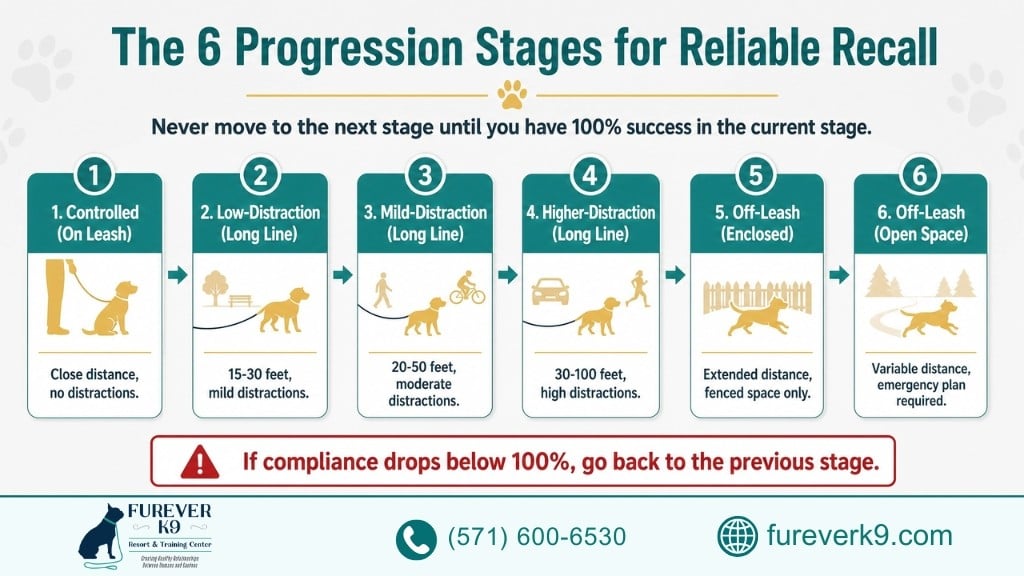
To build a reliable recall, you must work through specific progression stages. The critical rule is that you do not move to the next stage until you have achieved 100% success in the current stage
 

Stage 1: Training in a Controlled Environment (On Leash)

Begin with the dog on a leash at a close distance of just a few feet, with absolutely no distractions. The goal is for the dog to learn that “come” reliably results in treats and attention. You must maintain 100% success in this context before moving forward.

Stage 2: Training in a Low-Distraction Environment (Long Line)

Move to a moderate distance of 15 to 30 feet using a long line. Introduce mild distractions, such as normal household sounds or people being present. The dog learns that the command works across a distance, and you still enforce it if they hesitate.

Stage 3: Training in a Mild-Distraction Environment (Long Line)

Extend the distance to 20 to 50 feet, still utilizing the long line. Introduce moderate distractions, such as other dogs at a significant distance or activity happening nearby. The dog learns that recall is mandatory even when interesting things are happening nearby.

Stage 4: Training in a Higher-Distraction Environment (Long Line)

Extend the distance further, from 30 to 100 feet. Introduce moderate to high distractions, such as other dogs playing, activities, or interesting smells. The goal is for the dog to learn that reliability must increase despite their increased arousal levels. The long line remains attached for immediate enforcement.

Stage 5: Off-Leash Training (Enclosed Space)

Work at an extended distance with moderate distractions, but only within a completely enclosed, fenced space. If the dog does not come, you must be able to safely retrieve them. The dog learns that “come” means come, even without physical restraint.

Stage 6: Off-Leash Training (Open Space With Exit Management)

This final stage involves variable distances and high distractions. It requires strategic positioning and an emergency plan. The goal is for the dog to reliably come in real-world situations. This stage is only appropriate when reliability has been genuinely proven over months of practice.

If your dog’s compliance drops below 100% at any stage, you have jumped stages too quickly. You must go back to the previous stage and rebuild the foundation.

What Happens When Your Dog Doesn’t Come

Understanding the moment your dog chooses not to come is critical for teaching reliability. This is the ultimate teaching moment.
 

The Correct Response When Your Dog Ignores You

When your dog hears “come” and ignores it, they are actively learning something. They are either learning that the command is non-negotiable because you enforce it, or they are learning that it is optional because you do not.
 
If your dog ignores the recall, you must calmly enforce compliance. Because you only called when you had a leash or long line attached, you have the means to enforce the command. Go directly to the dog and retrieve them. There should be no yelling, no punishment, and no visible frustration. Bring the dog back to the original location where you called them. Call “come” again. When the dog complies—because they now know it is not optional—reward them immediately. The dog learns: “I was ignoring, the human enforced it, now I must come, and I still get a reward for compliance.”
 
You must never chase the dog, as this teaches them that running away is a fun game. You must never yell at the dog, which creates panic rather than compliance. You must never grab them harshly, which creates fear. Most importantly, you must never scold the dog after they finally comply, as the dog will associate coming to you with punishment. Do not simply give up and leave, as the dog will learn that ignoring you works perfectly.
 

Why Punishment Doesn’t Create Reliability

Owners sometimes believe that if they punish the dog for not coming, the dog will eventually learn to come. This approach is fundamentally flawed. Peer-reviewed research published in PLOS ONE demonstrates that dogs trained with aversive methods display more stress behaviors and show lower compliance than those trained with reward-based methods.
 
Punishment does not work because the dog learns to fear you, rather than understanding that “come” is a non-negotiable expectation. The dog becomes increasingly anxious about coming to you, and may learn to avoid coming altogether because approaching you means something scary is about to happen. This damages your relationship and trust, keeping the dog’s nervous system activated and stressed.
 
Reliable recall comes from consistent enforcement, consistent rewards, and a non-negotiable expectation. It never comes from fear.

Building True Off-Leash Reliability

Understanding realistic timelines and requirements prevents dangerous situations and sets both you and your dog up for success.
 

When Is Recall Actually Reliable Enough for Off-Leash?

The honest answer is that a dog is ready for off-leash freedom much later than most owners realize. The minimum requirements for off-leash privileges include a history of 100% compliance over multiple months—typically a minimum of three to six months of zero failures. This must be tested in progressively difficult scenarios, with no single instance of the dog ignoring a command without immediate enforcement. It is not enough that the dog “usually comes”; literally every single call must equal compliance.
 
You must have tested the recall across real-world scenarios, including the presence of other dogs, high-interest distractions like squirrels or deer, off-property environments, and high-arousal situations.
 
Furthermore, you as the owner must understand when your dog is over their threshold. You must know when not to call them, understand their body language, and always have an escape plan if something goes wrong.
 
A realistic assessment acknowledges that many dogs are never reliably off-leash. Only a small percentage of dogs achieve true 100% off-leash reliability. Most “off-leash dogs” you see at parks should actually be “on a long line in parks” dogs. Being off-leash is a privilege that must be earned, not an inherent right.
 

Red Flags: When Your Dog Should NOT Be Off-Leash

Your dog should never be off-leash if their recall history is incomplete or if they have had any recent failures. They should not be off-leash if they are highly aroused or anxious, if the environment has unfenced areas nearby, or if the dog has a high prey drive and prey animals are present. If you are uncertain about their compliance, or if you cannot immediately retrieve them if needed, the leash must stay on.
 
Off-leash freedom requires complete confidence in reliability, a solid backup plan, an appropriate environment, and the owner’s full attention and readiness. Most behavioral problems involving “off-leash” dogs stem from dogs that were never actually reliably trained being let loose in inappropriate environments.

How Furever K9 Approaches Recall Training

At Furever K9 Resort & Training Center, our philosophy prioritizes long-term reliability over quick, superficial training.

Our Assessment-First Approach

We do not just train the “come” command. We assess your dog’s current recall history to determine what has worked and what has failed. We look at context understanding to see where the dog is failing, and we analyze the owner’s patterns to see if they are inadvertently training unreliability. We assess the dog’s arousal levels, the value of the reinforcement being used, and the individual dog’s learning style. Only then do we create a customized protocol addressing the root issues.
 

Our Training Services for Recall

Our are designed to assess your current recall and coach you on consistency and enforcement, building progression stages at an appropriate pace. Our provides professional recall training in a controlled environment, giving your dog intensive practice with a professional while teaching you how to maintain the skills. For significant recall issues requiring intensive work, our immersive program provides 24/7 structure and consistency across all progression stages.
 
Reliable recall is not an accident. It is a deliberate choice to teach your dog that “come” is non-negotiable. Most owners stop at a “trained recall” and assume it is reliable. It is not. A trained dog might come sometimes; a reliably trained dog comes always, because they have learned there is no other option.
 
At Furever K9, I help Loudoun County owners build genuinely reliable recall—not quick training, but foundation-solid reliability that keeps dogs safe and owners confident. If you are ready to build actually reliable recall instead of hoping it works, contact in Leesburg, Virginia. Let’s assess what is preventing reliability and create a customized protocol that actually works.

FAQs

Your dog has learned that “come” is optional because sometimes ignoring you works and sometimes it does not. This is context-specific learning; your dog is evaluating whether coming to you is worth more than staying where they are. To build reliability, you must teach that “come” is always non-negotiable by ensuring every single call results in compliance, requiring perfect consistency from you.

While a basic trained recall might take four to eight weeks, a truly reliable recall—where the dog comes 100% of the time across all contexts—typically takes three to six months minimum of perfect consistency. The timeline is determined by achieving a 100% compliance history; if you call, the dog ignores, and you do not enforce it, your training timer essentially resets.

If your dog is too distracted, they are not ready for that context, and you have moved through the progression stages too quickly. The solution is to go back to a lower-distraction context, rebuild the foundation, and progress more slowly using a long line for enforcement until reliability is proven.

Yes, high-value treats are essential, but the real reward is the freedom to continue their activity after compliance. The dog learns that they get a treat and get to continue enjoying what they were doing, reinforcing the expectation that “come” is a mandatory rule, not just an option weighed against the value of a treat.

This is context-specific learning; your dog has learned that “come” at home means compliance is enforced, while “come” at the park means it is open to negotiation. You must use the park as a training ground with a long line attached so you can enforce the command 100% of the time until the reliability transfers to the new environment.

Share this Success Story!

I know I need help!!!

Let Lauren know what you're struggling with!
She'll get in touch with you to discuss options!