
Build your puppy potty training schedule by age around frequent daytime trips, with extra opportunities after waking, eating, drinking, and playing. Reward your puppy as soon as they finish in the right spot, and adjust the routine to their actual needs rather than expecting a birthday to bring reliable bladder control.
A puppy can have a successful morning and still leave a puddle after an afternoon game. That does not mean the training has disappeared. It may mean that the next trip needs to happen sooner, supervision needs to change, or a health concern needs attention.
For Leesburg and Loudoun County families, a useful plan has to fit ordinary life: getting ready for work, school pickup, dinner, and interrupted nights. Here is how to create that plan without punishing accidents or asking your puppy to hold it longer than they comfortably can.
How Often Should You Take a Puppy Out by Age?
Start with frequent trips while your puppy is awake, then adjust based on successful toileting, activity, and health. Age helps you plan, but it does not tell you exactly how long your individual puppy can wait.
VCA’s puppy housetraining guidance recommends outings every one to two hours while awake, plus trips after meals, large drinks, and waking. It also recommends breaks about every 30 minutes during high-energy play.
The age guide below applies that frequent-break approach to different stages. These are conservative planning examples, not tested age-specific bladder limits or requirements to extend the gap.
Puppy’s Age | Daytime Starting Routine | What to Adjust |
About 8–10 weeks | Start with roughly hourly opportunities while awake, plus trips after sleep, meals, substantial drinks, and play | Go sooner if your puppy shows signs or has accidents before the next trip; prepare for overnight outings |
About 11–16 weeks | Keep the frequent routine that is working; do not automatically add time because your puppy is older | Consider a small increase during calm periods only after repeated success under supervision |
About 4–6 months | Some puppies can move toward one- to two-hour awake gaps, but keep shorter intervals when needed | Continue event-based trips, review nighttime needs separately, and increase household freedom gradually |
If your puppy needs a break sooner than the example, take them. Sniffing, circling, restlessness, or suddenly leaving a game should override the timer.
A sleeping puppy and an active puppy do not necessarily need the same schedule. Neither does a recently adopted puppy with unfamiliar routines and one who has practiced successfully in your home for weeks.
Avoid treating the popular “age in months equals hours” formula as a daily training target. A possible holding time is not the same thing as a comfortable interval that gives a puppy plenty of chances to learn.
When Should Potty Trips Happen After Meals, Sleep, and Play?
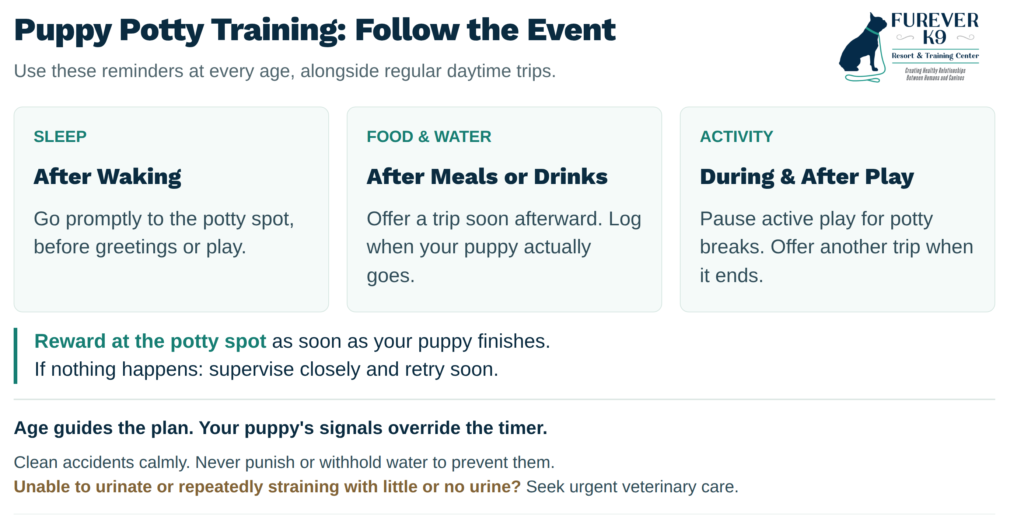
Offer a trip promptly after waking, soon after a meal or a substantial drink, and during and after active play. Those events add opportunities to the schedule, even when the next timed break is not due yet.
After Sleep: Potty Before Greetings
When your puppy wakes, head to the designated spot before starting a game or a busy greeting. Have the leash and your shoes ready so the transition does not become a long wait.
This applies to short naps as well as the first wake-up of the morning. If waking reliably leads to an accident near the door, make that route quicker and supervise the transition more closely.
After Meals and Drinks: Observe the Pattern
Offer a trip soon after eating or a large drink, then record when your puppy actually pees or poops. Some puppies will need another opportunity shortly afterward, so one unsuccessful trip is not a reason to assume they are empty.
Keep meal times reasonably consistent with your veterinarian’s feeding guidance. Do not change meal quantities or restrict water just to make the calendar easier.
Cornell’s guidance on increased drinking and urination explains why restricting water can be dangerous, particularly when increased thirst reflects a medical need. Keep fresh water available and ask your veterinarian about a noticeable change in drinking or urination.
During and After Play: Add Breaks
An energetic game can change how soon your puppy needs to go. Pause high-energy activity for bathroom opportunities rather than waiting for the regular interval to end.
VCA’s roughly 30-minute play-break recommendation is a reminder to check in, not permission to ignore earlier signals. Offer another trip when the activity finishes, especially if your log shows that this is a common accident point.
What Does a Practical Daytime Routine Look Like?
Organize the day around a repeating sequence: potty opportunity, supervised activity, rest, and another opportunity when the puppy wakes. Use clock reminders between events rather than forcing every puppy into one hour-by-hour timetable.
For example, the first part of your morning might be:
- Wake up and visit the potty spot. Wait quietly and reward successful elimination.
- Serve breakfast. Offer a trip afterward and record the result.
- Have a short period of supervised play or training. Include another opportunity when it ends, or sooner if needed.
- Settle for rest. Take your puppy out promptly on waking, then repeat the routine.
Through the afternoon, add trips after meals or substantial drinks, during active play, and at the regular awake interval that works for your puppy. Finish the evening with a bathroom opportunity before bed.
If your commute or an appointment creates a gap longer than your puppy manages, arrange someone to help. A longer crate stay is not a substitute for a needed bathroom break.
In a Leesburg townhouse or apartment, count the time needed to reach the potty area. Keep supplies near the door and make the plan workable before your puppy is urgently searching for somewhere to go.
What Should You Do If Your Puppy Does Not Go Outside?
Wait quietly for a few minutes, then return to close supervision and try again soon if nothing happens. An unsuccessful attempt should not lead straight to unsupervised access to the house.
VCA’s advice for an unsuccessful toilet trip suggests returning indoors after about five minutes without elimination, supervising carefully, and going back out at the first sign of restlessness.
Stay with your puppy at the designated spot rather than simply opening the door. That lets you see whether they actually went and reward at the right time.
Save an exciting game for after toileting when practical. If every trip becomes a play session first, it can be harder to tell whether your puppy had the opportunity to finish.
There is an important difference between a puppy who sniffs without attempting to urinate and one repeatedly straining with little or no urine. Repeated unproductive attempts or inability to urinate require urgent veterinary care, not another training retry.
How Should You Reward Successful Potty Trips?
Give quiet praise and a small, puppy-appropriate treat as soon as your puppy finishes, while you are still at the potty spot. Waiting until you return to the kitchen makes the reward less clearly connected to toileting there.
VCA’s recommendations for rewarding elimination support immediate rewards near the elimination area. Let your puppy finish rather than interrupting with excitement halfway through.
Keep treats ready before leaving home. If you want a potty cue, use a short phrase calmly as your puppy begins, rather than repeating it continuously while they investigate. For related practice with cues and rewards, see our guide to reward timing in dog training.
Everyone helping with the routine should use the same basic approach. A shared log is more useful than trying to remember whether someone else took the puppy out and whether anything happened.
How Should You Supervise During the First Week?
Use the first week to learn your puppy’s patterns and limit opportunities to disappear into another room. Close supervision means someone is actually watching, not just working nearby while the puppy has access to the whole house.
Start with a manageable area where you can notice sniffing, circling, or a pause in play. When you cannot watch, use an appropriate puppy-proofed pen or another safe arrangement that meets their needs. Our room-by-room dog-proofing checklist can help you review cords, small objects, cleaners, and other hazards before choosing that space.
A crate can be part of the setup if your puppy is comfortable with it and you provide timely outings. It should allow comfortable standing, turning, and lying down; it should never become a punishment or an endurance test.
These first-week checkpoints can help:
- Days 1–2: Record meals, drinks, waking, activity, outings, and accidents. Begin with frequent opportunities instead of testing limits.
- Days 3–4: Look for repeated trouble spots, such as an accident after play or a missed trip when someone leaves for work. Change the routine at those points.
- Days 5–7: If the pattern is improving, try one small change at a time, such as a little more supervised space. Keep the successful bathroom routine in place.
These checkpoints are for reviewing your plan, not a promise of housetraining within seven days. A puppy who is still learning at the end of the week has not failed.
What Should You Do After a Potty Accident?
Respond calmly, clean thoroughly, and use the incident to adjust the routine. Punishment does not show your puppy where to go next and can make toileting near you feel unsafe.
If you see an accident happening, gently guide your puppy to the designated spot if you can do so without frightening or forcing them. Reward if they finish there.
If you find the mess later, skip the correction entirely. VCA’s accident-cleanup and supervision guidance recommends calm cleanup, an enzymatic cleaner, and better supervision rather than punishment.
Use a pet-urine cleaner appropriate for the surface and follow its instructions. Keep your puppy away during cleaning and until the product’s directions say the area is ready for use.
Use This Accident Decision Tree
First, check health: Is there sudden regression, pain, straining, blood, diarrhea, or unusually increased thirst? Contact your veterinarian promptly; inability to urinate or repeated straining with little or no urine needs urgent care.
If there are no health concerns, check timing: Was the accident happening when you noticed it? Calmly guide to the potty spot if feasible; if you discovered it afterward, quietly clean instead.
Then check the routine: Did it follow waking, eating, drinking, or play? Add a trip at that event, shorten the relevant gap, and improve supervision before trying to extend the schedule again.
Not every indoor puddle belongs to the same category. For related patterns, see our guides to indoor urine marking and urination during greetings, without assuming either explanation rules out a medical concern.
How Should You Handle Potty Training at Night?
Offer a trip before bed, make overnight outings quiet and purposeful, and take your puppy out promptly on waking. Some puppies still need night trips for months, so assess nights separately from daytime progress.
VCA notes that puppies may need overnight bathroom outings until around five months. That is not a deadline, and it does not mean a younger puppy must wait through a full night.
Keep the sleeping area close enough to notice waking and restlessness. Respond to a possible bathroom need rather than assuming crying is simply an attempt to get attention.
If your log shows a predictable nighttime need, plan an outing before that point and adjust cautiously as dry nights develop. Do not deliberately wait for an accident to test how long your puppy can hold it.
Persistent distress in a crate deserves help with the sleeping setup and gradual acclimation. Suspected illness or repeated overnight soiling needs veterinary advice, not just a stricter confinement plan.
How Can You Adjust the Schedule Without Rushing?
Change the interval only after repeated success, and change one part of the plan at a time. A dry afternoon does not establish that your puppy is ready for a long unsupervised evening.
Use the printable puppy potty routine log to record age, events, actual elimination, accidents, and the next planned opportunity. It also includes adjustment checkpoints and the accident decision tree.
If your puppy repeatedly stays comfortable and dry at the current interval, consider adding a small amount of time during a calm, supervised period. Keep post-sleep, post-meal, and activity-related trips even when the regular gap changes.
If accidents return, go back to the shorter interval that worked. Check whether you also added more space, missed signals, or changed meals, activity, or caregivers.
Track opportunities and results, not just the number of dry days. That helps you see whether the routine is improving or whether someone is simply watching less closely.
Where Can a Puppy Potty Before Vaccinations Are Complete?
Ask your veterinarian to help choose a clean, controlled toilet area based on your puppy’s vaccination status and local disease risk. A private area may be more manageable than a heavily used communal dog toilet, but no setting should be described as risk-free.
AVSAB’s guidance on managing puppy exposure before full vaccination recommends controlled environments and avoiding unsanitized areas with heavy traffic from dogs of unknown health status.
If suitable outdoor access is not available, discuss a designated indoor toilet surface with your veterinarian and trainer. Keep the location consistent and separate from bedding and food, and supervise if your puppy might chew or swallow the material.
This is an exposure-planning question, not a reason to postpone teaching a toilet routine or to invent a universal vaccine cutoff.
When Should Potty Problems Prompt a Veterinary Visit?
Contact your veterinarian for sudden regression, painful or frequent urination, blood, diarrhea, excessive thirst, or repeated accidents despite an appropriate routine. A health-related change should not be treated as stubbornness.
Cornell’s information on urinary stones and obstruction signs identifies straining, frequent small urinations, accidents, and blood as possible warning signs. It also explains that urinary obstruction is a medical emergency.
Seek urgent veterinary care if your puppy cannot urinate or repeatedly strains with little or no urine. Do not wait for the next scheduled trip or try a home treatment.
For diarrhea, ask your veterinarian for guidance rather than simply adding more trips. Cornell’s  guide to diarrhea in dogs highlights concerns such as blood, vomiting, poor appetite, and lethargy; puppies with these signs need prompt attention.
If health concerns have been assessed and the routine is still difficult, a trainer can help review supervision, reward timing, and the plan between trips.
How Can Furever K9 Help With Your Puppy’s Routine?
Furever K9 offers private puppy training lessons in Leesburg with owner coaching and goals tailored to your family. Lessons take place at our facility, and you continue practicing at home. Our article on private training for puppies in Loudoun County explains how lessons and practice between visits fit together.
Bring your routine log or describe when accidents happen, what follows meals and play, and how nights are going. Those details give us a useful starting point for discussing your goals and training options at an evaluation.
Training support does not replace a veterinary examination when health signs are present. We also cannot promise that a puppy will be reliably housetrained by a particular age or after a set number of lessons.