You drop your dog off for grooming and hope for the best. You are not entirely sure what to tell the groomer about your dog’s specific needs, and you are unsure what is realistic to expect. You pick your dog up and have no idea if the groomer did what you wanted. You feel frustrated because you do not know how to support the grooming process at home, and you suspect you are missing something important about how to work effectively with your groomer.
Here is what most owners do not understand about professional grooming: it is not just a service you buy and walk away from. It is a partnership between you and your groomer, where communication, clear expectations, and at-home support determine the ultimate success of the experience. A groomer can only do their best if you communicate your dog’s needs, and you can only support grooming progress if you understand what the groomer is trying to accomplish and why.
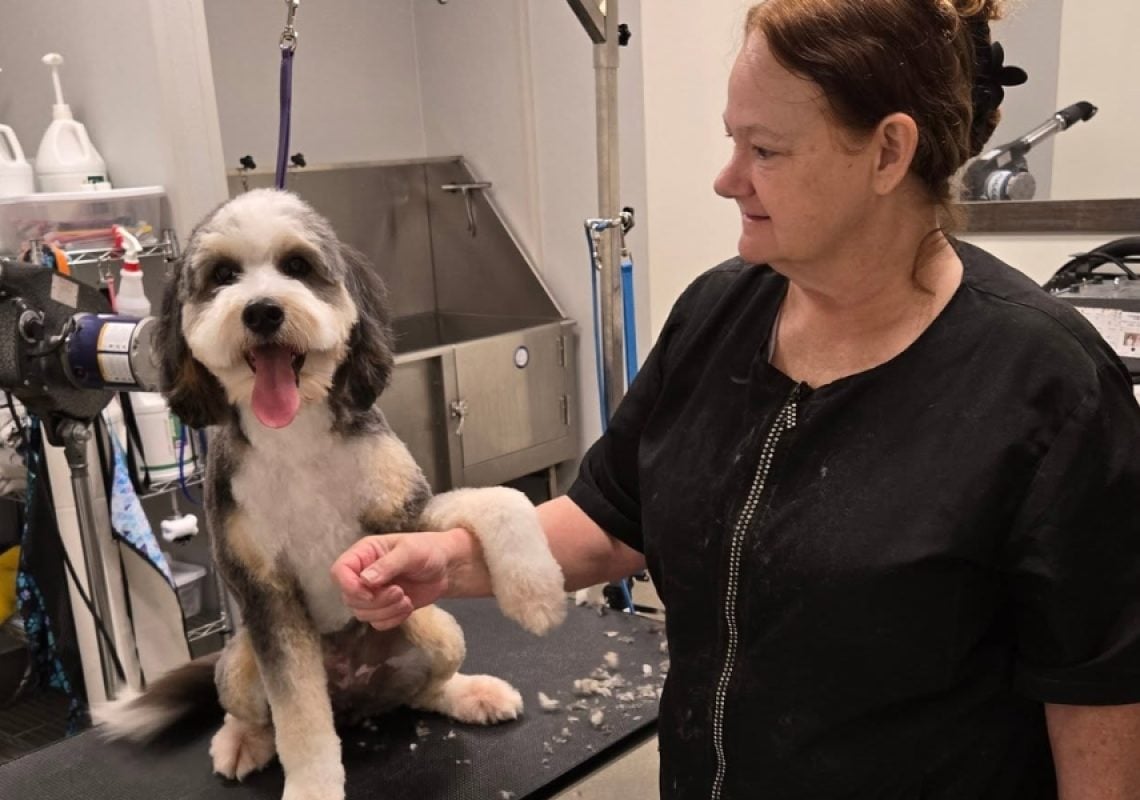
I am Lauren White, and at Furever K9 Resort & Training Center in Leesburg, Virginia, I work alongside Kathy Taylor, our professional groomer. Kathy and I consistently see owners who do not realize how much their communication and at-home support affects grooming outcomes. The owners who partner effectively with Kathy—those who communicate clearly, set realistic expectations, and support grooming work at home—see dramatically better results than owners who treat grooming as a purely transactional service.
This is not just about getting your dog clean. It is about creating a partnership where grooming supports your dog’s overall development. When grooming and training are coordinated, when expectations are clear, and when you provide support at home, your dog benefits exponentially.
Your groomer cannot do their best without your partnership. Understanding how to work effectively with your professional groomer changes everything.
What Your Groomer Needs From You to Do Their Best
Understanding your groomer’s needs prevents miscommunication and enables significantly better outcomes for your dog.
Why Clear Communication Matters
Your groomer needs comprehensive information about your dog’s specific needs. This includes any behavioral anxiety or fears, whether those are grooming-specific, general anxiety, or a fear of certain types of handling. It includes physical issues such as past injuries, sensitive areas, skin conditions, or chronic ear problems. It also includes coat or nail conditions requiring special attention, past grooming experiences (both positive and negative), and any current medications or health conditions.
Your groomer also needs to understand your specific goals. What do you want the grooming session to accomplish? Is your primary focus cleanliness, coat health, nail maintenance, or anxiety reduction? Do you want specific styling, or just practical, low-maintenance care? What are your timeline expectations for how often you need grooming, and what are your budget considerations?
If your dog is currently enrolled in training programs, you must tell your groomer. Share whether your dog is participating in Board & Train, private lessons, or group classes. Discuss specific behavioral goals or protocols, and explain how grooming should integrate with that training. Share any recent changes in behavior or confidence.
With this information, your groomer can adjust their handling approach for anxious dogs. They can work around physical issues safely, coordinate grooming with training goals, and set realistic expectations about what is achievable. Ultimately, this allows them to provide the best possible care and experience. Without this information, your groomer is forced to guess and may miss critical needs.
How to Have Effective Communication Conversations
Effective communication happens at multiple touchpoints throughout the grooming relationship.
Grooming is part of ongoing care. Consistent communication ensures your groomer knows how your dog is doing, what is working well, and what requires adjustment.
What Realistic Expectations Look Like
Understanding what is realistic prevents frustration and sets your groomer up for success.
What Grooming Can and Cannot Do
Grooming can keep your dog’s coat healthy and clean, maintain proper nail length, and provide an opportunity to check for skin issues or parasites. It provides safe, professional handling that can create positive experiences and build confidence through proper care, supporting your dog’s overall health and comfort.
However, grooming cannot magically fix behavior problems—that is the role of training. It cannot instantly resolve deep-seated anxiety that has not been addressed previously, nor can it change your dog’s fundamental personality. It cannot guarantee perfect cooperation if your dog is severely anxious, and it cannot replace behavioral training with handling alone. Most importantly, grooming cannot fix problems that require your consistency at home.
If your dog has significant grooming anxiety, you must expect gradual improvement over multiple appointments. Each appointment should be slightly better than the last, though there may be minor setbacks if something unexpected occurs. Your dog will absolutely need at-home support between appointments, and the timeline for significant behavioral improvement is typically measured in weeks or months, not hours.
Do not expect dramatic, instant change. Do not expect perfect cooperation on the very first appointment. Do not expect anxiety to resolve without your at-home support, and do not expect grooming alone to fix severe anxiety without accompanying behavioral training.
What to Expect During the Grooming Process
A typical grooming appointment includes several stages: a bath taking 5 to 15 minutes depending on the coat, drying taking 10 to 20 minutes, brushing and detangling taking 10 to 20 minutes, nail trimming taking 5 to 10 minutes, ear cleaning taking 5 minutes, and final touches taking 5 to 10 minutes. The total time is generally 45 to 90 minutes, depending entirely on your dog’s size, coat condition, and cooperation level.
It is entirely normal for dogs to sometimes resist during grooming. This is a normal reaction, not a failure. Some dogs are simply easier to groom than others, but cooperation generally improves with repetition. Anxious dogs may not be “perfect,” but they can improve significantly. Your groomer may recommend shorter, more frequent appointments for highly anxious dogs to build tolerance.
What constitutes a red flag? It is a red flag if your groomer refuses to discuss your dog’s needs, will not accommodate anxiety or physical concerns, seems rough or impatient, or if your dog consistently comes home more anxious than before. It is also a concern if your groomer dismisses your observations about your dog. If something feels wrong, trust your instinct. True partnership requires mutual respect.
How to Support Grooming Work at Home
Understanding your role enables continuity and progress between professional appointments.
At-Home Care Between Appointments
Regular brushing helps maintain coat health between appointments, preventing matting and tangling. More importantly, it teaches your dog that touch is normal and safe, providing an opportunity to check their skin and paws.
Paw checks are particularly important. Inspect your dog’s paws regularly, handling them gently to teach your dog that paw manipulation is normal. Check between the pads for debris or infection, and notice any changes in nail growth or color.
Handling practice directly supports grooming work. According to certified professional dog trainers, practicing cooperative care—where you train your dog to be an active, willing participant in handling—empowers the dog and reduces anxiety . Touch your dog’s ears, face, and paws regularly, making the experience positive with treats and gentleness. Build your dog’s comfort with handling to support your groomer’s work by normalizing touch.
For nail maintenance, if you are comfortable, perform light filing between appointments. Otherwise, simply monitor that the nails are not overgrowing. Support your groomer’s work by keeping the nails from getting completely out of hand.
Whatever you do, do it consistently. Dogs learn routine and expect it; consistency directly supports grooming cooperation.
How to Coordinate Grooming With Training
If your dog is in training, you must communicate with both your trainer and your groomer. Your trainer should know your dog’s grooming schedule and goals, and your groomer should know your training protocols and behavioral work. Both professionals can coordinate to support your dog effectively.
For example, if your training goal is to build confidence through handling, professional handling during grooming reinforces that training. Your role is to provide regular at-home touch practice that supports both. If your training goal is to reduce anxiety through routine and structure, a consistent grooming appointment schedule provides that structure. Your role is maintaining the schedule and supporting calm behavior around grooming.
When grooming and training are aligned, your dog receives a consistent message that handling is safe. Multiple positive experiences reinforce confidence, making progress faster and stronger. Your dog develops a solid, unshakable trust foundation.
What to Do if Grooming Goes Badly
If something negative happens during a grooming session, get specific details from your groomer about what occurred and how your dog reacted. Stay calm, because your dog reads and mirrors your reaction. Assess any physical damage, and make a veterinary appointment if an injury is possible.
In the following days, watch closely for behavioral changes such as increased anxiety or defensive behavior. Do not force grooming or handling while their anxiety remains high. Provide extra support and reassurance, and contact your groomer to discuss what happened and how to adjust the approach.
If a severely bad experience occurred, take a break from professional grooming if the anxiety is high. Work with your trainer on anxiety management, and return to grooming gradually with a highly modified approach. Consider finding a new groomer if the relationship of trust is permanently damaged.
Choose your groomer carefully. Interview them first, watch how they interact with your dog, and trust your instinct. If something feels off, it probably is.
Understanding Grooming as Part of Overall Care
Seeing grooming in its proper context changes how you approach it.
How Grooming Fits Into Furever K9’s Holistic Approach
At Furever K9, we see grooming as an integral part of overall dog development.
Our training services include Private Lessons for coaching you on behavioral development, Group Classes for socialization and confidence building, Board & Train for intensive behavior modification, and Day Training for consistent work. Our grooming services include Professional Grooming with expert handling and care, focusing on confidence building through safe handling, direct communication with training goals, and support for overall dog development.
Training builds behavioral confidence, while grooming builds confidence during moments of vulnerability. Together, they create a dog who is confident and trusting in all situations. When you utilize both services, grooming supports training goals, and training supports grooming readiness. Your dog receives comprehensive development, resulting in faster and stronger progress.
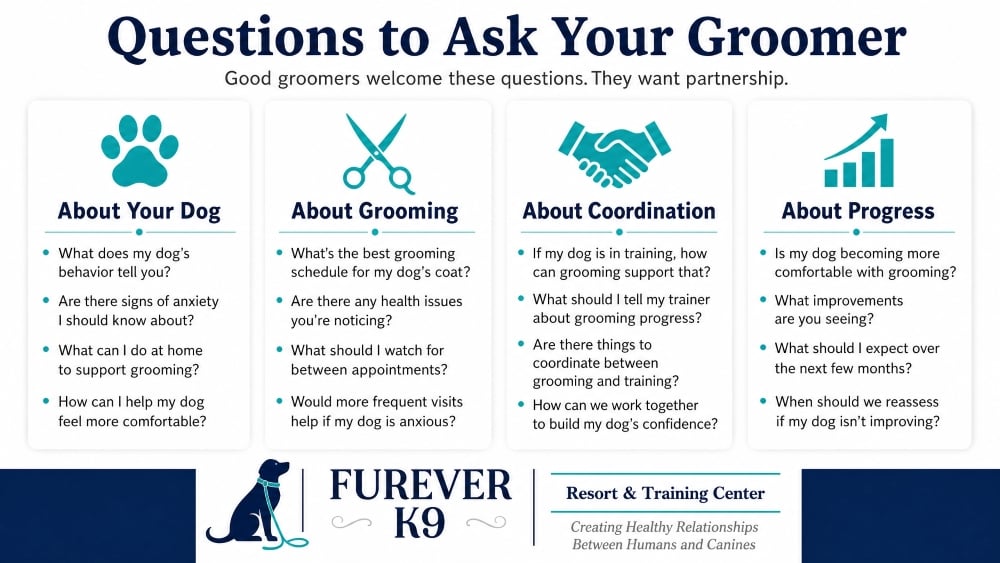
Questions to Ask Your Groomer
To build a strong partnership, actively ask your groomer questions:
- About your dog: What does my dog’s behavior tell you? Are there signs of anxiety I should know about? Is there anything I should do at home to support grooming? How can I help my dog feel more comfortable?
- About grooming: What is the best grooming schedule for my dog’s coat? Are there any health issues you are noticing? What should I be watching for between appointments? Would more frequent appointments help if my dog is anxious?
- About coordination: If my dog is in training, how can grooming support that? What should I tell my trainer about my dog’s grooming progress? How can we work together to build my dog’s confidence?
- About progress: Is my dog becoming more comfortable with grooming? What improvements are you seeing? What should I expect over the next few months?
Good groomers welcome these questions because they actively want a partnership.