

What Does Fear Actually Look Like in Dogs?
Common Fear Signals vs. Owner Misconceptions
What the Dog Does | What Owners Often Think | What It Actually Means |
Hiding/Withdrawal | “He’s just antisocial.” | Seeking safety from perceived threats. |
Growling/Snapping | “He’s being aggressive.” | Trying to create distance from a threat when they can’t escape (defense, not offense). |
Freezing | “He’s being stubborn.” | A classic fear response (fight, flight, or freeze) hoping the threat won’t notice them. |
Excessive Barking | “He’s dominant/excited.” | Fear communication saying, “Stay away! I’m scared!” |
Submissive Urination | “He’s not housetrained.” | Extreme appeasement behavior born from fear and anxiety during greetings. |
Refusing Food | “He’s a picky eater.” | Anxiety is so high that survival instincts have overridden hunger. |
How Do You Know Your Dog Is Genuinely Fearful?
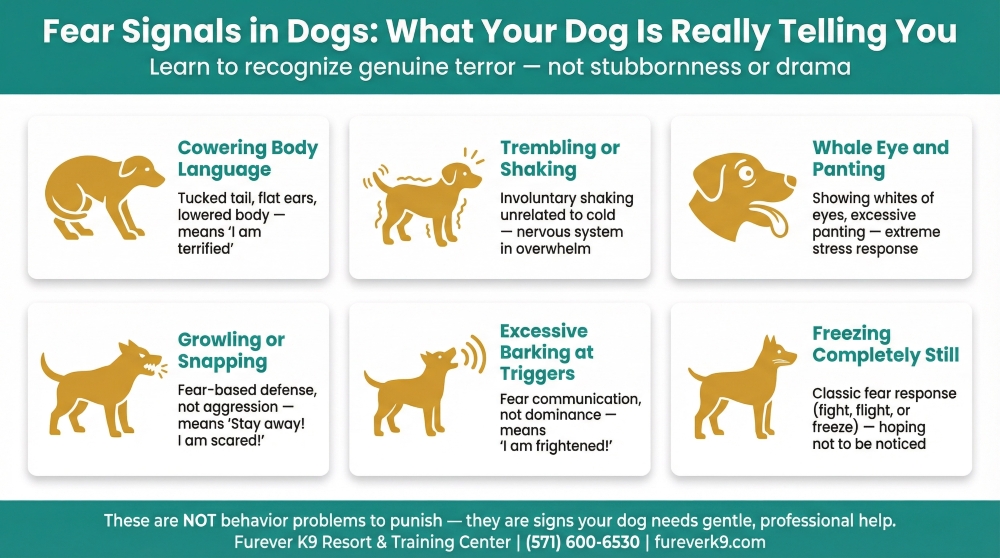
- Cowering Body Language: A dog lowering their body, tucking their tail between their legs, pulling their ears back flat against their head, or avoiding eye contact is screaming “I’m terrified” in the only language they have.
- Trembling or Shaking: Unrelated to cold, this indicates high anxiety or fear. It’s an involuntary physiological response activating their sympathetic nervous system.
- Panting, Drooling, or Whale Eye: Showing the whites of the eyes and excessive panting are physical stress symptoms accompanying fear.
- Destructive Behavior: When left alone, chewing door frames or frantic scratching often stems from panic and a desperate attempt to escape, not spite.
Why Is Understanding the Root of Fear So Important?
What Training Methods Actually Help Fearful Dogs?
How Does Desensitization Work for Anxious Dogs?
- Find the Threshold: If your dog fears other dogs, we start at distances where they notice the other dog but remain calm—maybe 50 feet away. We don’t force close proximity that triggers panic.
- Build Neutrality: Over many repetitions at that comfortable distance, your dog learns that other dogs appearing doesn’t mean anything bad happens.
- Decrease Distance: We gradually decrease distance in tiny increments over multiple sessions as your dog remains calm.
What Is Counterconditioning and Why Does It Transform Fearful Dogs?
- The Process: When that other dog appears, high-value treats appear. The other dog predicts amazing things happening.
- The Shift: Over time, your dog’s emotional response shifts. Instead of “Oh no, another dog—I’m terrified,” they think “Oh, another dog—where’s my chicken?”
- The Reward: The treats must be genuinely high-value—whatever your dog considers the absolute best thing in the world (cheese, chicken, hot dogs). Regular kibble won’t cut it.
Why Does Positive Reinforcement Matter So Much for Fearful Dogs?
- Building Confidence: Every time we reward calm, brave behavior, we’re communicating “Yes! That’s exactly what I wanted! You’re safe when you do that!”
- Avoiding Force: Force-based training methods—leash corrections, shock collars, yelling, alpha rolls—increase fear. The American Veterinary Society of Animal Behavior explicitly recommends against these methods, especially for fearful or anxious dogs.
- Providing Agency: Positive reinforcement allows fearful dogs to make choices and experience success without pressure, reducing the helplessness that fuels anxiety.
What Role Do Safe Spaces Play in Anxiety Management?
- Define the Space: This might be a crate they view positively, a quiet bedroom, or a specific corner with their bed.
- Respect the Boundary: Never force a fearful dog out of their safe space. Dragging them out teaches them they have no safe refuge anywhere.
- Teach Coping Skills: Teaching your dog to “go to your bed” on cue gives them a coping strategy to remove themselves from stressful situations.
How Do You Socialize a Fearful Dog Without Making Things Worse?
What Makes Socialization Safe for Anxious Dogs?
- Controlled Environments: At Furever K9, our carefully supervised socialization sessions ensure your fearful dog encounters only calm, appropriate dogs in structured settings.
- Dog-Led Pacing: We never force interaction. If your dog wants to observe from across the room for three sessions before approaching, that’s fine.
- Reading Body Language: When we see stress signals—lip licking, yawning, looking away, stiff body—we increase distance or end the session.
- Small Groups: One or two very calm, friendly dogs who understand social cues help fearful dogs learn appropriate interaction without overwhelm.
How Do You Know When Your Fearful Dog Is Ready for More Interaction?
- Voluntary Approach: Your dog approaching triggers voluntarily instead of avoiding them.
- Relaxed Body Language: Loose muscles, soft eyes, natural tail position, and willingness to take treats.
- Engagement: Seeking treats or engaging with you during exposure shows they’re not overwhelmed.
- Quick Recovery: If a small startle results in brief tension followed by relaxation within seconds, your dog’s coping skills are improving.
What Socialization Mistakes Make Fearful Dogs Worse?
- Flooding: Forcing dogs into overwhelming exposure hoping they’ll “get over it” typically worsens fear and can cause trauma.
- Punishment: Correcting your dog for growling just suppresses the warning signal, creating dogs who “bite without warning.”
- Unrealistic Expectations: Comparing your dog to confident dogs creates unrealistic pressure. Fearful dogs progress at their own pace.
- Inconsistency: Your dog needs predictable experiences to learn new emotional responses.
What Support Do Fearful Dogs Need at Home?
How Do Routines Help Anxious Dogs Feel Secure?
- Predictable Schedules: Knowing when meals, walks, and bedtime happen stops constant vigilance about what might happen next.For a real example, read about a former stray who learned to live in a house with Lauren's help.
- Consistent Responses: If you sometimes comfort fearful reactions and sometimes ignore them, your dog can’t predict outcomes. Consistency builds security.
- Appropriate Exercise: Physical and mental stimulation reduces anxiety. Sniffing games and indoor play provide necessary outlets.
- Established Rituals: A special treat before leaving for work helps dogs prepare mentally and reduces separation anxiety.
What Environmental Management Reduces Daily Stress?
- Reduce Triggers: Disconnect the doorbell temporarily while working on systematic desensitization.
- Visual Barriers: Close curtains or use window film to prevent rehearsing fearful responses to passing dogs or people.
- Auditory Masking: Use white noise or calming music to mask triggering sounds.
- Natural Outlets: Provide appropriate outlets for species-appropriate activities like sniffing, chewing, or foraging.
When Should You Seek Professional Help for a Fearful Dog?
What Signs Indicate Your Dog Needs Professional Training?
- Daily Life Disruption: Fear preventing normal activities—walks, vet visits, having guests, leaving the house.
- Safety Concerns: Dogs who bite, lunge, or snap from fear need expert evaluation and carefully structured intervention.
- Panic Responses: Destructive escape attempts, self-injury, or complete shutdowns need immediate professional assessment.
- Progressive Worsening: Despite home efforts, you need professional expertise identifying what’s not working and adjusting approaches.
- Generalized Anxiety: Multiple fears affecting quality of life extensively benefit from comprehensive professional programs.
How Does Furever K9 Help Fearful Dogs Specifically?
What Results Can You Realistically Expect?
Transform Your Dogs Today
FAQs About Training Fearful Dogs
The goal isn’t to eliminate all fear—it’s to reduce it to manageable levels where your dog can live comfortably and enjoy daily activities. Many fearful dogs become confident, happy companions who maintain some healthy caution. That’s success.
There’s no universal timeline. Mild fear may improve within weeks, while severe anxiety can require months or years. Progress isn’t linear—expect improvements, plateaus, and occasional setbacks. Patience matters more than speed.
No. Adult fearful dogs need careful desensitization and counterconditioning to change existing negative emotional responses. They require much more gradual, controlled exposure than confident puppies. The methods differ significantly.
Comfort your dog. You can’t reinforce emotions—only behaviors. Providing comfort teaches them you’re a safe haven, which reduces fear. However, let them choose whether to accept comfort or retreat to their safe space.
Yes. Fear-based aggression responds well to systematic desensitization and counterconditioning. These cases require professional guidance for safety. Address the fear, and aggression typically decreases. Safety management is crucial throughout.