

Should You Choose a Crate, a Playpen, or Both?
What You Need | A Crate May Fit When… | A Playpen May Fit When… |
A place to rest | Your puppy can relax in it without distress | Your puppy settles better with more room |
A brief break from direct supervision | Your puppy is comfortable with the closed door and care needs are met | A larger, puppy-proofed area better meets their needs |
A toilet option during a gap between outdoor trips | A closed crate is not an appropriate place to create a separate toilet corner | There is room for a designated toilet area away from bedding and food |
Practice with boundaries | You are teaching voluntary entry and brief door closure | You are teaching comfort behind a barrier with room to move |
Overnight management | Your puppy is comfortable in the crate and you can respond to their needs | A secure pen offers a more suitable sleeping arrangement |
What Should a Puppy Crate Training Schedule by Age Include?
Puppy’s Age | A Useful Practice Priority | What Determines Duration |
About 8–10 weeks | Explore an open crate or pen, accept rewards inside, and rest with you nearby | Comfort, frequent care needs, and whether the puppy can remain relaxed |
About 11–16 weeks | Add brief door closures and small changes in your position only after easier steps are comfortable | The response to each change, not the puppy’s birthday |
About 4–6 months | Practice an established skill at different times and in slightly different everyday situations | Continued comfort, timely potty access, movement, and social contact |
How Should You Set Up the Crate and Playpen Before Bringing Your Puppy Home?
Choose Enough Space and a Suitable Location
Check Equipment and Nearby Hazards
- Assemble and secure the crate or pen correctly, including doors, latches, and panels.
- Check whether your puppy could climb out, squeeze through, push the barrier over, or catch a paw.
- Keep cords, curtains, cleaners, small objects, and tempting household items beyond reach, including through the bars.
- As a snag-risk precaution, remove collars, dangling tags, harnesses, and attached leashes before closed-crate time. Ask your veterinarian about any equipment that must stay on.
- Choose bedding and toys your puppy does not shred or swallow, and watch new items before considering unsupervised use.
Keep Water and Comfort in the Plan
What Can You Practice Each Day During the First Week?
Day | Practice If Your Puppy Is Ready | Stay at This Stage If… |
1 | Secure the door open, let your puppy investigate, and reward voluntary approaches or entry | They avoid the space or hesitate; reward nearer the entrance instead |
2 | Offer some of their usual food or a suitable toy inside, with the door open and you nearby | They grab the food and hurry out or cannot engage comfortably |
3 | Encourage quiet time inside without trapping them; notice comfortable standing, lying down, or chewing | They keep checking the exit or cannot relax |
4 | Move the door slightly, then reopen; if comfortable, try a momentary closure while staying beside them | Door movement causes tension, whining, or scrambling |
5 | Repeat comfortable brief closures; make one small increase in time without increasing your distance | Their response worsens or they become distressed when food ends |
6 | With closure already comfortable, make a small movement within the room and return | They become worried as soon as you move away |
7 | Review the pattern; repeat easy successes and, only if ready, briefly step out of sight and return | They have not comfortably completed the earlier steps |
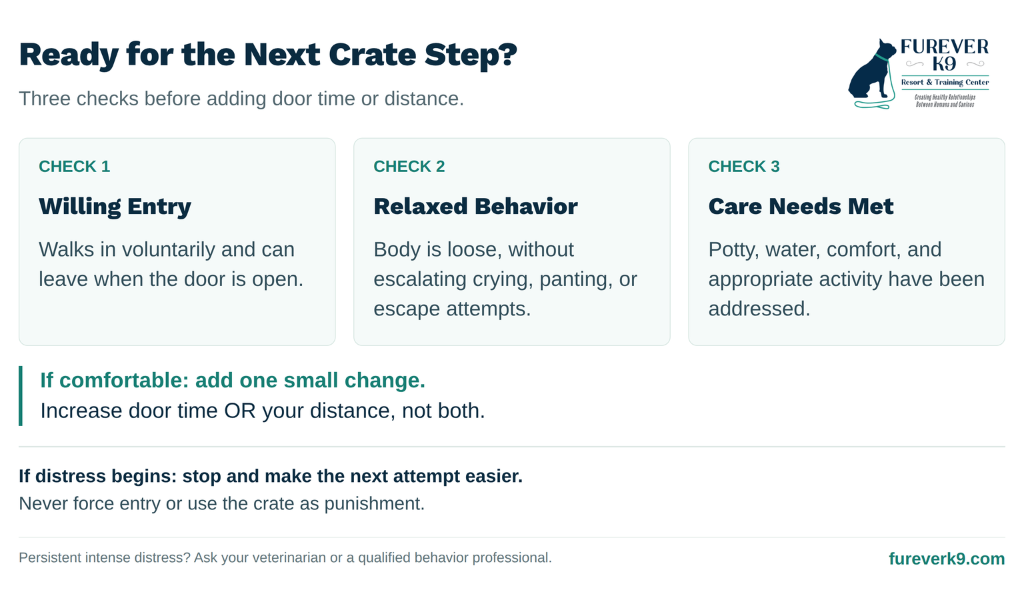
How Do You Know When to Make Crate Practice Harder?
- Entry is voluntary. Your puppy chooses to walk in rather than being pushed, dragged, or trapped by a treat.
- Behavior remains comfortable. Their body is loose, they can engage or rest, and there is no escalating vocalizing, panting, or scrambling to escape.
- Care needs are met. They have appropriate bathroom access, water, physical comfort, and a day that includes interaction and activity.
How Should Crate Practice Fit Around Potty Trips and Rest?
What Should You Do If Your Puppy Cries or Struggles?
What You Notice | A Useful Response | What Not to Do |
Hesitation at the entrance | Keep the door open and reward comfortable approaches | Push, pull, or carry the puppy in to make them accept it |
Worry when the door moves | Return to open-door practice and make movement smaller | Close it fully and wait for the puppy to give up |
Brief whining or restlessness | Check potty, water, comfort, and the training step; make the next repetition easier | Label the puppy stubborn or assume every sound is attention-seeking |
Waking and then vocalizing | Consider a prompt, quiet potty opportunity and other care needs | Expect them to wait because they were asleep earlier |
Persistent panting, cowering, frantic scratching, or escape attempts | End confinement safely and seek appropriate professional guidance | Use cry-it-out, punishment, or stronger restraint |
Repeated crate accidents or a sudden change | Review trip timing and arrange veterinary advice when needed | Withhold water or punish the accident |
What Should the First Nights Look Like?
When Should You Ask a Veterinarian or Behavior Professional for Help?
How Can Furever K9 Help With Puppy Crate and Playpen Training?
Conclusion
FAQs
There is no single duration that establishes both physical comfort and emotional readiness for every puppy. Begin new crate training with very brief practice, provide frequent care and potty opportunities, and ask your veterinarian about individual needs rather than using age as an hourly allowance.
No, do not use cry-it-out for a puppy showing distress. Check their needs, make the setup or exercise easier, and stop for professional guidance if the response is intense, persistent, or escalating.
Yes, if the pen still has enough usable space for your puppy to stretch, move, and access water and any appropriate toilet area. Secure the crate door open and check the whole arrangement for climbing, tipping, and snag hazards.
The better choice is the safe arrangement your puppy can rest in comfortably while you can respond to their needs. A pen may offer more suitable space during early training, but neither option removes the need for gradual introduction or overnight care.
The pace varies with the puppy’s comfort, prior experience, health, and the difficulty of each step. Use the first-week plan as a repeatable sequence, not a promise that closed-door or out-of-sight practice will be comfortable within seven days.