

Match the Brush to the Coat
- Start with coat structure, not a trendy tool. Hair length, density, texture, and the presence of an undercoat determine what will be comfortable and effective.
- Short coats need light, regular maintenance. A rubber brush, grooming mitt, or soft bristle brush usually removes loose hair and debris without pulling.
- Long, silky, curly, and wavy coats need frequent checks. Tangles often begin behind the ears, under the front legs, and along the rear legs.
- Double coats require patience. Work in small sections and remove loose undercoat gently without aggressively raking the skin.
- Never cut mats out with scissors. Tight or extensive mats can pull on the skin and should be handled by a professional groomer or veterinarian.
- Keep the process positive. Short, reward-based sessions are safer and more productive than restraining a dog through a stressful grooming session.
Why Does Coat Type Matter When Brushing a Dog?
- Is the coat smooth, dense, double, long, curly, wavy, wiry, or fine and silky?
- Does your dog have a soft undercoat beneath longer guard hairs?
- Are there tangles in high-friction areas, such as behind the ears or under the front legs?
- Is your dog comfortable with being touched and brushed today?
Which Dog Brush Works Best for Each Coat Type?
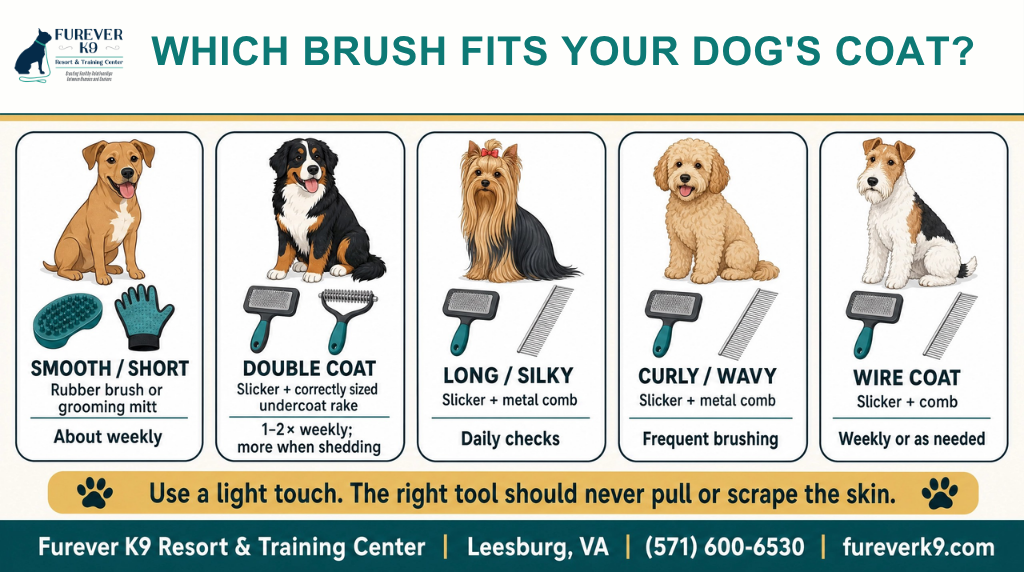
Coat Type | Common Examples | Useful Tools | Main Goal | Starting Frequency |
Smooth or short | Boxer, Beagle, short-coated Chihuahua | Rubber brush, grooming mitt, soft bristle brush | Lift loose hair and surface debris | About weekly |
Short, dense or double | Labrador Retriever, German Shepherd, Husky | Slicker brush, undercoat rake sized for the coat, comb, bristle finishing brush | Remove loose undercoat gently and inspect the skin | Once or twice weekly; more during shedding |
Long or silky | Yorkshire Terrier, Afghan Hound, Lhasa Apso | Slicker brush, pin brush for finishing, metal comb | Prevent tangles before they become mats | Daily checks; frequent brushing |
Curly or wavy | Poodle, Bichon, many Poodle mixes | Slicker brush and metal comb | Reach through curls and detect hidden knots | Daily to several times weekly, depending on coat length |
Wire-coated | Wire Fox Terrier, Schnauzer | Slicker brush, comb, suitable bristle brush | Remove debris and manage tangles without rough pulling | Weekly or as the coat requires |
How Should You Brush a Smooth or Short Coat?
- Begin at the shoulder or back, where most dogs are more comfortable with handling.
- Use gentle, even strokes to lift loose hair and debris.
- Move gradually over the sides, chest, and hindquarters.
- Slow down near the belly, tail, and legs, and stop if your dog becomes uncomfortable.
- Finish with a soft cloth or bristle brush if you want to remove remaining loose hair and add shine.
How Do You Brush a Double-Coated Dog Safely?
| Do | Avoid |
| Work for a few minutes at a time and check skin as you go | Trying to remove an entire seasonal shed in one exhausting session |
| Use a tool designed for the dog’s coat length | Assuming every “de-shedding” tool is safe for every double coat |
| Start with the least tangled areas to build tolerance | Pulling or yanking through packed loose fur |
| Use a comb to find hidden tangles on the legs, chest, and tail | Shaving or cutting a double coat at home without professional advice |
What Is the Best Way to Brush Long, Silky, Curly, or Wavy Coats?
- Choose a calm time and begin with a short, easy area, such as the back or shoulder.
- Separate a thin layer of hair so you can see close to the skin.
- Hold the hair near the skin to reduce tugging, then gently work from the ends of the hair toward the roots on any tangle.
- Brush the small section with a light touch, then use a metal comb to confirm it moves through freely.
- Continue one thin layer at a time, offering small breaks and rewards.
How Can You Make Brushing Less Stressful for Your Dog?
If Your Dog Does This | Your Best Response |
Leans in, stays loose, or takes treats comfortably | Continue briefly, keeping the session easy and rewarding |
Turns their head away or steps back | Give space, reduce the intensity, and return to an easier area |
Freezes, tries to leave, growls, or snaps | Stop the session and seek guidance before trying again |
Shows sudden sensitivity in one area | Do not work through it; contact your veterinarian if pain or a skin issue is possible |
When Is It Time to Call a Professional Groomer or Veterinarian?
The Right Brushing Routine Starts With Observation
FAQs
It depends on the coat. Smooth short coats often need a light weekly brush, while long, silky, curly, or wavy coats may need daily checks and frequent brushing. Double-coated dogs usually need more brushing during heavy shedding periods.
A rubber brush, grooming mitt, or soft bristle brush is usually a good choice for a smooth, short coat. Use light strokes in the direction the hair grows and do not over-brush sensitive skin.
An undercoat rake can help remove loose undercoat when it is the correct length for the dog’s coat and used gently. It is not required for every dog, and repeated or forceful passes can irritate the skin.
No. Mats can pull the skin upward, making accidental cuts much more likely. Use professional grooming or veterinary help for tight, extensive, or painful mats.
Brushing does not stop normal shedding, but it removes loose hair before it lands in your home and helps you keep the coat clear of debris. Dogs with double coats may still shed heavily during seasonal coat changes.