
Managing a High-Energy Dog Without Trying to “Wear Them Out”
- Do not chase a single magic exercise number. A dog’s needs vary with age, health, development, breed tendencies, lifestyle, and individual preferences.
- Build a four-part routine: movement, sniffing or enrichment, training, and intentional rest. Exercise alone does not teach a dog how to settle.
- Use structured outlets. Long-line walks, scent games, recall practice, place work, and food puzzles give energy a productive direction.
- Watch arousal, not just fatigue. More intense play is not always better. If your dog gets frantic, jumpy, mouthy, or unable to settle, change the activity rather than simply adding more of it.
- Get help when the home plan is not enough. Furever K9 offers individualized Board & Train, private lessons, day training, group classes, and structured daycare for owners in Leesburg, Loudoun County, and Northern Virginia.
What Should You Focus on When Training a High-Energy Dog?
What the dog needs | Useful outlets | What to avoid |
Physical movement | Brisk leash walks, hiking, controlled retrieve games, or safe long-line exploration | Sudden, repeated high-impact activity for growing puppies or unconditioned dogs |
Mental work | Search-and-find games, food puzzles, simple obedience, shaping, and scent work | Repeating hard tasks until the dog becomes frustrated or frantic |
Impulse control | Place, recall, leave it, waiting at doors, and calm greetings | Only asking for obedience when the dog is already over threshold |
Rest and recovery | A quiet room, crate or mat routine, predictable downtime, and lower-arousal enrichment | Constant entertainment that teaches the dog to expect stimulation all day |
How Much Exercise Does a High-Energy Dog Need?
What Is a Better Measure Than Minutes on a Clock?
Your dog’s situation | A practical starting point | Adjustment to consider |
Young, healthy adult dog | A purposeful walk plus a short training or scent session | Add variety before simply adding intensity |
Adolescent dog | Multiple brief outlets spaced across the day | Keep sessions successful; do not expect adult-level impulse control overnight |
Puppy | Age-appropriate exploration, play, and short training games | Protect growing joints and prioritize sleep and calm handling |
Senior dog | Gentle movement, sniffing, and low-impact cognitive work | Ask a veterinarian about new restlessness, pain, or mobility changes |
Dog with sudden behavior change | Pause assumptions about “extra energy” | Schedule a veterinary assessment before changing exercise dramatically |
What Does a Balanced Daily Routine Look Like for Busy Northern Virginia Owners?
Time of day | Primary goal | Example activity |
Morning | Move and explore | A purposeful leash walk with time to sniff, followed by breakfast in a puzzle or scatter feed |
Midday | Think and practice | Three to five minutes of recall, place, leash skills, or a short scent-search game |
Afternoon | Appropriate activity | Controlled fetch, a training walk, or a safe long-line outing in a suitable location |
Evening | Downshift | A calm chew or food toy, a settle-on-mat routine, and quiet time away from household commotion |
Which Enrichment Activities Help High-Energy Dogs Settle?
- Sniffing and search games: Hide part of your dog’s meal in a few cardboard boxes or around one room, then let them search at a manageable difficulty.
- Food-based enrichment: Use a stuffed food toy, lickable treat, or puzzle feeder only when your dog can work it without becoming frustrated or guarding it.
- Training as enrichment: Practice one or two familiar skills in a new but low-distraction setting, then finish while your dog is successful.
- Purposeful play: Use tug, retrieve, or flirt-pole work with clear start, pause, and “all done” cues so arousal does not spiral upward.
- Social time: Some dogs enjoy carefully selected interaction with known, compatible dogs; others find it overstimulating. Match the outlet to the individual dog.
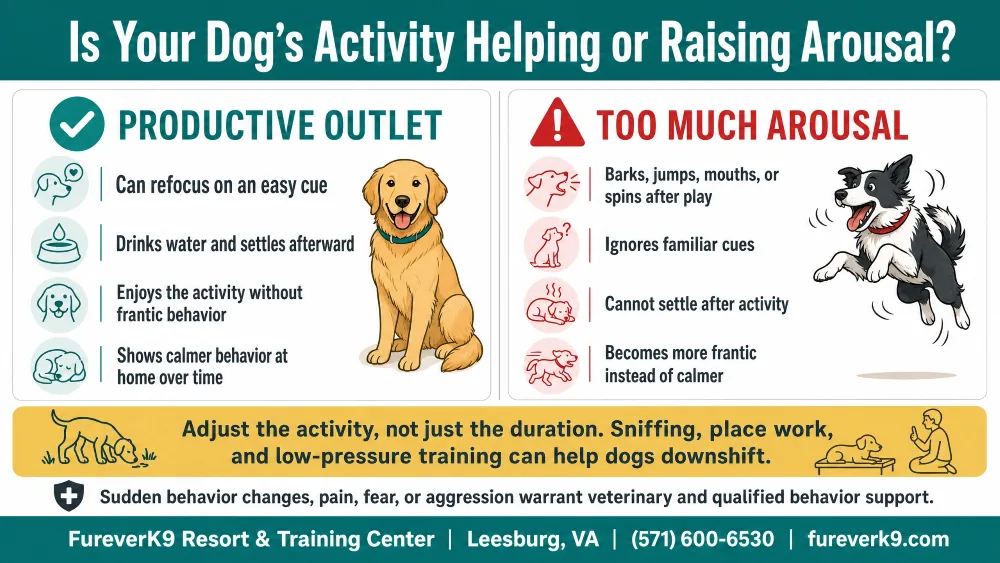
Which Training Skills Make the Biggest Difference at Home?
Why Can Too Much Excitement Make a High-Energy Dog Harder to Manage?
When Can Furever K9 Help a High-Energy Dog?
Give Energy a Job, Then Teach Rest
FAQs
Normal high-energy dogs usually respond to a better combination of exercise, enrichment, training, and rest. If your dog cannot settle, shows sudden behavior changes, or you suspect pain, anxiety, or a medical concern, speak with your veterinarian and review Furever K9’s guide to hyperactive vs. high-energy dogs.
There is no one answer. Activity needs vary by age, health, physical structure, breed tendencies, fitness, and the individual dog. Build an appropriate plan with your veterinarian and use your dog’s ability to recover and settle as an important guide.
No. Walking can meet physical and enrichment needs, but it does not automatically teach leash manners, calm greetings, recall, or impulse control. Brief, repeated training sessions help the dog use their energy more thoughtfully at home and outdoors.
They can be enjoyable for some socially appropriate dogs, but they are not necessary or suitable for every dog. Choose controlled, safe outlets and do not rely on a dog park to teach recall, social skills, or self-regulation.
Yes. A Board & Train stay can establish a training foundation and daily structure, but the household must maintain the skills when the dog returns home. Furever K9 can help determine whether Board & Train, private lessons, day training, or another option fits your goals.