
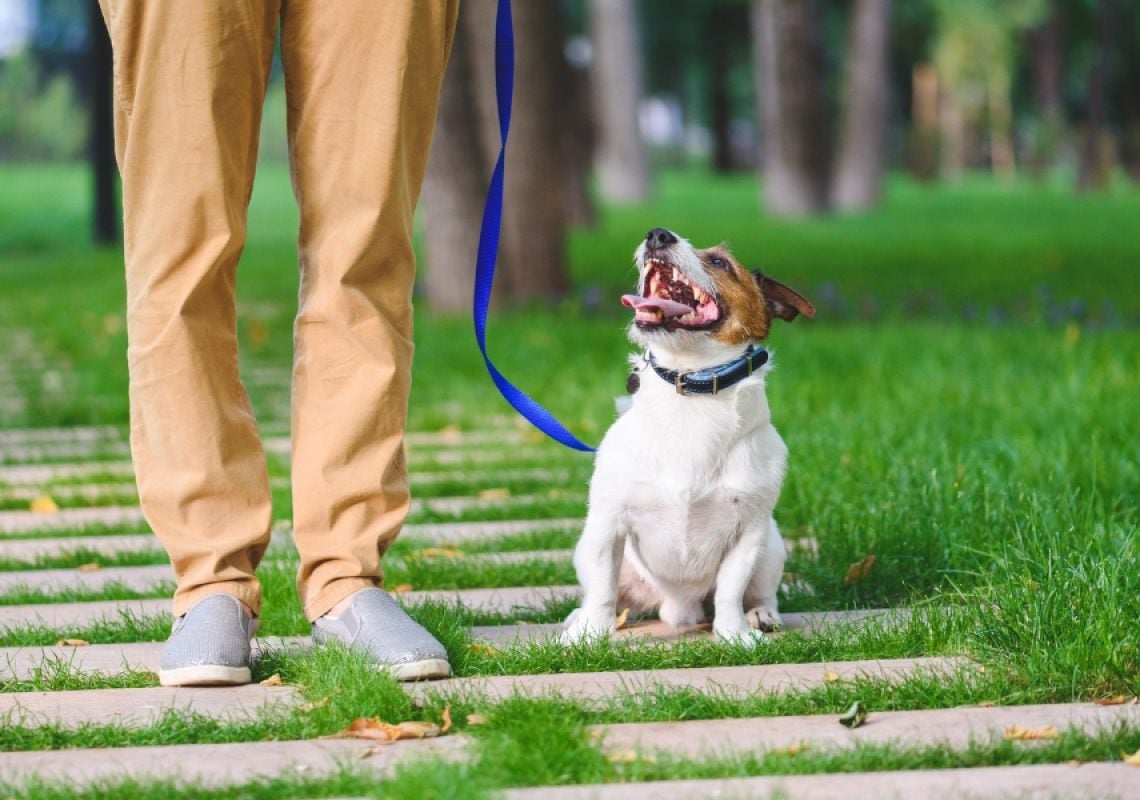
Why Doesn’t Training at Home Transfer to Other Places?
What Is Context-Specific Learning in Dogs?
- Your dog’s “perfect” sit at home isn’t really trained until it works everywhere.
- Each new environment requires explicit training, not just expectation.
- Difficulty level increases dramatically with environmental changes.
- What seems like one behavior to you is many different behaviors to your dog.
Why Do Distractions Destroy Trained Behaviors?
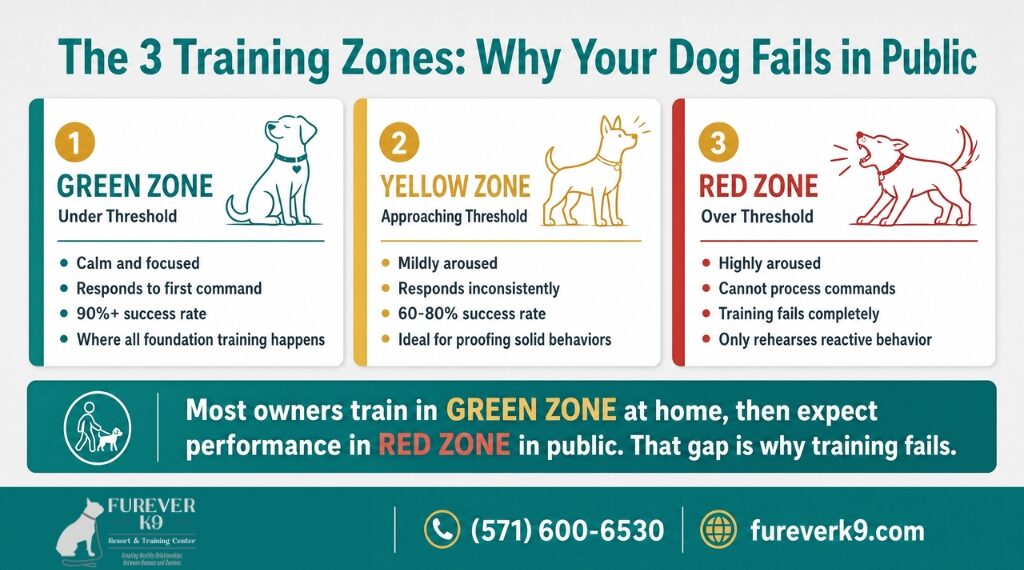
The Three-Zone Model of Dog Training
Training Zone | Dog’s Mental State | Training Effectiveness | What You Should Do |
Green Zone (Under Threshold) | Calm, focused, able to think and learn | Trained behaviors work reliably | Do all initial foundation training here |
Yellow Zone (Approaching Threshold) | Mildly aroused but still able to respond with effort | Trained behaviors work inconsistently | Good zone for proofing once behaviors are solid in green |
Red Zone (Over Threshold) | Highly aroused, reactive, unable to think clearly | Trained behaviors fail completely | Leave immediately. No learning happens here—only rehearsal of reactive behaviors |
What Role Does Handler Anxiety Play?
How Do You Actually Proof Training to Work Everywhere?
The Correct Progression for Proofing Behaviors
How Do You Proof Against Specific Distractions?
- Distance: Start with increased distance from distractions. A dog who can’t sit when another dog is 5 feet away might succeed at 50 feet. Gradually decrease distance as reliability improves.
- Duration: Start with very short durations. A sit-stay might work for 3 seconds before working for 30. Build duration slowly.
- Distraction Level: Start with mild distractions and progressively increase intensity (e.g., stationary person 30 feet away → walking person 20 feet away → running dog 10 feet away).
What Rewards Work for High-Distraction Environments?
- Low value: Kibble, basic dog treats, verbal praise
- Medium value: Slightly better treats, cheese, hot dogs
- High value: Real meat (chicken, steak, liver), string cheese
- Highest value: Whatever YOUR specific dog values most (some dogs prefer play/toys over any food)
What Are the Most Common Proofing Mistakes?
Why Does Repeating Commands Make Training Worse?
- Each repeated command without response trains your dog that commands are optional.
- Dogs learn to wait for the “serious” version (the loud, frustrated one).
- You’ve accidentally taught that five commands equal one actual command.
- Give the command once in a calm, clear voice.
- If there is no response within 2-3 seconds, physically help the dog into position (gently).
- Reward the assisted position (less enthusiastically than a voluntary response).
- If the dog can’t succeed even with help, the environment is too difficult—reduce the difficulty.
What Happens When You Skip Progression Steps?
How Do You Know When Training Is Truly Proofed?
- Dog responds to the first command 90%+ of the time.
- Response time is consistent (not slower with each difficulty increase).
- Dog can perform in multiple different locations, not just one “trained” public space.
- Performance holds under various weather conditions, times of day, and handler moods.
- Dog recovers quickly from occasional failures without a complete breakdown.
- Dog responds “sometimes” or “usually but not always.”
- Requires multiple commands or a louder/firmer voice.
- Only works in specific practiced locations.
- Falls apart in slightly novel or more difficult situations.
When Should You Seek Professional Help with Proofing?
- Proofing Isn’t Working: You’ve followed the progression systematically for weeks, but the dog isn’t improving or is regressing.
- Dog Shows Anxiety: Anxiety prevents learning. If your dog can’t get under threshold even in relatively easy environments, you need help.
- You Can’t Identify Difficulty Levels: You’re unsure whether an environment is too easy, too hard, or appropriate, and you can’t read your dog’s body language.
- You’re Reinforcing Wrong Behaviors: You don’t recognize subtle command inflation or other training errors.
FAQs
Dogs are context-specific learners who associate behaviors with the exact environment where they learned them. They don’t automatically understand that “sit” at home means the same thing at the park. You must explicitly teach generalization through systematic proofing in progressively more difficult environments.
Basic commands in moderately distracting environments take 4-8 weeks of systematic proofing. Reliable obedience in highly distracting environments takes 3-6 months of progressive work, and rock-solid reliability everywhere requires 6-12 months of varied practice plus lifetime maintenance.
The biggest mistakes are jumping from home to highly distracting environments without intermediate steps and repeating commands when the dog doesn’t respond. Owners also frequently fail to use high-value rewards that can compete with environmental distractions.
No. If your dog doesn’t respond in public, the environment is too difficult or their arousal is too high to process commands. Corrections punish the dog for failing in situations where they weren’t properly prepared to succeed; instead, reduce the difficulty and rebuild success.
Train in the “green zone” where your dog is calm and responds within 2-3 seconds, and proof in the “yellow zone” where they are mildly aroused but can still respond with effort. Avoid the “red zone” where your dog cannot take treats or process commands entirely.