
Your dog licks their lips constantly during a training session. They yawn every time your toddler approaches their bed. They turn their head away when you lean in for a hug. You might think they are just being quirky, tired, or even a bit stubborn. You had no idea your dog was practically screaming, “I’m uncomfortable!” in the only language they possess.
Here is the truth that most dog owners completely miss: Your dog communicates constantly through subtle body language signals. They tell you exactly how they are feeling—whether they are stressed, anxious, or trying to de-escalate tension. But because we interpret their actions through a human lens, we miss these signals entirely. Worse, we often unintentionally escalate the very situations that are causing our dogs stress.
I’m Lauren White, and at Furever K9 Resort & Training Center in Leesburg, Virginia, I teach Loudoun County families to actually see what their dogs are telling them. We aren’t just talking about the obvious signs like growling, barking, or cowering. We focus on the subtle, easily missed calming signals dogs use to communicate discomfort, request space, or defuse tension before it turns into conflict.
Learning to read calming signals fundamentally changes your relationship with your dog. You stop accidentally stressing them out. You intervene before situations escalate to snapping or biting. You finally understand when your dog genuinely needs space, when a training session is too intense, and when they are actually comfortable versus just tolerating something. This isn’t optional knowledge for responsible dog owners—it is essential for a safe, trusting bond. Penny, a bulldog who never learned dog manners from her mother, is a good example of why this matters.
What Are Calming Signals and Why Do Dogs Use Them?
Calming signals are specific, subtle behaviors dogs use to communicate stress, discomfort, or a desire to de-escalate tension in their environment.
The Function of Calming Signals in Dog Communication
Dogs use calming signals to say, “I am not a threat,” or “Please don’t be a threat to me.” These appeasement gestures evolved to prevent physical conflict between dogs and maintain social harmony within a group. A dog who displays calming signals is actively trying to keep a situation peaceful.
- Self-Soothing Mechanism: Just as humans might take deep breaths, bite their nails, or fidget when anxious, dogs use behaviors like lip licking or yawning to calm their own nervous systems during uncomfortable situations.
- Dog-to-Dog Communication: When your dog approaches another dog while showing calming signals—soft eyes, turning their head slightly away, or moving slowly—they are broadcasting, “I come in peace. I am friendly.”
- Dog-to-Human Communication: Your dog does not have a separate language for you. The exact same lip licking, yawning, and turning away they use with other dogs are the signals they use to tell you they are feeling overwhelmed.
When subtle behavioral indicators of fear or anxiety are ignored, the dog has no choice but to escalate. If polite communication fails, they must resort to growling, snapping, or biting to be heard. Most “sudden” aggression wasn’t sudden at all—the owners simply missed the warnings.
What Makes Calming Signals Different from Other Body Language?
Calming signals are specifically designed to reduce tension or communicate discomfort, whereas other body language communicates entirely different emotional states. A play bow communicates a desire to play. A stiff, forward posture communicates alertness or a potential threat. Calming signals specifically communicate, “I am uncomfortable,” or “Let’s de-escalate this.”
- They are incredibly subtle: Unlike obvious signals like barking or lunging, calming signals are often quick, small movements that are easily overlooked if you aren’t paying close attention.
- Context is everything: A yawn when your dog just woke up from a nap is entirely different from a yawn during a chaotic family gathering or a vet visit. Understanding the context helps you distinguish a stress yawn from a tired yawn.
- They look strange to humans: Because this is species-specific communication, behaviors like turning the head away, blinking slowly, or lifting a front paw seem random to us unless we understand the intent behind them.
At Furever K9, our training programs are designed to teach owners how to recognize these signals during actual training sessions, helping you finally see what you’ve been missing.
The Most Common Calming Signals You Need to Recognize
Learning to identify these specific signals helps you accurately interpret what your dog is experiencing throughout daily life.
Recognizing Stress-Related Calming Signals
- Lip Licking (When Not Around Food): This quick tongue flick across the nose or lips is one of the most common calming signals. You will frequently see it during grooming, vet visits, intense training sessions, or when strangers approach too quickly.
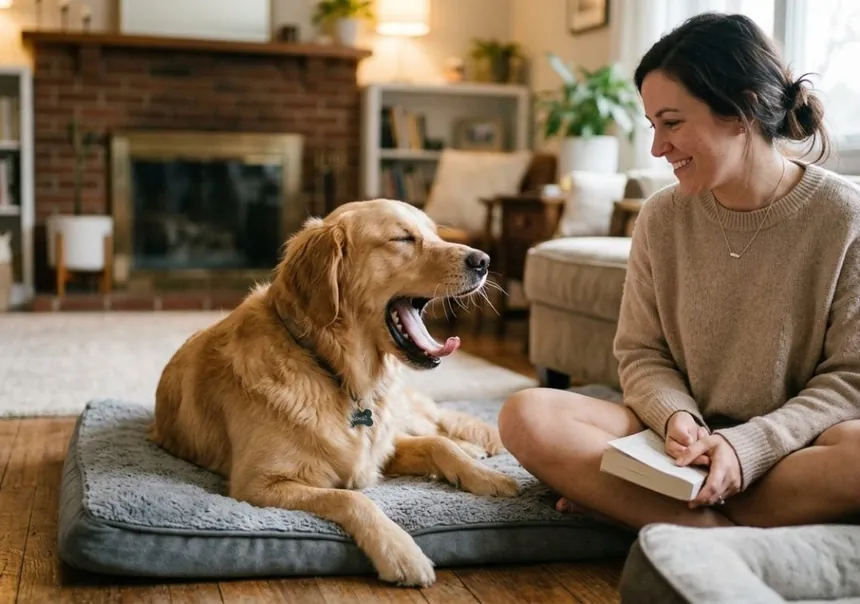
- Yawning (When Not Tired): Stress yawns look distinctly different from sleepy yawns. They are often more exaggerated, with a longer, wider mouth opening. You will notice these during tense situations, never during relaxed rest.
- Turning the Head or Body Away: This indicates your dog wants distance or feels uncomfortable with direct, face-to-face interaction. They are not ignoring you; they are saying, “This is too much pressure, I need space.”
- Whale Eye (Showing the Whites of the Eyes): This happens when your dog’s head faces one direction, but their eyes track something else, exposing the whites of their eyes. It strongly indicates anxiety, stress, or the monitoring of a perceived threat.
- Slow, Deliberate Movements: When trying to calm a situation, dogs will replace their normal pace with slow motion. Instead of bouncing excitedly, a stressed dog moves deliberately to communicate non-threatening intentions.
Calming Signals That Indicate a Need for Space
The Signal | What It Looks Like | What Your Dog Is Communicating |
Freezing | Stopping all movement suddenly and going completely still | Extreme discomfort or fear; they are so stressed they are unsure what to do next. |
Sudden Sniffing | Dropping the head to sniff the ground intensely during an interaction | Displacement behavior; redirecting stress into a “normal” activity to self-soothe. |
Shaking Off | A full-body shake (like after a bath) when completely dry | Releasing physical tension and stress after an uncomfortable encounter ends. |
Paw Lifting | Holding one front paw slightly off the ground | Uncertainty, hesitation, or discomfort with the current situation. |
Curving Approach | Walking in an arc rather than a straight line toward someone | Politeness; a direct approach is confrontational, while curving shows friendly, non-threatening intent. |
How Calming Signals Combine
Dogs rarely show a single calming signal in isolation. During stressful situations, you will typically see multiple signals chained together: lip licking, followed by turning away, combined with slow movements and whale eye.
The intensity and frequency of these signals indicate your dog’s stress level. One quick lip lick might mean mild uncertainty. Continuous lip licking combined with freezing and whale eye indicates serious stress that requires your immediate intervention. Reading these combinations, rather than isolated signals, provides a clear, accurate picture of your dog’s emotional state.
How Should You Respond When You See Calming Signals?
Recognizing calming signals is only valuable if you change your behavior in response to what your dog is communicating.
What Does an Appropriate Response Look Like?
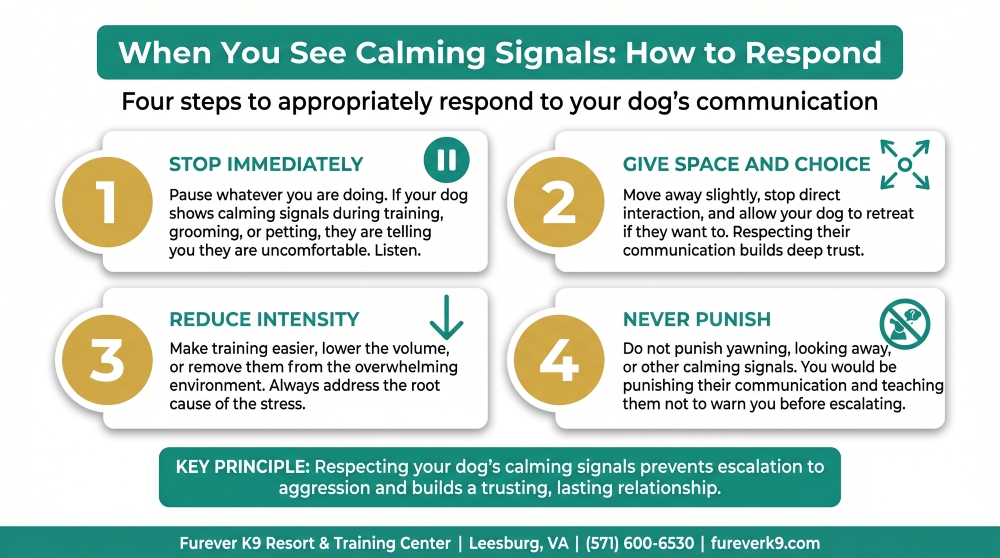
1.Stop what you are doing immediately. If your dog shows calming signals during grooming, training, petting, or any interaction, pause. They are telling you they are uncomfortable—you need to listen.
2.Give your dog space and choice. Move away slightly, stop direct physical interaction, and allow them to retreat if they want to. Respecting their communication builds immense trust.
3.Reduce the intensity of the situation. If a training exercise is too challenging, make it easier. If an environment is too loud or stimulating, remove them from it. Address the root cause of the stress.
4.Never punish calming signals. Punishing behaviors like yawning or looking away (because you think the dog is being “defiant”) is dangerous. You are punishing their communication, effectively teaching them not to warn you before they escalate to aggression.
Our Private Lessons teach you to recognize calming signals in real-time and coach you on how to respond appropriately during actual, hands-on scenarios.
Creating Environments Where Dogs Feel Comfortable
Predictable routines drastically reduce stress by creating consistency. When dogs know what to expect from their day, they experience far less anxiety.
Positive reinforcement training creates an environment where dogs feel safe expressing discomfort. A calm, consistent trainer lets dogs show when they are uncomfortable, and we adjust our approach to each dog. By providing your dog with choices—such as voluntary participation in training and the freedom to walk away from overwhelming situations—you actively encourage a relaxed, confident state of mind.
Why Do So Many Owners Miss Calming Signals?
Understanding why these signals go unnoticed helps you train your eye to watch more carefully.
What Makes Calming Signals Easy to Overlook?
- They are incredibly fast: A lip lick lasts less than a second. A head turn is momentary. If you aren’t paying close attention, you will miss them entirely.
- Human-centric interpretation: We interpret dog behavior through a human lens. We assume yawning means they are tired, turning away means they are stubborn, and sniffing means they are distracted.
- Goal blindness: When you are hyper-focused on teaching a specific behavior or getting a cute photo, you fail to notice that your dog is uncomfortable throughout the entire interaction.
- Lack of education: Most owners simply don’t know these signals exist. You cannot see what you don’t know to look for.
The Danger of Ignored Communication
When polite communication doesn’t work, dogs escalate. What owners label as “sudden” aggression is almost always the result of multiple, ignored calming signals.
When dogs realize their communication is consistently ignored, they can develop learned helplessness. They stop trying to communicate their discomfort and become shut down, or they become suddenly reactive without warning because they have learned that subtle signals are useless. Consistently ignoring your dog’s requests for space damages trust, creating an anxious, avoidant, or defensive companion.
When to Seek Professional Assessment
Some situations require expert guidance to properly interpret your dog’s signals and communication patterns. If you have difficulty distinguishing calming signals from normal behaviors, or if your dog displays conflicting signals that seem contradictory, professional interpretation is necessary.
If your dog is escalating to aggression despite your attempts to recognize their signals, it means your interventions are not effective. Professional help can identify where the communication breakdown is happening.
At Furever K9, our Board and Train programs document exactly which calming signals your specific dog uses during various situations. We then teach you to recognize these specific patterns during comprehensive handoff sessions.
Conclusion
Your dog is talking to you constantly through subtle body language signals that reveal exactly how they feel. Lip licking, yawning, turning away, and moving slowly are not random behaviors. They are vital pieces of communication you’ve been missing simply because no one taught you how to recognize them.
Learning to read calming signals transforms your relationship. You stop accidentally pushing your dog past their comfort zone. You intervene long before stress escalates to aggression. You build profound trust by respecting their communication, becoming fluent in their language instead of forcing them to endure yours.
The difference between owners who recognize calming signals and those who don’t is stark. Dogs whose signals are respected become confident communicators who rarely escalate to aggression. Dogs whose signals are ignored become anxious and reactive.
Ready to understand what your dog is really telling you? Contact Furever K9 Resort & Training Center at (571) 600-6530 or visit us at 20690 Gleedsville Road, Leesburg, VA 20175. Let’s teach you to recognize your dog’s calming signals and respond appropriately.
Your dog has been talking. It is time you learned to listen.
FAQs
No. Calming signals are about communication and de-escalation, not dominance or submission. Dogs use these signals to manage social situations, communicate discomfort, and maintain harmony, not to demonstrate “rank” or hierarchy.
Yes, to some extent. You can yawn, blink slowly, or turn slightly away to communicate calmness to a stressed dog. However, this works best when combined with actually removing the stressor, rather than just mimicking signals.
Context matters. If your dog shows multiple calming signals during fetch, they may be overstimulated or the activity may be too intense for them. Try a calmer version of the game and watch to see if the stress signals decrease.
Most dogs share common signals like lip licking and yawning, but individual patterns vary. Some dogs rely heavily on certain signals more than others. Learning your specific dog’s unique “vocabulary” is crucial for effective communication.
Stress yawns occur in situations where your dog isn’t tired (like a vet visit or training session) and usually feature a wider mouth opening and longer duration. Tired yawns happen during actual rest periods and look much more relaxed.