
Dog Parks in Loudon County
Author picture

Should You Take Your Dog to Dog Parks in Loudon County? A Trainer’s Honest Opinion

Dog parks aren't always safe for socialization. Expert trainer perspective on dog park risks and better alternatives in Loudoun County. Call FureverK9 (571) 600-6530.
While dog parks seem like a convenient way to exercise and socialize your dog, they are highly unpredictable environments that often do more harm than good. Puppies, reactive dogs, and small dogs are especially at risk for trauma or injury. Professional daycare, structured playdates, and supervised training offer far safer, more beneficial socialization alternatives.
 
You take your dog to the dog park thinking you’re being a responsible owner. They need socialization, exercise, and interaction with other dogs, right? The dog park seems like the perfect solution—free, convenient, and full of playmates. But within minutes, a scuffle breaks out. A large dog bowls over your smaller dog. Someone’s off-leash dog with zero recall comes barreling over. Your dog comes home limping, scared, or newly aggressive toward other dogs. You’re left wondering what went wrong.
 
Here is what well-meaning dog owners often misunderstand about dog parks. They can be wonderful for the right dog in the right park with responsible owners present. But they can also be training disasters, socialization nightmares, and safety hazards for dogs who aren’t ready, owners who don’t supervise, and situations that spiral out of control.
 
I’m Lauren White, and at FureverK9 Resort & Training Center in Leesburg, Virginia, I have worked with countless Loudoun County dogs whose behavioral problems stem directly from traumatic dog park experiences. Friendly dogs become reactive. Well-socialized puppies learn that other dogs are terrifying. Owners convinced dog parks are essential for socialization often do not realize they are creating the exact opposite effect.
 
Dog parks aren’t inherently good or bad—but most owners don’t understand when they’re appropriate, how to use them safely, or when alternatives like professional daycare programs provide better socialization without the risks.
 

Are Dog Parks Actually Good for Dogs?

 
Understanding what dog parks provide—and what they don’t—helps you make informed decisions.
 

What Do Dog Parks Actually Offer?

Potential Benefits (When Used Correctly)
What Dog Parks Do Not Provide
Off-leash exercise in fenced, safe space
Guaranteed appropriate play partners
Opportunity for appropriate dog-dog play
Supervision ensuring safe interactions
Mental stimulation from novel environment
Training or structured socialization
Convenience and no cost for owners
Safety from aggressive or unvaccinated dogs
Community among dog owners
Protection from irresponsible owners
 
The quality of a dog park experience depends entirely on your specific dog’s temperament, the other dogs present that particular day, owner supervision, park design, and crowding levels. Even the best dog park on its best day can become problematic with one irresponsible owner or one aggressive dog.
 

Which Dogs Should Never Go to Dog Parks?


Puppies Under 4-6 Months

According to VCA Hospitals, puppies have incomplete vaccinations making them vulnerable to diseases like parvovirus. More importantly, one bad experience during their critical socialization period can create lasting fear. They need controlled, positive socialization, not chaotic free-for-alls.

 
Reactive or Aggressive Dogs
 
Dog parks will make reactivity worse, not better. Other dogs and owners are not your dog’s training tools. Putting reactive dogs in triggering situations is unfair to everyone; these dogs need professional behavior modification.
 
Dogs with Poor Recall
 
If your dog won’t come when called reliably, they’re not ready for off-leash environments. Lack of recall creates safety risks for your dog and others.
 
Dogs Who Resource Guard
 
Parks often have toys, sticks, or other items triggering guarding behavior, which can easily escalate to fights.
 
Elderly, Injured, or Very Small Dogs
 
Rough play can injure fragile dogs, and size mismatches create trampling risks. Prey drive in some larger dogs can also trigger dangerous chasing. Many parks have separate small dog areas addressing this—use them.
 
At FureverK9, our daycare program provides structured, supervised play with carefully matched playgroups—eliminating the unpredictability and risks of public dog parks.
 

What Problems Do Dog Parks Create?

 
  • Fear and Reactivity Development: One bad experience (being bowled over, humped relentlessly, chased, cornered) can create lasting fear of other dogs.
  • Learning Inappropriate Play Styles: Constant rough play, mounting, and chasing to exhaustion teaches these as normal interactions.
  • Rehearsing Poor Recall: Every time your dog ignores your recall at the park, they practice ignoring you, teaching them that commands are optional in exciting situations.
  • Injuries and Disease Transmission: Rough play leads to sprains and bite wounds, while shared water bowls and close contact facilitate the spread of parasites and illnesses.
  • Reinforcement of Arousal: Constant high excitement teaches dogs that maximum arousal is normal, worsening hyperactivity.
 

If You Do Use Dog Parks, How Do You Use Them Safely
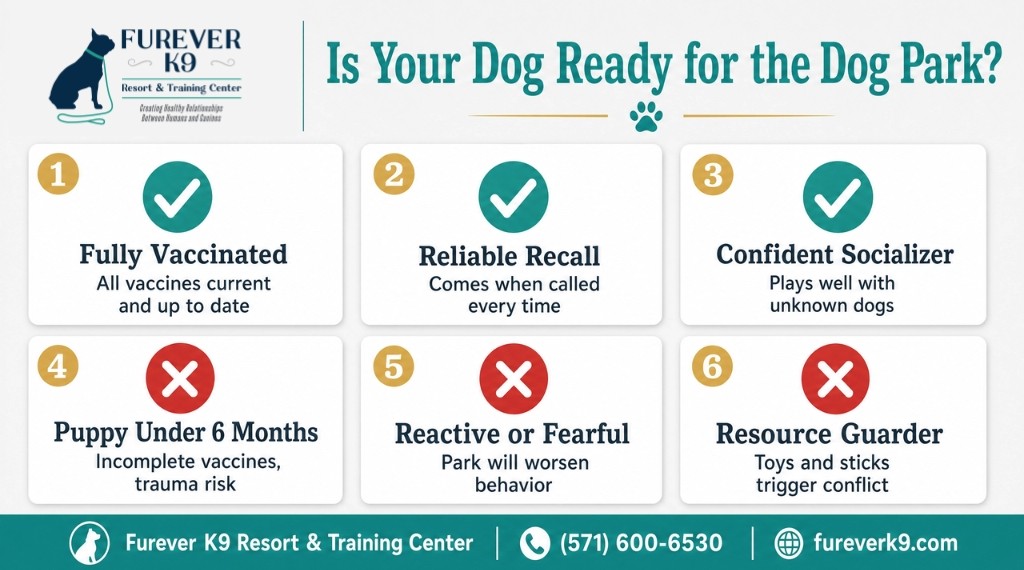
is your dog ready fo dog parks in loudon county infographics
For dogs appropriate for parks, strategic use minimizes risks.
 

How Do You Evaluate Whether a Park Is Safe?

 
Before entering, assess the physical space for double-gated entries, adequate fencing, separate size areas, and cleanliness. Evaluate the dogs present—look for appropriate play styles with role reversals and breaks, and avoid parks where dogs are standing stiffly or fixating.
 
Watch the owners. Are they actively watching their dogs, or are they on their phones? Are they intervening when play gets too rough?
 
Red Flags to Leave Immediately:
 
  • Stiff, tense body language in multiple dog
  • Mounting or humping that owners don’t interrup
  • Chasing that doesn’t reverse (the same dog is always chased
  • Overcrowding or owners not paying attention

Trust your instincts. If something feels wrong, leave. You can always come back another time.

What Rules Should You Follow at Dog Parks?

 
This article about ‘dog park safety’ emphasize the importance of leaving before problems develop. Supervise constantly with eyes on your dog at all times. Practice recalls periodically throughout the visit to maintain your dog’s attention. Intervene in inappropriate play immediately, and leave before your dog is exhausted—overtired dogs make poor choices. Never bring toys, treats, or food, as these create resource guarding conflicts.
 
At FureverK9, we teach these skills in our training programs—recall reliability, reading dog body language, and knowing when to intervene—making dog park visits safer IF you choose to use them.
 
What Are Better Alternatives to Dog Parks?
 
For many dogs, alternatives provide superior socialization and exercise without the risks.
 

How Is Professional Daycare Different from Dog Parks?

 
Professional daycare offers several distinct advantages over public parks:
Feature
Professional Daycare
Public Dog Park
Screening
All dogs evaluated for appropriate play style
No screening; anyone can enter
Supervision
Constant monitoring by trained staff
Relies on varying owner attentiveness
Environment
Controlled, climate-controlled, structured breaks
Unpredictable, weather-dependent, chaotic
Health
Strict vaccination and health requirements enforced
Rules exist but are rarely enforced
Our daycare program at FureverK9 provides everything dog parks attempt—socialization, exercise, mental stimulation—with professional supervision eliminating the unpredictability and risks. Dogs are evaluated, playgroups are matched, and staff intervene before problems develop.
 

What About Structured Playdates?

 
Organized playdates with known dogs allow you to control which dogs your dog interacts with. You choose appropriate play partners you trust, supervise interactions ensuring positive experiences, and can end the session if it’s not going well. There are no unknown variables.
 
Start in neutral territory, keep initial sessions short (20-30 minutes), and end on a positive note before the dogs tire.
 

What are the Dog Parks in Loudoun County?

 
If you decide dog parks are appropriate for your dog, here are the primary off-leash dog parks in Loudoun County:
 

Leesburg Area

 
Leesburg Dog Park at Olde Izaak Walton Park
 
  • Address: 850 Davis Court SE, Leesburg, VA 20175
  • Hours: Dawn to dusk, seven days a week
  • Features: Fenced off-leash area with separate small dog section (for dogs under 25 pounds), water access, benches, parking available
Rules: Dogs must be licensed, vaccinated, and on-leash entering/exiting. No dogs under 4 months or in heat. Handlers must supervise at all times and clean up after their dogs.
 
Dog Park at Lansdowne Town Center
  • Address: Lansdowne Town Center, Leesburg, VA
  • Features: Fenced off-leash area within the town center development
  • Best For: Convenient location with nearby amenities
Creighton West Park Dog Park
  • Address: Leesburg, VA
  • Features: Fenced off-leash play area
  • Best For: Alternative to Olde Izaak Walton when crowds are high

Surrounding Areas

 
Brambleton Dog Park
  • Location: Ashburn, VA (off Legacy Park Drive)
  • Features: Well-maintained fenced off-leash area, good for practicing recalls
Evermoore Neighborhood Park Dog Park
  • Location: Leesburg area
  • Features: Off-leash area within neighborhood park

Strategic Timing for Safer Visits

 
Visit during weekday mornings or early evenings when crowds are lighter. Avoid weekend afternoons or arriving right after work when energy levels are highest and parks are most crowded. Less crowded visits reduce arousal levels, improve play quality, and make it easier to monitor your dog’s interactions.
 
Before Your First Visit: Call the Leesburg Parks & Recreation Department at (703) 777-1368 to confirm current hours, any maintenance closures, and to ask about crowd patterns at specific times.
 

When Should You Seek Professional Help?

 
Seek professional help if your dog shows fear or reactivity toward other dogs, if dog park visits consistently end badly, or if your dog’s recall is unreliable in stimulating environments. Professional trainers can assess your dog’s needs and create appropriate socialization plans.
 

How Does FureverK9 Provide Better Socialization?

 
At our facility at 20690 Gleedsville Road in Leesburg, we provide behavioral evaluations to assess temperament, structured daycare with carefully matched playgroups, and training integration to build skills like recall and impulse control. We provide the safe socialization many owners seek from dog parks—without the unpredictability and safety risks.
 
Dog parks can be wonderful for the right dog with responsible owners during uncrowded times. But that’s a lot of variables that must align for successful visits. Understanding that dog parks aren’t essential for socialization, aren’t appropriate for all dogs, and carry real risks helps you make informed decisions.
 
At FureverK9, I help Loudoun County families determine appropriate socialization strategies for their specific dogs. Ready to discuss whether dog parks are right for your dog or explore better socialization options? Contact FureverK9 Resort & Training Center at (571) 600-6530 or visit us at 20690 Gleedsville Road, Leesburg, VA 20175

FAQs

No, dog parks are generally not safe for puppies under 4-6 months due to incomplete vaccinations and disease risk. One negative experience during their critical socialization period can create lasting fear. Puppies need controlled, positive socialization with known-friendly dogs in safe environments.

Appropriate play includes role reversals, frequent breaks, and loose, bouncy body language. Signs of bullying include your dog trying to hide, stiff body language, constant fleeing without reversing roles, or seeking you for protection. Intervene immediately if you see these signs.

Yes, absolutely. Small and large dog separation prevents trampling and crushing injuries from size mismatches. Even friendly large dogs can seriously harm small dogs or trigger dangerous prey drive responses during chase play.

Quality matters more than duration; stay 20-45 minutes maximum and leave before your dog becomes exhausted. Overtired dogs make poor social decisions and are more prone to injuries and conflicts.

No. Dog parks are highly stimulating, unpredictable environments where reactive dogs will be over-threshold and unable to learn. Reactivity requires professional behavior modification in controlled settings, not chaotic park exposure.

Share this Success Story!

I know I need help!!!

Let Lauren know what you're struggling with!
She'll get in touch with you to discuss options!