

- The Problem: Many owners confuse “exposure” with “socialization.” Exposing a puppy to overwhelming situations creates fear, while true socialization requires orchestrating positive experiences.
- The Reality: The critical socialization window (weeks 3–16) is a neurological developmental phase where a puppy’s brain forms permanent templates for how to process the world.
- The Solution: You must actively create controlled, positive interactions with diverse people, animals, and environments during this brief window.
- The Warning: Once the window closes around 16 weeks, learning becomes exponentially harder. A dog that could have been confident with a few weeks of early socialization may require years of intensive remediation if this window is missed.
- The Bottom Line: Your puppy’s first 16 weeks are not just important; they are neurologically non-negotiable. What you do during this time dictates the dog you will live with for the next 15 years.
What Is the Critical Socialization Window?
Why Is This Window Called “Critical”?
The Socialization Timeline
Developmental Stage | Neurological Activity | Socialization Focus |
Weeks 3–6: Foundation | Senses fully developing; first neural pathways forming. | Varied tactile experiences; gentle handling; introduction to household sounds. Safe, contained experiences. |
Weeks 6–9: Social Learning | Rapid learning and memory formation; fear responses begin to develop. | Supervised play with calm dogs; exposure to varied people; introduction to basic grooming and vet visits. |
Weeks 9–12: Confidence Peak | Neural pathways solidifying; personality emerging; resilient to minor stressors. | Expanded environments; meeting people in various contexts; vaccination-safe exposure to public places. |
Weeks 12–16: Window Closing | Brain becoming set in templates; fear responses more pronounced if unaddressed. | Solidify previous experiences; address any emerging fearfulness immediately; begin structured training. |
Why Can’t You Just “Fix It Later”?
What Counts As Positive Socialization?
Exposure vs. Socialization
Components of Positive Socialization
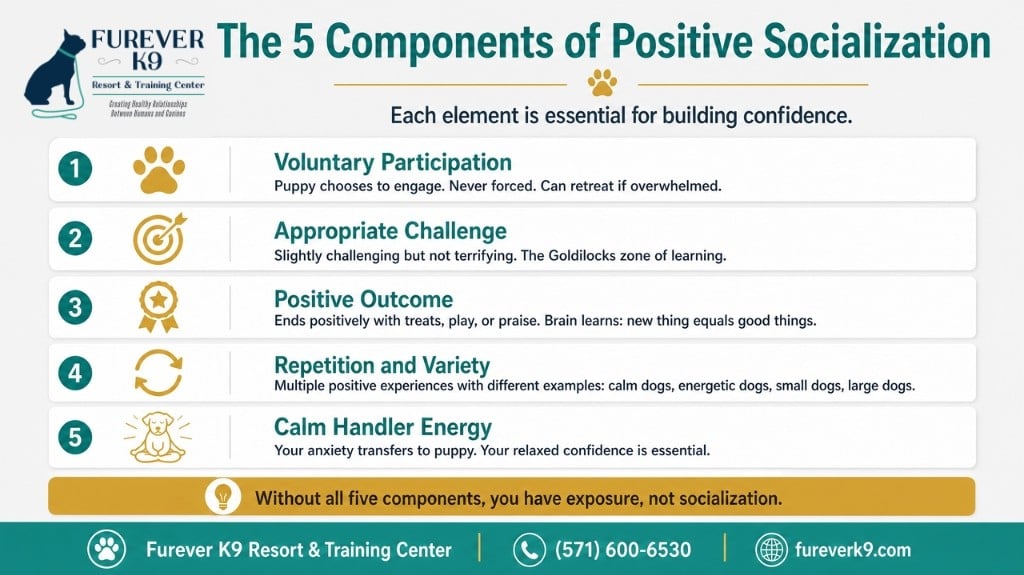
- Voluntary Participation: The puppy must choose to engage and should never be forced. They must have the option to retreat if they feel overwhelmed.
- Appropriate Challenge Level: The experience should be slightly challenging but not terrifying—the “Goldilocks zone” of learning.
- Positive Outcome: The experience must end positively with a treat, play, or praise, teaching the brain that the new stimulus equals good things.
- Repetition and Variety: The puppy needs multiple positive experiences with different examples (e.g., calm dogs, energetic dogs, small dogs, large dogs) to prevent them from only being socialized to one specific type.
- Calm Handler Energy: Your anxiety transfers directly to your puppy. Relaxed confidence is essential.
How Do You Create a Socialization Plan?
What Should Your Puppy Experience?
Furever K9’s Puppy Program
What Happens If You Miss the Window?
FAQs
Socialization builds foundational neural pathways and confidence around worldly stimuli during the critical window, while training teaches specific behaviors and commands. A well-trained dog can still be fearful if poorly socialized; ideal puppyhood requires both positive socialization for a solid foundation and early training for skills and bonding.
No, puppies begin learning immediately and can start positive reinforcement training at 6–8 weeks. Short, fun training sessions during the critical socialization window actually support socialization by creating positive experiences and building confidence through success.
Adequate socialization looks like confidence in varied situations, curiosity rather than fear, quick recovery from mild scares, and relaxed body language. Inadequate socialization manifests as hiding, extreme fearfulness, hesitation around people, and difficulty with routine handling.
Assume minimal socialization and start immediately with slow, controlled introductions, building positive associations gradually without forcing interactions. Understand that you are doing partial remediation and foundation-building simultaneously, and seek professional guidance to identify fears and create an appropriate protocol.
Never force an interaction, as forcing confirms the danger and increases fear. Instead, respect the fearfulness, create distance from the trigger, pair the scary stimulus with high-value treats from a safe distance, and gradually decrease the distance as the puppy’s confidence builds.