

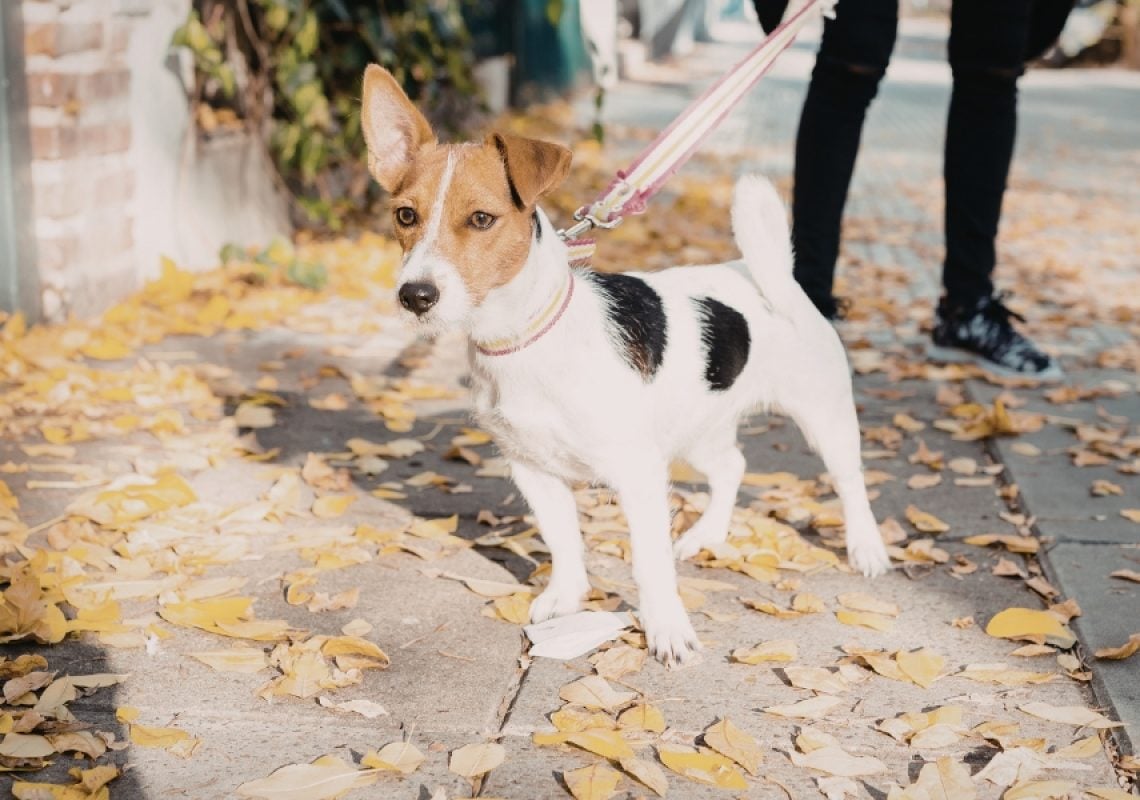
Dog on leash alert and tense during a walk on a leaf-covered sidewalk, illustrating early signs of leash reactivity in a real-world environment.
Author picture

Leash Reactivity Training: How to Stop Your Dog From Lunging on Walks

Struggling with dog lunging on walks? Discover expert leash reactivity training strategies from FureverK9 in Loudoun County. Learn how to stop leash reactivity. Call (571) 600-6530.
You see another dog three houses down and your stomach drops. Before you can even react, your dog has spotted them too. They lunge forward with such force you nearly lose your grip on the leash. They are barking, spinning, and pulling with all their strength while you desperately try to regain control. The other owner gives you a horrified look and crosses the street. You are mortified, frustrated, and increasingly convinced you will never be able to walk your dog like a normal person.
 
You have started walking at 5 AM to avoid other dogs. You have mapped out routes through your Loudoun County neighborhood based on which houses have dogs behind fences. You have turned down invitations to walk the W&OD Trail with friends because you know it would be a disaster. Walking your dog—something that should be enjoyable—has become the most stressful part of your day.
 
Here is what desperate owners dealing with leash reactivity do not realize: your dog is not aggressive, dominant, or trying to embarrass you. They are overwhelmed, frustrated, or scared, and they are doing the only thing they know how to do when trapped on a leash: make themselves bigger and louder to either create distance from the scary thing or express their frustration that they cannot reach what they want.
 
I am Lauren White, and at FureverK9 Resort & Training Center in Leesburg, Virginia, I have helped countless Loudoun County families transform their reactive dogs from neighborhood nightmares into calm walking companions. The solution is not about forcing your dog to “behave” or using corrections that increase their stress. It is about changing their emotional response to triggers while teaching you to read their signals and intervene before explosions happen.
 

What Is Actually Happening When Your Dog Lunges on the Leash?

 
Understanding the difference between reactivity and aggression prevents panic and ensures you use appropriate training methods.
 

Is My Dog Reactive or Actually Aggressive?

 
Leash reactivity is an over-the-top response to normal environmental stimuli when your dog is restrained by the leash. Your dog sees a trigger and becomes over-aroused. Because the leash prevents their natural options, that frustration or fear erupts as barking, lunging, and sometimes growling.
 
True aggression involves intent to cause harm. While reactive dogs sound and look terrifying, their goal is usually to create distance from what scares them or to express frustration that they cannot reach what they want. They are not trying to attack.
Behavioral Sign
Leash Reactivity
True Aggression
Primary motivation
Frustration, fear, or over-excitement
Intent to cause harm or defend resources
Body language
Tense, frantic movements, quick recovery
Stiff, hard staring, sustained tension
Off-leash behavior
Often plays well with other dogs
May exhibit aggressive behavior
Bite history
Rarely bites
History of intentional biting
Response to distance
Calms quickly once trigger is out of sight
May remain fixated and tense
 
The distinction matters tremendously for training. Reactivity responds to behavior modification addressing the underlying emotion. Aggression may require more intensive intervention. If you are unsure, professional evaluation is critical.
 

Why Does My Dog Only Act This Way on Leash?

 
This is the question that confuses owners most. Your dog plays beautifully with other dogs at daycare or the dog park. But the moment you clip on that leash, they transform into a lunging, barking monster.
 
Leash restraint creates barrier frustration. Your social dog who wants to greet every dog they see cannot reach them. That frustration builds with every encounter until it explodes as reactivity.
 
Leash restraint also removes the flight option for fearful dogs. Off-leash, a nervous dog can create their own safe distance from scary things. On leash, they are trapped. When they cannot flee, they resort to making themselves look big and scary to drive the threat away.
 
Your energy travels down the leash as clearly as words. When you tense up and tighten your grip on the leash the moment you spot another dog, you are broadcasting “DANGER!” Your dog responds to your anxiety, not just to the trigger.
 
Research from the  emphasizes that punishment-based training methods increase anxiety and can worsen reactivity. The goal is changing emotional responses, not suppressing behavior through fear or discomfort.

Why Is Your Dog Reactive? The Root Causes

Effective treatment requires understanding what is driving the behavior for your individual dog.
 

What Causes Frustration-Based Reactivity?

 
Your dog loves other dogs. During our , they play appropriately with their friends. But on leash, they lose their minds at the sight of another dog. This is the frustrated greeter. They want to say hello, play, interact—but the leash physically prevents them from reaching their goal.
 
The solution for frustrated greeters is not allowing on-leash greetings—that actually makes reactivity worse. The solution is teaching your dog that other dogs on walks are not for greeting; they are just part of the scenery to calmly acknowledge and ignore.
 

How Does Fear Create Leash Reactivity?

Fear-based reactivity is incredibly common in rescue dogs, dogs with limited early socialization, or dogs who had negative experiences with other dogs, people, or environmental triggers.

 
When your fearful dog sees something scary, their instinct is to run away. The leash prevents escape. Unable to flee, they resort to the only defensive option available: trying to scare the threat away by acting big, loud, and dangerous.
The solution for fearful dogs requires building confidence and changing their emotional association with triggers from “scary threat” to “neutral part of environment” through systematic desensitization and counter-conditioning.
 

What Role Does Lack of Impulse Control Play?
 
Some dogs simply have not learned to control their excitement about stimulating things in the environment. When they see a squirrel, jogger, bicycle, or skateboard, their prey drive or excitement kicks in and they have zero impulse control to manage that arousal.
 
At FureverK9, our incorporate impulse control exercises as foundation work before addressing specific reactivity triggers.
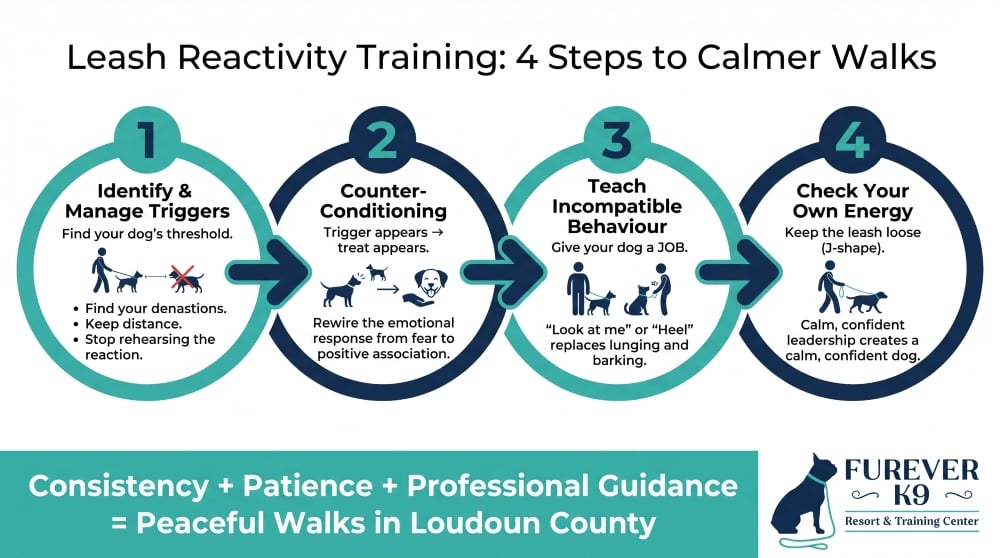
leash reactivity training steps infographics

How Do You Actually Stop Leash Reactivity?

Effective reactivity training changes your dog’s emotional response to triggers, not just suppresses the visible behavior.
 

Why Can’t You Just Correct the Behavior?

 
I see this mistake constantly. Owners pop the leash, use prong collars, or yell “no” when their dog reacts. Sometimes this temporarily suppresses the visible behavior.
 
But corrections do not change the underlying emotion driving the behavior. Your fearful dog is still afraid. Your frustrated dog is still frustrated.
 
Studies on  show that punishment-based approaches to reactivity increase stress, can worsen fear-based behaviors, and damage the dog-handler relationship.
 

What Is Counter-Conditioning and Why Does It Work?

 
Counter-conditioning changes your dog’s emotional response to triggers by creating new, positive associations. The basic formula: Trigger appears → amazing thing happens → trigger disappears → amazing thing stops.
 
Your dog begins associating the trigger with the amazing thing (usually extremely high-value treats). Over many repetitions, their emotional response changes from “Oh no, a dog! Scary/frustrating!” to “Oh look, a dog! That means treats are coming!”
 
This requires starting at a distance where your dog can see the trigger but remain calm—their threshold distance. If your dog is already reacting, you are too close.
 

How Do You Implement Counter-Conditioning Correctly?

 
  1. Find your dog’s threshold distance for their specific triggers.
  2. Use extraordinarily high-value rewards (real chicken, cheese, hot dogs).
  3. Mark the moment your dog notices the trigger with “yes!” or a clicker, then immediately deliver treats.
  4. Feed continuously while trigger is visible. The moment the trigger disappears, the treat party stops.
  5. Move slowly with distance reduction. Do not decrease threshold distance until your dog shows a conditioned emotional response at the current distance.
Our teach you exact timing, proper reward delivery, and how to read your dog’s body language.
 

Why Does Your Energy Matter So Much?

 
The leash tension loop is real and powerful. When you see a trigger, you tense up. You tighten the leash. You hold your breath. You radiate anxiety. All of this travels directly down the leash to your dog, signaling “THREAT! PREPARE FOR DANGER!”
 
Breaking this loop requires managing your own emotional response. When you spot a trigger, take a deep breath. Keep the leash loose—maintain a “J” shape with slack in the leash. Project calm confidence even if you are faking it.
 

What Are the Early Warning Signs of Reactivity?

 
Learning to recognize the escalation ladder lets you intervene before your dog reaches explosion point.
 

Alert Stage: Body stiffens, ears prick forward, intense stare. Redirect now with counter-conditioning or create distance.

Aroused Stage: Body leans forward, hackles rise, fast breathing. Increase distance immediately.

Over Threshold Stage: Barking, lunging, spinning. The thinking brain has shut down. Create distance quickly.

What Equipment Actually Helps with Reactivity?

 
The right equipment improves your ability to safely manage your reactive dog, but equipment alone never solves reactivity.
 

Front-Clip Harnesses: Reduce pulling by redirecting forward momentum. Provide better control without neck pressure.

Martingale Collars: Prevent dogs from slipping out of their collar. Provide secure fit without harsh corrections.

What I Do Not Recommend: Retractable leashes, prong collars, and choke chains.

When Should You Seek Professional Help?

 
Seek professional help if you experience escalating reactivity, safety concerns, severe life impact, diagnostic uncertainty, or failed training attempts.
 

How Does FureverK9 Address Leash Reactivity?


Behavioral Evaluation: Thorough assessment identifying what is driving your dog’s reactivity.

Private Lessons: We’ll coach you through the process in real-world environments.

Board and Train Programs: Intensive foundation training in controlled environments.

At our facility in Leesburg, I can create controlled training scenarios with distance-appropriate triggers, teaching your dog new response patterns before you practice in the real world.
 
Your dog’s leash reactivity is an emotional response to overwhelming stimuli when physical restraint removes their natural coping options. Stopping reactivity requires changing those underlying emotions through systematic counter-conditioning, managing triggers, and addressing your own anxiety.
 
Ready to stop dreading walks and start enjoying them? at (571) 600-6530 or visit us at 20690 Gleedsville Road, Leesburg, VA 20175. Let’s evaluate your dog’s specific reactivity and create a training plan that actually works.

FAQs

Some dogs can be completely rehabilitated. Others will always have lower tolerance for certain triggers but can be managed so successfully that walking becomes peaceful and enjoyable.

Absolutely not. On-leash greetings are unnatural for dogs and often make reactivity worse. The goal is teaching your dog that other dogs on walks are not for greeting—they are just scenery to calmly ignore.

There is no quick fix because you are changing an emotional response. Most owners see initial improvement within 2-4 weeks of consistent, correct training. Solid reliability typically takes 2-4 months.

For most reactive dogs, a well-fitted front-clip harness provides the best balance of control and comfort. Avoid retractable leashes, prong collars, and choke chains.

This is a generalization problem. Your dog learned the behaviors in specific contexts but has not generalized those skills to real-world walking. You need to explicitly practice in many different environments.

Share this Success Story!

I know I need help!!!

Let Lauren know what you're struggling with!
She'll get in touch with you to discuss options!