

FK9 Featured Image
Author picture

How Your Home Environment Shapes Your Dog’s Behavior: What Actually Matters

Your dog is perfect at training sessions but falls apart at home. They’re calm when it’s just you but become reactive when the kids are running around. They settle easily in your bedroom but pace anxiously in the living room. You’re doing everything the trainer said, but your home environment seems to be sabotaging every bit of progress.
 
Here is what frustrated owners often fail to realize: Your dog’s behavior isn’t happening in a vacuum. The chaos level in your household, the predictability of your schedule, the amount of visual stimulation from windows, and even where your dog sleeps—all of these environmental factors shape behavior as powerfully as any training technique you apply.
 
I’m Lauren White, and at Furever K9 Resort & Training Center in Leesburg, Virginia, I’ve worked with countless Loudoun County families whose training efforts failed. It wasn’t because they had bad dogs or poor technique; it was because their home environment was working against them every single day.
 
The transformation isn’t about moving to a quieter neighborhood or getting rid of your kids. It’s about understanding which specific environmental factors affect your individual dog and making strategic modifications that support the behaviors you’re trying to build. Sometimes, tiny environmental changes create breakthrough behavioral improvements that months of training alone couldn’t achieve.
 

Why Does Your Home Environment Matter So Much for Dog Behavior?

 
Dogs are incredibly sensitive to their surroundings in ways that constantly surprise owners who don’t realize how much environment influences behavior.
 

How Does Environmental Chaos Affect Your Dog’s Nervous System?

 
Unpredictable households keep dogs in constant low-level stress. When they never know when kids will run screaming through the house, when the doorbell might ring, or when someone will drop something loud in the kitchen, their nervous system can’t relax. That chronic stress baseline makes everything harder.
 
Dogs in chaotic environments have shorter attention spans during training because their brains are constantly monitoring for the next unpredictable stimulus. They aren’t being stubborn or distracted—their nervous system is doing exactly what it evolved to do: stay alert to changing conditions.
 
Visual overstimulation from windows creates rehearsal of unwanted behaviors. A dog who watches squirrels, delivery trucks, and passing dogs all day is practicing vigilance and reactivity constantly. By evening, they’re wound tight even though they haven’t left the house.
 
At Furever K9, we evaluate home environments as carefully as we evaluate dogs because we’ve learned environment can make or break training success.
 

What Environmental Factors Create Anxiety in Dogs?

  • Constant Stimulation Without Downtime: Just like you need quiet time after a busy day, dogs need periods where nothing happens. Homes where something is always happening create chronically overstimulated dogs.
  • Lack of Safe Spaces: Even confident dogs need quiet areas where they can remove themselves from household activity when overwhelmed. Without these spaces, stress compounds with no relief.
  • Conflicting Social Signals: If Dad allows jumping but Mom corrects it, the dog never knows what’s expected. This inconsistency is an environmental problem, not a training failure.
  • High-Traffic Sleeping Areas: Dogs sleeping in family rooms where people pass constantly never achieve deep, restorative sleep. Chronic sleep deprivation severely affects emotional regulation.
  • Unmanaged Triggers: The dog barking at window activity all day has practiced reactive behavior hundreds of times before you even start training alternative responses.

How Do Different Dogs Respond Differently to the Same Environment?

 
Sensitive dogs require quieter, more predictable environments than confident dogs. What feels like normal household activity to a bold Labrador might be overwhelming chaos to a sensitive herding breed.
 
High-energy dogs deteriorate faster in under-stimulating environments. A Border Collie in a quiet, boring household becomes destructive not from lack of exercise, but from insufficient mental engagement. Anxious dogs, on the other hand, need immense structure and predictability to feel secure.
 

What Environmental Changes Actually Improve Dog Behavior?

 
Strategic environmental modifications often create faster behavioral improvements than training alone because you are addressing root causes, not just symptoms.
 

How Does Creating Routine Change Your Dog’s Behavior?

 
Consistent daily schedules allow dogs to predict what happens next, dramatically reducing anxiety and vigilance. When your dog knows meals happen at specific times, walks follow consistent patterns, and bedtime is predictable, their nervous system can relax.
  • Predictable Responses: If jumping always results in being ignored, your dog learns what to expect.
  • Strategic Exercise Timing: A dog who walks at 7 AM daily is calmer by 8 AM than a dog whose walks happen randomly. The predictability itself calms them.
  • Established Bedtimes: Consistent bedtime rituals teach anxious or overstimulated dogs when it is time to stop being vigilant and finally relax.
Our training programs incorporate routine establishment because consistent environments amplify training effectiveness dramatically.
 

What Physical Environmental Modifications Help Most?

  • Manage Window Access: Closing curtains in rooms where your dog practices window-barking reduces daily practice of unwanted behaviors by hundreds of repetitions.
  • Create Dedicated Safe Spaces: A crate or quiet room where nothing bad ever happens provides essential escape options. Forcing dogs out of safe spaces defeats their purpose.
  • Reduce Household Chaos During Training: If you’re working on calm greetings, having family members arrive home one at a time during initial training supports behavior change.
  • Strategic Furniture Placement: If your dog obsessively watches out front windows, moving their bed away from that window removes the opportunity for constant rehearsal of alert behaviors.

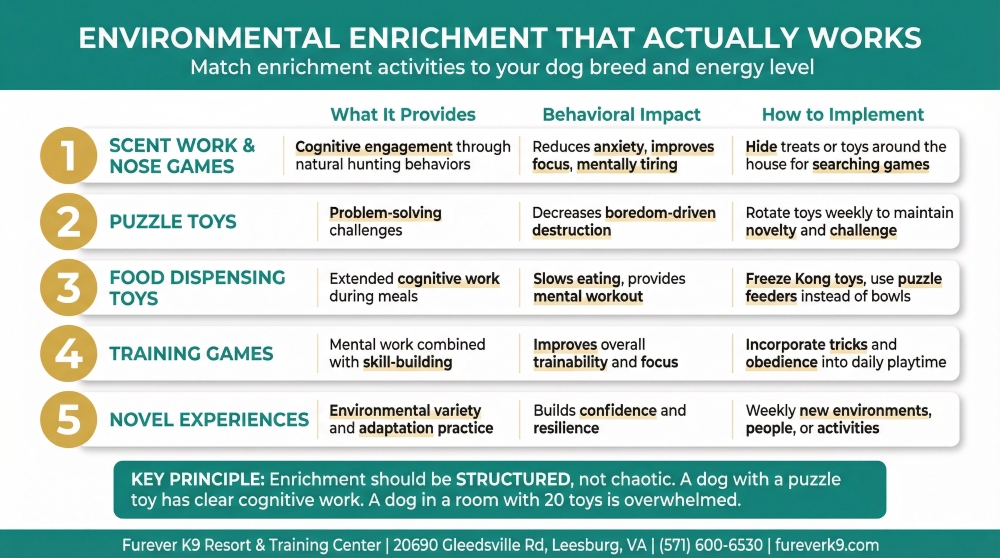
How Does Environmental Enrichment Affect Training Success?

 
Mental stimulation through enrichment activities improves focus during training sessions. A dog whose cognitive needs are met brings better attention to formal training than a cognitively starved dog.
Enrichment Type
What It Provides
Behavioral Impact
Implementation
Scent Work
Cognitive engagement through natural hunting behaviors
Reduces anxiety, improves focus, tires mentally
Hide treats/toys for searching games
Puzzle Toys
Problem-solving challenges
Decreases boredom-driven destruction
Rotate toys to maintain novelty
Food Dispensing Toys
Extended cognitive work during meals
Slows eating, provides mental workout
Freeze Kong toys, use puzzle feeders
Training Games
Mental work combined with skill-building
Improves overall trainability
Incorporate tricks into daily routine
Novel Experiences
Environmental variety and adaptation practice
Builds confidence and resilience
Weekly new environments/activities
Enrichment satisfies instinctual needs that, when unmet, drive problem behaviors. Dogs don’t chew furniture or dig holes because they’re bad—they’re expressing unmet needs.
infographics about home environment enrichment guide

Why Is Early Environment So Critical for Long-Term Behavior?

 
The environment puppies experience during critical developmental periods shapes behavior throughout their lives in ways that later training can influence but rarely completely overcome.

What Happens During Critical Socialization Periods?

 
Between 3-14 weeks, puppies’ brains are wired by experiences in ways that become relatively fixed. Positive exposures during this window create resilient, confident adult dogs. Lack of exposure or negative experiences create fear and anxiety that persist lifelong.
 
Studies on early life experiences demonstrate that fearful dogs had significantly fewer socialization experiences and lower quality maternal care during puppyhood. These early environmental deficits correlated with higher anxiety throughout life .
 
Quality matters more than quantity. A hundred neutral or negative exposures don’t help. Ten extremely positive experiences with various people, dogs, environments, and stimuli build confidence and resilience.
 

What Can You Do About Poor Early Socialization?

 
Systematic desensitization helps adult dogs overcome early environmental deficits. Fearful adult dogs can learn that previously scary things are safe through gradual, positive exposure.
 
Creating predictable, stable home environments helps anxious dogs from poor backgrounds feel secure. Consistency provides the stability their early environment lacked. Professional guidance from Furever K9’s Private Lessons helps identify which environmental modifications will most benefit dogs with early socialization deficits.
 

How Does Training Environment Affect Learning Success?

Where and how you train matters almost as much as what you train.

Why Do Behaviors Learned at Training Facilities Sometimes Fail at Home?

 
Context-specific learning means dogs learn behaviors in the environment where they’re taught. Your dog performs perfectly at our facility because they learned in that environment. Generalization to home requires specific transfer training.
 
Arousal levels differ dramatically between controlled training environments and chaotic homes. Dogs in calm training settings can focus and learn. The same dogs in stimulating home environments might be too aroused to access what they learned. This is why our Board and Train programs include comprehensive handoff training teaching you to transfer behaviors to your home environment effectively.
 

Conclusion

 
Your dog’s behavior problems might not be training failures or “bad dog” issues. They might be environmental factors you haven’t recognized working against every training effort you make. The chaos, unpredictability, overstimulation, or lack of appropriate outlets in your home environment could be the real problem.
 
Understanding how environment shapes behavior lets you make strategic modifications that support the behaviors you want. Sometimes these environmental changes work faster than training because you’re removing obstacles rather than just building skills.
 
At Furever K9, we specialize in this integrated approach because I’ve learned that the best training in the world can’t overcome an environment working against it. Your home doesn’t have to be perfect—it just has to support your dog’s specific needs.
 
Ready to discover how your home environment affects your dog’s behavior? Contact Furever K9 Resort & Training Center at (571) 600-6530 or visit us at 20690 Gleedsville Road, Leesburg, VA 20175. Let’s evaluate your dog’s environmental needs and create modifications that actually work.
Tiira, K., & Lohi, H. (2015). Early Life Experiences and Exercise Associate with Canine Anxieties. PLOS ONE, 10(11), e0141907.

FAQs

Environmental modifications alone rarely fix everything, but they create breakthrough improvements that training alone couldn’t achieve. Addressing factors like overstimulation and lack of routine alongside training produces significantly better results.

More than most owners realize. While some stable dogs adapt to irregular schedules, anxious or sensitive dogs require predictable daily patterns for meals, exercise, and sleep to reduce vigilance and feel secure.

This is due to context-specific learning. Your dog learned the behavior in a calm, controlled environment, but hasn’t generalized it to the chaotic, highly stimulating environment of your home.

It depends on the dog. For calm dogs, it provides enrichment; for reactive dogs, it creates hundreds of daily rehearsals of unwanted barking and arousal, which sabotages training efforts.

Choose a quiet area away from household traffic, add comfortable bedding, and ensure nothing scary ever happens there. Never force your dog out of this space—it only works if they have total autonomy over it.

Share this Success Story!

I know I need help!!!

Let Lauren know what you're struggling with!
She'll get in touch with you to discuss options!