


Jack Russell Terrier sitting calmly on a mat during training, illustrating focus and impulse control techniques related to how to stop dog whining.
Author picture

How to Stop Excessive Dog Whining: Expert Training Strategies for a Calmer Dog

Discover why your dog won't stop whining and learn expert, reward-based training strategies to reduce vocalization. Professional help available from Furever K9 in Loudoun County. Call (571) 600-6530.
Excessive dog whining can be an incredibly frustrating issue for pet owners, often signaling underlying behavioral problems or emotional distress. Whether your dog whines at the door, during mealtimes, or the moment you pick up your keys, understanding the root cause behind this vocalization is crucial for effective management.
At Furever K9 Resort & Training Center in Leesburg, Virginia, we help Loudoun County families decode their dog’s communication. This article explores the various causes of excessive whining—including anxiety and attention-seeking behaviors—and provides practical, reward-based strategies to address these issues. By implementing consistent training, you can help your dog become a calmer, more confident companion.
 

What Are the Common Causes of Excessive Dog Whining?

 
Excessive dog whining stems from various causes, each requiring a tailored approach for resolution. Before you can stop the whining, you must identify what your dog is trying to communicate.
 

The 4 Main Types of Whining

Type of Whining
Why It Happens
What It Looks Like
Attention-Seeking
The dog wants you to look at, pet, or feed them.
Whining while staring at you, pawing, or bringing toys. Stops when you engage.
Separation Anxiety
The dog experiences genuine panic when left alone.
Whining combined with pacing, panting, destruction, or inappropriate elimination.
Environmental Stress
The dog is reacting to loud noises or routine changes.
Whining during thunderstorms, fireworks, or when strangers enter the home.
Medical/Pain
The dog is experiencing physical discomfort.
Sudden onset of whining, especially when moving or being touched.
 
According to behavior experts at the ASPCA , if your dog suddenly starts vocalizing more than usual, your first step should always be a veterinary visit to rule out pain or underlying medical conditions.
 

How Does Attention Seeking Trigger Whining Behavior?

 
Dogs often whine to gain attention from their owners, especially if they have learned that this behavior results in a response. Common scenarios include whining for food, playtime, or simply to be petted.
 
Addressing attention-seeking whining involves teaching dogs that silence is more rewarding than vocalization.
 
How to Stop Attention-Seeking Whining:
  • Ignore the noise completely: Do not look at, speak to, or touch your dog while they are whining. Even scolding constitutes attention and will reinforce the behavior.
  • Use dramatic body language: Turn your back, fold your arms, or leave the room to clearly indicate that whining makes you withdraw.
  • Reward the silence: The moment your dog stops whining and settles, calmly provide praise or a treat.
  • Preempt the whine: Regularly seek out your dog to give them attention and rewards when they are already resting quietly.
When your dog understands that silence works well to get your attention, they won’t feel as motivated to whine.
 

Is Anxiety a Key Factor in Dog Whining?
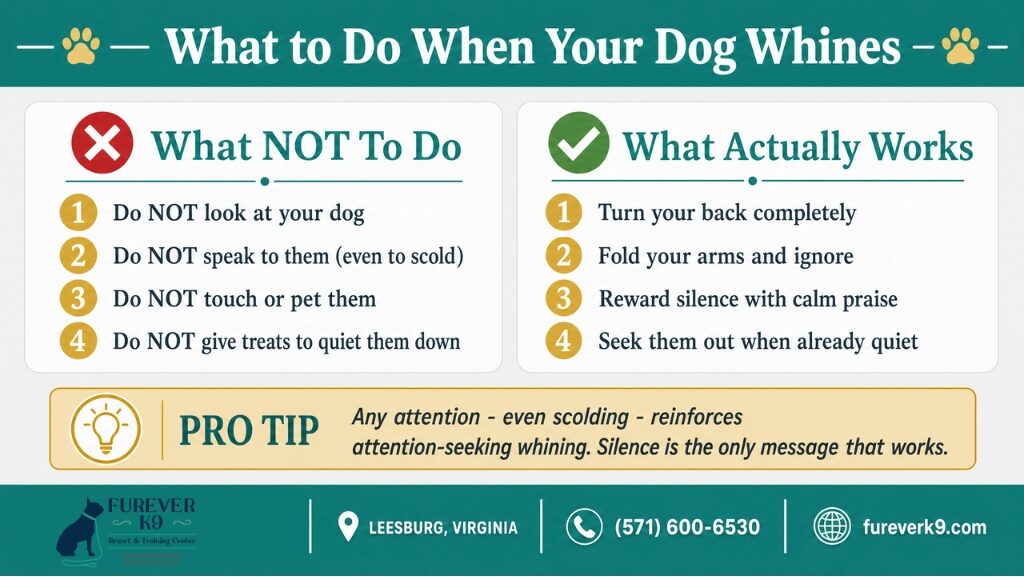
How to stop dog whining infographics
Anxiety plays a significant role in excessive dog whining, manifesting through various physical and behavioral symptoms. Dogs may exhibit signs of distress, such as pacing, panting, or hiding, alongside their vocalizations.
 

Understanding Separation Anxiety

 
Recent research highlighted by the American Veterinary Medical Association (AVMA) suggests that separation anxiety should be seen as a sign of underlying frustrations rather than a single diagnosis. A comprehensive study of over 2,700 dogs identified four main forms of distress when dogs are separated from their owners:
  1. A focus on getting away from something inside the house
  2. Wanting to get to something outside
  3. Reacting to external noises or events
  4. A form of boredom and frustration
Identifying these specific anxiety triggers is essential for effective management. Strategies to address anxiety-related whining include creating a safe space for the dog, establishing predictable routines, and gradually desensitizing the dog to your departure cues.
 

Which Positive Reinforcement Techniques Effectively Reduce Dog Whining?

 
Reward-based training methods are highly effective in reducing excessive dog whining. These methods focus on rewarding desired behaviors rather than punishing unwanted ones, an approach strongly supported by major veterinary behavior organizations .
 

Effective Techniques Include:

  • Rewarding Silence: Provide treats or praise when the dog is quiet, reinforcing the behavior you want to see.
  • Redirecting Attention: Engage the dog in training exercises (like asking for a “sit” or “place”) to give them an incompatible behavior to focus on.
  • Consistency in Training: Ensure all family members apply the exact same rules regarding whining to avoid confusing the dog.

How Can Desensitization Help Calm Anxious Dogs?

 
Desensitization is a valuable technique for calming anxious dogs and reducing excessive whining. This process involves gradually exposing the dog to anxiety-inducing stimuli in a highly controlled manner.
 
For example, if your dog whines when you pick up your car keys (a departure cue), you can start picking up your keys multiple times a day without actually leaving. Over time, the keys lose their association with the panic of you leaving. Combining desensitization with counter-conditioning—where positive experiences (like high-value treats) are associated with the anxiety trigger—can further enhance the effectiveness of this approach.
 

What Role Does Consistent Behavior Training Play?

 
Consistent behavior training is crucial in managing excessive dog whining. Establishing a structured environment helps dogs understand expectations and reduces overall anxiety.
 
Regular practice of commands and tricks not only strengthens the bond between the dog and owner but also provides mental stimulation, which can alleviate boredom-related whining. At Furever K9, our training programs focus heavily on impulse control, teaching dogs how to manage their own arousal levels rather than relying on vocalization.
 

When Should Professional Help Be Sought?

 
Recognizing when to seek professional help is crucial for effective intervention, especially for severe separation anxiety.
 
Signs You Need Professional Assistance:
  • Persistent whining despite implementing home strategies consistently for several weeks
  • Destructive behavior when left alone (chewing doorframes, destroying crates)
  • Severe anxiety symptoms, such as excessive drooling, self-injury, or indoor urination
  • Whining that disrupts your sleep or causes tension with neighbors
 

How Furever K9 Can Help

 
Furever K9, LLC offers a range of professional dog training services designed to address excessive whining and other behavioral issues in Loudoun County. Whether through our Board and Train programs or Private Lessons, our training focuses on reward-based techniques and customized plans tailored to your dog’s unique needs.
 
Ready to help your dog become calmer and more confident? Contact Furever K9 Resort & Training Center at (571) 600-6530 or visit us at 20690 Gleedsville Road, Leesburg, VA 20175.

FAQs

Your dog whines during mealtimes because they have learned that this behavior occasionally results in food. To stop this, completely ignore the whining and never feed your dog from the table.

You can calmly reassure a fearful dog, but avoid excessive coddling that might reinforce their panicked state. Focus instead on removing the scary stimulus or redirecting their attention to a simple training task.

If you are 100% consistent in ignoring the noise, attention-seeking whining can significantly decrease within 1 to 2 weeks. However, the behavior may temporarily worsen (an “extinction burst”) before it gets better.

Yes, sudden or uncharacteristic whining can be a primary indicator of pain or medical distress. If your normally quiet dog begins whining, especially when moving or being handled, consult your veterinarian immediately.

Proper crate training provides a secure, den-like environment that can reduce anxiety-related whining. However, the crate must be introduced gradually using positive reinforcement, never as a punishment.

Share this Success Story!

I know I need help!!!

Let Lauren know what you're struggling with!
She'll get in touch with you to discuss options!