Helping a puppy through biting and teething takes two kinds of support: comfortable, appropriate chewing outlets and practice interacting with people without putting teeth on skin. Start with toys, reward gentle engagement, and interrupt rough play calmly rather than trying to frighten your puppy into stopping.
That sounds straightforward until a sleeve becomes a tug toy or a quiet evening turns into a series of ankle nips. You can be patient with your puppy and still need a better plan for protecting your hands.
This guide helps Leesburg and Loudoun County puppy owners distinguish chewing from play mouthing, prepare for predictable trouble spots, and recognize when a veterinarian or behavior professional should be involved. The goal is not to suppress every use of your puppy’s mouth. It is to give that normal behavior an appropriate outlet while making everyday interaction more manageable.
What Does Bite Inhibition Mean for Your Puppy?
Bite inhibition is the ability to regulate the pressure of mouth contact. The ASPCA’s explanation of puppy bite inhibition distinguishes controlling bite force from learning not to mouth people at all.
A chew toy and a household rule serve different purposes. The toy gives your puppy something appropriate to use their mouth on. The rule helps them learn how to approach and play with you.
For home practice, you do not need to invite bites or put a hand in your puppy’s mouth to see how much pressure they apply. Concentrate on toy-directed play, comfortable interactions, and a consistent response to unwanted contact. If you need a more individualized bite-inhibition exercise, have a qualified trainer assess your puppy and show you a suitable approach.
Being gentle during a game does not make a dog incapable of biting. Pain, fear, and other circumstances can change behavior, so supervision remains important even when play is improving.
Why Is Your Puppy Using Their Teeth on Everything?
Puppies use their mouths to investigate and play, and teething can add an urge to chew. Excitement, frustration, and discomfort can also contribute, so the setting matters as much as the puppy’s age.
Dogs Trust’s guidance on the causes of puppy mouthing explains these overlapping influences. A puppy grabbing a pant leg during movement needs a different setup from one avoiding food because their mouth hurts.
Where Does Teething Fit In?
According to VCA’s veterinary guide to puppy teeth and teething, baby teeth commonly start falling out around 12 weeks as permanent teeth emerge. The permanent set is normally present by about six months, although development varies between puppies.
Those milestones help explain a period of increased chewing. They do not establish a date when all mouthing should disappear, and they do not explain every hard bite.
What Should You Notice Before Choosing a Response?
Look for the circumstances immediately before the contact: a fast-moving person, a long play session, an attempt to pick the puppy up, or someone approaching a valued item. Do not reproduce a worrying situation to collect more information.
The following checklist is a starting point for observation, not a way to diagnose your puppy:
A loose, playful appearance is not a reason to accept injury. If you are unsure what you are seeing, get support instead of trying increasingly forceful responses.
How Can You Set Up Gentle Interaction Before Teeth Touch Skin?
Make appropriate play available early and respond when your puppy chooses it. You will have more opportunities to teach if attention and toys are not reserved for the moment after a bite.
Give Your Puppy a Clear Way to Ask for Attention
When your puppy approaches with a toy, acknowledge them with a manageable game. When they come over without grabbing you, offer calm attention. A simple, already-learned sit can also become a way to request interaction.
Practice when the puppy is comfortable and able to engage. An excited puppy repeatedly biting a sleeve is not in the best position to learn a new cue.
Prepare for Predictable Busy Moments
If mouthing starts when the family comes home, have a toy and a separate puppy area ready before the greeting. If movement across the room triggers ankle chasing, avoid starting chase games with feet or clothing.
Keep toys where adults can reach them, but only allow access to items appropriate for the puppy and the level of supervision available. A damaged toy is not a useful alternative.
For setting up a safer area, Furever K9’s home dog-proofing checklist covers cords, clutter, small objects, and other household hazards.
Leave Room for Downtime
More activity is not always the answer to a more mouthy puppy. Review whether the day includes enough rest alongside bathroom opportunities, feeding, play, and learning.
When the evening becomes difficult, try reducing the demands and excitement rather than adding another energetic game. There is no single schedule that fits every puppy, so use the pattern you observe to guide adjustments.
What Is a Calm Response to Play Mouthing?
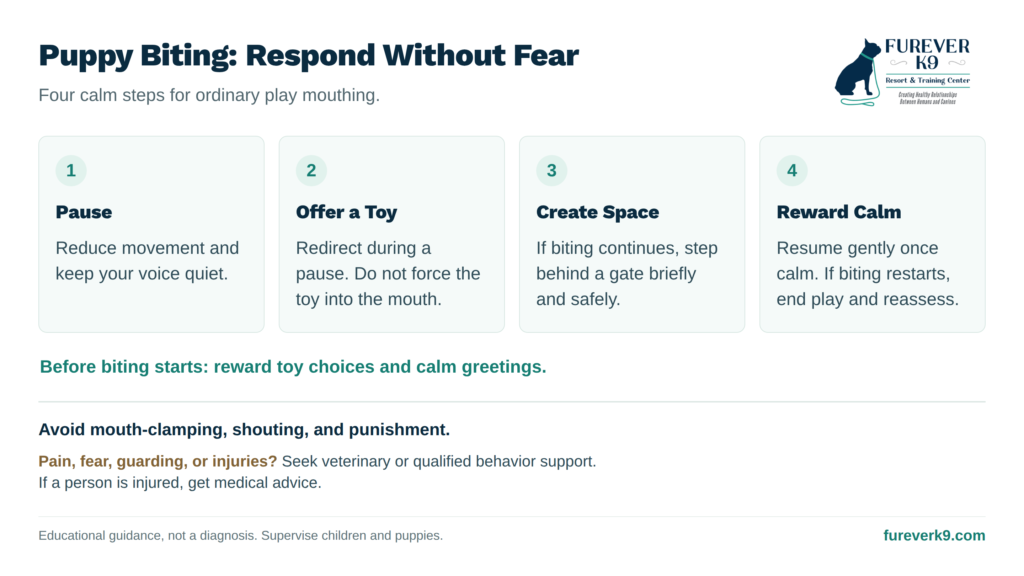
For ordinary play mouthing, take excitement out of the interaction, offer a toy during a pause, and create brief, safe separation if needed. Return to interaction only when your puppy can participate comfortably.
- Make the interaction less exciting. Stop the rapid hand movements or back-and-forth pulling on clothing. Keep your voice quiet, but do not stay within reach while being hurt.
- Offer an appropriate outlet. During a break in the mouthing, present a suitable toy without pushing it into the puppy’s mouth. Continue gentle engagement when their attention moves to the toy.
- Use your prepared exit if necessary. If the puppy continues grabbing, move behind a gate or into an adjacent space briefly. The puppy’s area must be secure and free of hazards.
- Choose an easier activity on your return. Reward a calmer approach, offer suitable toy play, or allow the interaction to end. If the same problem immediately resumes, reassess the puppy’s needs instead of repeating the game indefinitely.
You do not need to add a shouted command or a loud yelp. If sound increases the puppy’s excitement or worry, keep the response quieter.
Avoid chasing the puppy, grabbing their collar, or carrying them away as a punishment. Those extra interactions can make it harder to settle the situation. If using a barrier produces distress, ask a trainer to help with the setup rather than repeatedly leaving the puppy to struggle.
How Do You Choose Chews That Support Teething Comfort?
Choose items with an appropriate size, texture, and age recommendation, then watch how your puppy uses them. No toy or chew is safe for every puppy, and supervision remains necessary.
Cornell offers a practical screening rule: you should be able to make an indentation in the item with a fingernail. Passing that check is not a guarantee against choking, swallowing pieces, or other injury.
Before offering something new, check:
- Suitability: Is it intended for a puppy of this age and size?
- Texture: Does it yield rather than feel rigid or rock-hard?
- Condition: Are there cracks, loose parts, or pieces the puppy could pull off?
- Use: Is the puppy chewing comfortably, or trying to swallow the item?
Keep a small selection of appropriate options rather than relying on one product. You might rotate a flexible puppy chew, a suitable food toy, and a supervised play toy, checking each item regularly and removing damaged ones.
Do not offer ice cubes or hard frozen objects to crunch. For questions about cooling products, edible chews, or a particularly determined chewer, ask your veterinarian to help select an option.
A chew can provide an outlet. It does not, by itself, teach a puppy how to interact gently with human skin.