A puppy can start daycare when their veterinarian considers the proposed setting appropriate, the facility’s age and health requirements are met, and the puppy is comfortable with the type of interaction offered. A birthday or vaccine appointment alone does not establish readiness for group play.
If you’re asking when can puppies go to daycare, you’re probably trying to balance two needs: keeping your puppy healthy and giving them good experiences while you manage your day. You don’t have to choose between rushing into open play and avoiding every new experience.
For puppy owners in Leesburg and Loudoun County, the useful next step is to check health, behavior, and facility policy separately. At Furever K9, we encourage you to discuss your puppy’s needs before making a daycare reservation.
What Age Should a Puppy Be Before Starting Daycare?
There is no single starting age that makes every puppy ready for every daycare. The answer depends on vaccine history, current health, the environment, the facility’s rules, and the individual puppy’s response.
The American Animal Hospital Association’s guidelines recommend repeating core puppy vaccinations at two- to four-week intervals until the puppy is older than 16 weeks. The technical guidance notes that later doses may be preferred in areas with higher distemper or parvovirus risk. Your veterinarian should determine the schedule for your puppy.
That vaccination guidance is not a daycare admission rule. Turning 16 weeks does not automatically mean a puppy has the appropriate protection or is ready for an extended day in a group. Equally, guidance for an early, controlled puppy class should not be treated as permission for open-play daycare.
Ask two separate questions: “When is this setting appropriate for my puppy medically?” and “What are this facility’s current puppy entry requirements?”
What Should You Confirm With Your Veterinarian?
Ask your veterinarian about the actual daycare environment, not just whether your puppy has received vaccines. Share the likely contact with other dogs, group activity, shared spaces, and the facility’s health-screening practices.
Ohio State University’s veterinary guidance recommends assessing exposure risk and using several prevention measures together. Vaccination, screening, parasite control, and cleaning can reduce risk, but they do not eliminate every infectious-disease risk.
Bring your puppy’s records and ask:
- Is the vaccine schedule appropriate for the group setting we’re considering?
- What additional vaccinations or preventive care should we discuss based on lifestyle and local risk?
- How long should we wait after the relevant doses before this type of contact?
- Are there health or development concerns that should limit play or attendance?
- What activity and rest arrangements would suit this puppy?
There is no universal waiting period after every vaccine that this article can safely apply to every puppy. Vaccine type, dose history, and the individual dog matter. Follow your veterinarian’s advice and confirm the facility’s requirements too.
Do not send a puppy with a new cough, vomiting, diarrhea, or other concerning illness signs into daycare while you wait to see what happens. Contact your veterinarian before group exposure. Veterinary biosecurity guidance treats these signs as reasons to assess possible transmissible illness, not as proof of a particular diagnosis.
What Records and Policies Should You Ask Furever K9 About?
Confirm current puppy eligibility and submit the required records before arranging attendance. Meeting a facility’s administrative requirements is important, but it does not replace veterinary advice about your puppy.
Our dog daycare in Leesburg lists proof of rabies, DHPP, Bordetella, and a negative fecal test from within the last 12 months. DHPP is a combination vaccination; your veterinarian can help interpret the product and dose dates on your puppy’s records.
The daycare page also states that titer tests are accepted. Ask which specific records are acceptable for your puppy rather than assuming a titer replaces every vaccination or applicable requirement.
- Minimum age: What is the current age requirement for this puppy and this service?
- Vaccine timing: Which doses, documents, and post-vaccination intervals are required?
- Evaluation: What assessment is needed before attendance, and what information should you provide?
- Group arrangements: How are puppies matched with other dogs, and are separate puppy groups available?
- Introduction and rest: Can the start be made shorter or quieter if appropriate, and how are breaks managed?
- Reservation: Which attendance days and arrival and pickup windows can you book?
Dogs have a behavioral evaluation before attending our daycare unless they have already trained with us. For a puppy, confirm how that requirement applies alongside current age and health eligibility.
Furever K9 daycare is by reservation, with pay-per-day attendance and no walk-ins. Our published description says dogs attend with the same small group and staff each time. It does not mean every puppy will need, or be offered, the same introduction plan.
What Does Behavioral Readiness Look Like?
Look for comfortable participation and the ability to take a break, not just excitement about seeing another dog. The evaluation should help determine whether the environment is a good match for your puppy.
Blue Cross notes that daycare can overwhelm some young or shy dogs. Its guidance emphasizes monitoring interactions, protecting quieter dogs from more boisterous play, and providing downtime.
Useful observations to share include whether your puppy can approach without being pushed, move away from interaction, accept ordinary handling, and settle in a quieter space. These are discussion points, not a home test that guarantees admission.
Also describe what happens when things become busy. Does your puppy keep trying to hide, avoid contact, or get away? Do they become so excited that they struggle to disengage? Those details may suggest a need for a calmer introduction or a different setting.
A puppy who enjoys one familiar playmate has not necessarily shown that they will enjoy a larger group. Tell the team what you have observed rather than feeling you need to describe your puppy as outgoing.
How Do You Decide: Yes, Not Yet, or Ask a Professional?
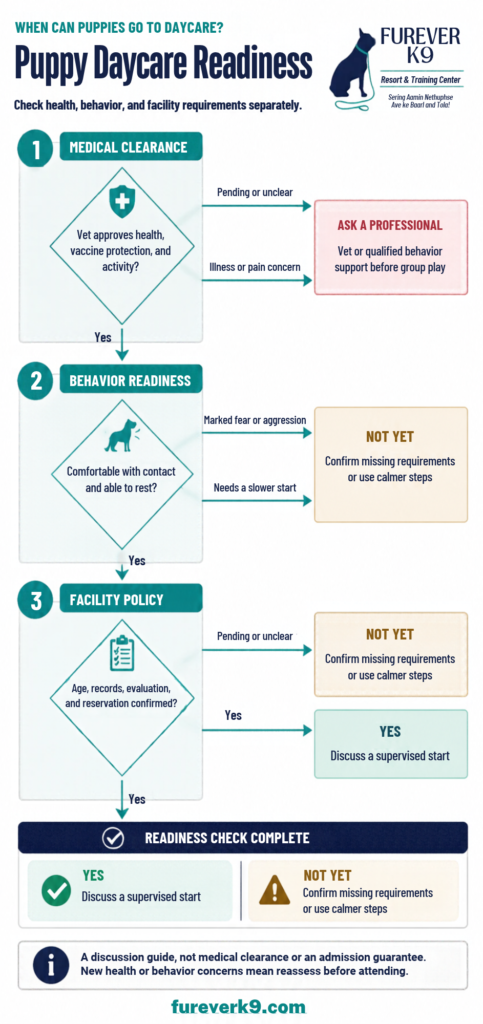
Check medical clearance, behavior readiness, and facility policy in that order. Treat “yes” as a reason to discuss an appropriate supervised start, not a guarantee of safety or acceptance.
Medical Clearance
Has your veterinarian advised that this puppy’s health, vaccine protection, and activity needs suit the proposed setting?
If timing or records are unclear, choose not yet and confirm them. If there is an illness or pain concern, choose ask a professional and contact your veterinarian before group play.
Behavior Readiness
Is your puppy comfortable with the proposed contact and able to rest between activities?
If they need quieter steps, choose not yet for open play and discuss alternatives. Marked fear, repeated escape attempts, or aggression calls for professional guidance, rather than forcing a trial day. AVSAB advises veterinary guidance for puppies displaying fear.
Facility Policy
Has the facility confirmed that age, health records, evaluation requirements, and the reservation are in place?
If something is missing or unconfirmed, choose not yet and resolve it with the team. If all three checks are satisfied and no new concern has appeared, yes means you can discuss the agreed introduction.
Revisit the decision if health or behavior changes. Earlier approval does not mean a new cough, injury, or distress signal should be ignored.