


What Your Dog’s Ears Are Telling You
Author picture

What Your Dog’s Ears Are Telling You: A Guide to Canine Communication

Learn how to read dog ear positions to understand your dog's emotional state. Expert guide to canine body language, stress signals, and communication. FureverK9 Leesburg. (571) 600-6530.

Decoding Dog Ear Positions

  • The Basics: Dog ear positions are a direct barometer of emotional state. Perked ears signal alertness, relaxed ears suggest calm, and flattened ears indicate anxiety, fear, or submission.
  • Breed Differences Matter: Prick-eared dogs (like German Shepherds) are easier to read than floppy-eared dogs (like Retrievers). For floppy ears, watch the muscle tension at the base of the ear rather than the tip.
  • Context is Everything: Never read ears in isolation. You must combine ear position with tail movement, facial tension, and eye contact to get an accurate picture of what your dog is feeling.
  • The Cost of Misreading: Research shows owners consistently underestimate their dog's fearfulness. Recognizing subtle ear shifts helps you intervene before a behavior escalates into barking or lunging.
  • Professional Help: Learning to read these signals accurately is the foundation of effective training, helping you respond to your dog's needs with confidence rather than frustration.
Dog ear positions reveal a canine’s emotional state through distinct muscle cues. Perked ears signal alertness, while ears flattened against the head indicate submission or anxiety. Relaxed ears suggest contentment. Dogs, wolves, and other canids all rely on ear communication as part of their body language, and understanding it gives owners a reliable window into how their dog is feeling. However, as the notes, most people still misread the signals dogs are actually sending.
 

What Do Different Dog Ear Positions Actually Signal?

Dog ear positions serve as a direct barometer of canine mood, giving pet owners a reliable window into their dog’s emotional state. Reading ear posture accurately—alongside other body language cues—helps owners respond to their dogs with greater confidence and consistency.
 
Canine ear signals are rooted in genetics. Dogs, wolves, and other canids share this communication system, though regular interaction with humans and other animals shapes how individual dogs express themselves over time. Learning to read these signals is one of the foundational skills FureverK9 builds into every , regardless of which service a client starts with.
 
Here is a quick reference for interpreting the most common ear positions:
Ear Position
Emotional State
What It Typically Signals
Perked forward
Alert, aroused, or curious
Focused attention, positive anticipation, or potential frustration
Relaxed, neutral
Calm, content
The dog feels safe and comfortable in their environment
Flattened against head
Fearful, anxious, or submissive
Appeasement, attempting to communicate they pose no threat
Pulled slightly back
Unsure or appeasing
Mild stress or a desire to de-escalate a situation
One up, one down
Divided attention
Curiosity or listening to multiple sounds simultaneously

Why Do Dogs Flatten Their Ears Against Their Head?

Ears pressed flat against the skull often appear when a dog feels submissive, anxious, or fearful. This posture signals appeasement—the dog is communicating that it poses no threat to whatever is causing the stress. While many owners interpret this as “guilt” when a dog has been caught doing something mischievous, it is actually a response to the owner’s tone or body language, not an admission of wrongdoing.
 

How Do Perked Ears Differ From Relaxed Ears?
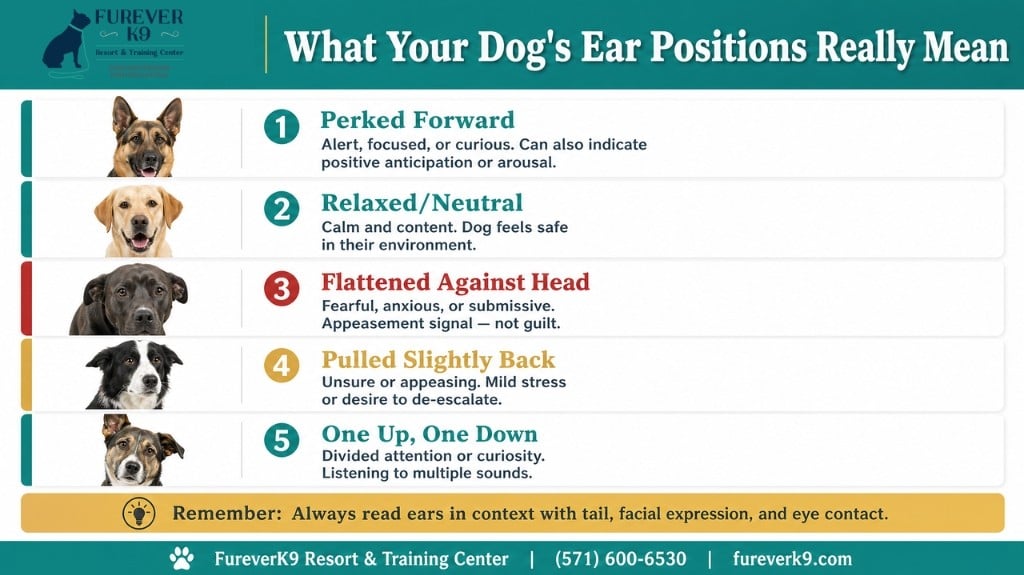
Perked ears point forward and reflect active alertness; the dog is focused on something specific in its environment. This can indicate positive anticipation, curiosity, or even . Relaxed ears, by contrast, sit in a neutral position and indicate a calm, content animal. The contrast between these two states is one of the clearest ways to read a dog’s mood, helping owners gauge whether their dog needs redirection, engagement, or simply to be left alone to rest.

How Does Ear Shape Affect Your Ability to Read a Dog’s Signals?

Not every dog telegraphs emotion the same way, and ear shape is a significant reason why. A dog’s breed-typical ear structure changes how visible—and how readable—these signals are to the average owner.
 

Are Prick-Eared Dogs Easier to Read Than Floppy-Eared Dogs?

Generally, yes. Breeds with naturally erect ears, such as German Shepherds, Huskies, and Corgis, have a wider range of visible motion. Their ears can rotate, tilt, and pin back dramatically, which makes shifts in mood easier to spot at a glance.
 
Floppy-eared breeds, like Basset Hounds, Cocker Spaniels, and many retrievers, have less visible ear mobility because the ear itself is heavier and hangs by default. Their signals are still present, but as , owners often need to look closer at the base of the ear and the surrounding muscles rather than the tip. Furthermore, owners should always compare a dog’s ear position to that specific dog’s own normal baseline rather than comparing it to another breed’s posture.
 

How Do Cropped or Docked Ears Change the Picture?

Dogs with surgically cropped ears—a cosmetic practice sometimes seen in breeds like Doberman Pinschers and Great Danes—can display an exaggerated version of the “alert” posture even when relaxed, since the ear no longer folds naturally. This does not mean the dog’s underlying emotional signaling has changed, only that the visual shorthand owners rely on (like a fully flattened ear) may look different or be harder to distinguish. In these cases, facial tension, body posture, and tail position become even more important secondary cues for accurate interpretation.
 

Does Age Affect How a Dog Uses Its Ears?

Puppies are still developing muscle control over their ears well into their first few months, and ear carriage in young puppies can be an unreliable signal on its own. As dogs mature, ear position becomes a more consistent and deliberate part of their communication, which is one reason trainers encourage owners to start observing body language patterns early and track how they change over time.
 

How Do Canine Ear Signals Combine With Other Body Language?

Canine ear signals never communicate in isolation. The meaning of an ear position shifts entirely depending on what the rest of the dog’s body is doing at the same time. Reading ears alongside tail movement, facial tension, and eye contact gives a far more accurate picture of a dog’s emotional state than observing ears alone.
 

Why Does Full-Body Context Matter for Reading Ears?

Dogs use a combination of physical cues to express how they feel, and ear position is just one piece of a larger puzzle. Tail wagging, for example, conveys different emotions depending on its speed and direction—a stiff, rapid wag often signals over-arousal, while a loose, sweeping wag indicates happiness. Relaxed or tense facial features reveal whether a dog is calm or stressed. Eye contact adds another layer, signaling trust or challenge depending on the situation. No single signal tells the .
 
When owners understand dog ears in context, their responses to their dog’s needs become far more accurate. The key signals to observe together include:
 
  • Ear position: Forward, flattened, or neutral
  • Tail movement: Speed, height, and direction
  • Facial expression: Relaxed jaw versus tight, tense features
  • Eye contact: Soft gaze versus hard stare or “whale eye” (showing the whites of the eyes)

What Are Common Body Language Combinations to Watch For?

Ear position is one of the primary ways dogs communicate, both with people and with each other. Owners who learn to read these combined signals respond more appropriately to their dog’s needs, which strengthens the bond and supports lasting behavioral progress.
 
Here are a few real-world combinations to watch for:
Signal Combination
Likely Emotional State
Recommended Owner Action
Ears back + tail tucked + lip licking
Strong anxiety or fear
Remove the dog from the situation immediately; do not force interaction.
Ears forward + weight shifted forward + hard stare
Over-arousal or potential reactivity
Redirect the dog’s attention; create distance from the trigger.
Ears relaxed + loose, wagging tail + soft eyes
Comfortable and content
Safe to approach or continue the current activity.
One ear up, one ear back
Curiosity or divided attention
Monitor the situation; no immediate action required.

What Mistakes Do Owners Commonly Make When Reading Ear Signals?

The most common mistake is treating a single signal as the whole story. An owner might see relaxed ears and assume a dog is comfortable, completely missing a stiff body or a hard stare that suggests otherwise. Another frequent error is assuming all dogs display the same signals identically—breed, individual temperament, and past experience all shape how a dog “speaks” through body language.
 
Finally, many owners only start paying attention to body language after a dog has already reacted, rather than watching for the earlier, quieter cues that usually come first. A found that non-experts are often less able to pick up on subtle signs of canine stress—including tucked ears—and tend to underestimate how fearful or anxious their dog actually is in the moment. Ear position often shifts before a bark, lunge, or snap does, which is exactly why it is worth learning to recognize on its own.
 

How Can Professional Training Help You Understand Dog Ears?

Professional training builds the observational skills dog owners need to read canine ear signals accurately and respond with confidence. Without structured guidance, misreading a dog’s body language can lead to missed cues, miscommunication, and strained relationships.
 

Why Does Clear Communication Matter in Dog Training?

Training grounded in clear communication, consistency, and humane, positive reinforcement-based handling produces stronger, more reliable results. FureverK9, a professional dog training, boarding, and daycare facility in Leesburg, VA, serves dog owners throughout Loudoun County, Northern Virginia, and the greater Metro D.C. area, applying these principles. These are the same principles behind , helping owners recognize what their dogs are expressing, including the subtle shifts in ear position that signal stress, excitement, or submission.
 

How Do Tailored Sessions Help Owners Understand Dog Ears?

are designed around each dog’s specific temperament, triggers, and training goals. That individualized structure gives owners repeated, real-world opportunities to understand dog ears in context—not just in theory. Trainers guide clients through live scenarios, connecting ear position and body language to actionable responses.
 
Key benefits of professional training for reading canine signals include:
  • Recognizing fear versus aggression through ear and posture combinations
  • Identifying stress signals before behavior escalates
  • Building consistent responses that reinforce calm, confident behavior

What Should You Do When You Notice Stress Signals in Your Dog’s Ears?

Spotting a stress signal is only useful if it changes what you do next. When you notice ears pinned back alongside other tense body language, the most effective response is usually to create space—physically move your dog away from whatever is triggering the reaction, rather than forcing continued exposure.
 
Calm, low-key praise for relaxed behavior reinforces the state you want to see more of. Conversely, punishing a dog for showing early warning signs (like a stiffened posture or flattened ears) can teach the dog to suppress those signals rather than feel less stressed, which often makes future warnings harder to spot. Over time, consistent, low-pressure exposure paired with positive reinforcement helps a dog build genuine confidence instead of just tolerance.
 
Understanding your dog’s ear positions empowers you to respond thoughtfully to their emotional and physical needs. By recognizing the subtle shifts between alert, relaxed, and anxious ear placements, you strengthen the communication bond with your companion—the foundation of a confident, well-adjusted dog. Spend time observing these signals, and you will gain deeper insight into your dog’s world.
 
If you would like hands-on help learning to read your own dog’s body language, FureverK9’s private lessons in Leesburg are built around exactly this kind of real-time coaching. Call (571) 600-6530 or to schedule a session.

FAQs

Perked ears point forward and reflect active alertness, indicating the dog is focused on something in its environment. This posture can signal positive anticipation, curiosity, or arousal that could lead to frustration.

Flattened ears signal appeasement and submission, communicating that the dog poses no threat. This posture often appears when a dog feels anxious, fearful, or submissive, such as when they are being scolded.

No. Ear position meaning shifts depending on what the rest of the dog’s body is doing at the same time. Owners should read ears alongside tail movement, facial tension, and eye contact for an accurate picture.

Yes, floppy-eared breeds have less visible ear mobility. Owners of these breeds need to pay closer attention to the muscle tension at the base of the ear, along with facial tension and tail position, rather than relying on ear tip movement alone.

This typically indicates divided attention or curiosity. Your dog may be listening to multiple sounds simultaneously or trying to process confusing information. On its own, this is not a cause for concern.

Share this Success Story!

I know I need help!!!

Let Lauren know what you're struggling with!
She'll get in touch with you to discuss options!