Search “mastering clicker training” and you will find no shortage of guides telling you it is the fastest, most magical way to train any dog. Most of them skip a critical step: they never mention that scientists have actually tested these claims, and the results are more interesting—and more useful—than the marketing suggests.
You have probably heard other dog owners rave about clicker training, or maybe you have picked up a clicker yourself only to have it sit in a drawer, unused and confusing. You are not doing anything wrong—clicker training has a learning curve, and without understanding the “why” behind the technique, it is easy to feel like you are just making random noises at your dog. The good news is that once the mechanics click, this method becomes one of the clearest ways to communicate with your dog.
Clicker training is not a trend or a gimmick, but it is also not the guaranteed shortcut some articles promise. This guide walks through what the research actually shows about its effectiveness, exactly how the mechanics work, and how to apply the technique to everything from basic obedience to real behavioral challenges.
What Is Clicker Training and How Does It Actually Work?
Clicker training is a positive reinforcement method that uses a small mechanical device to mark the exact moment a dog performs a desired behavior, followed immediately by a reward. The click itself does not reinforce anything—it is a signal, or “bridge,” that tells your dog precisely which action earned the treat that follows.
This technique is built on a psychological principle called conditioned reinforcement, first described by B.F. Skinner in his foundational research on operant learning. The clicker becomes a conditioned reinforcer through repeated pairing with food: click, then treat, click, then treat, until your dog understands that the sound always predicts something good is coming.
Why Does the Clicker Work Better Than Just Saying “Good Dog”?
The clicker’s main advantage is precision and consistency, not magic. Your voice changes with your mood, background noise can drown it out, and the tone or cadence of “good dog” varies from one repetition to the next. A clicker produces the exact same sound every single time, which removes ambiguity about what is being marked.
Timing matters enormously here. Dogs connect a reward with an action only when the marker happens within a fraction of a second of the behavior. A click can capture that instant far more reliably than fumbling for a treat, which is why trainers often describe the clicker as “freezing” the exact moment of success so your dog knows precisely what earned the reward.
What Does the Research Say About Clicker Training’s Effectiveness?
This is where it is worth being honest with you, because the science is more nuanced than many training articles suggest. A systematic review and meta-analysis published in the Journal of Applied Animal Welfare Science examined conditioned reinforcement across multiple species and found what researchers describe as a moderate overall effect, concluding that clicker-based training is genuinely effective at changing animal behavior, though the size of that benefit varies by species and task.
However, not every study shows a clear advantage over simply using food alone. Research published in the IAABC Foundation Journal found that the clicker as a marker was no more effective than using food alone as a reinforcer for simple tasks . Similarly, research published in PeerJ comparing clicker training, verbal marker training, and food-only reinforcement in naïve dogs learning a new behavior found no significant advantage for the clicker group in acquisition speed .
Where the clicker does appear to shine is with more complex, multi-step behaviors. The IAABC Foundation Journal research found that while a clicker offered no advantage for simple tasks, it produced faster acquisition than food alone when dogs were learning more complicated behavior chains—suggesting the clicker’s real value emerges once you move beyond basic cues into more intricate training goals .
The takeaway for dog owners is that clicker training is a legitimate, evidence-supported tool, particularly valuable for complex behaviors and precise timing, but it is not inherently superior to well-timed verbal markers for every situation. What matters most is consistency and correct mechanics, not the tool itself.
Does the Type of Clicker You Use Actually Matter?
The specific device matters less than you might think. Any clicker that produces a sharp, consistent sound will work, since the goal is simply a signal your dog can distinguish clearly from background noise. Box clickers (the classic small plastic button) are the most common, while button clickers offer a quieter option for noise-sensitive dogs or apartment living.
If your dog seems startled by the sound, muffling the clicker in your pocket or hand for the first few sessions, or switching to a quieter button-style clicker, solves the problem faster than abandoning the method altogether. What matters far more than the specific device is your timing and consistency in using it.
When Should You Start Clicker Training Your Dog?
Clicker training can begin at almost any age, from young puppies to senior dogs learning new skills for the first time. There is no minimum age requirement, though the approach and expectations should adjust based on your dog’s developmental stage and prior training history.
Can You Clicker Train a Puppy?
Yes, puppies as young as eight weeks old can begin learning basic clicker associations. At this age, sessions should be extremely short (one to two minutes), low-distraction, and focused entirely on building the click-equals-treat association before introducing any actual behaviors.
Young puppies have limited attention spans, so the goal early on is not teaching commands—it is simply helping your puppy understand that the click sound reliably predicts a reward. Once that foundation is solid, usually after just a handful of short sessions, you can begin shaping simple behaviors like sitting or making eye contact.
Is It Too Late to Clicker Train an Adult or Senior Dog?
Not at all. Adult and senior dogs are often excellent clicker training candidates because they typically have longer attention spans and more impulse control than puppies. Dogs with an established training history sometimes need a brief adjustment period to understand the new marker, but most dogs pick up the click-treat association within the first few sessions regardless of age.
The main consideration for older dogs is physical comfort. Sessions involving movement-based behaviors should account for any mobility limitations, and shorter, more frequent sessions tend to work better than long ones as dogs age.
How Do You Start Clicker Training the Right Way?
Successful clicker training begins with “charging” the clicker—building the association between the sound and the reward—before you ever ask your dog to do anything. Skipping this foundational step is the most common reason clicker training feels confusing or ineffective for new users.
What Is “Charging the Clicker” and Why Does It Matter?
Charging the clicker simply means teaching your dog that click always equals treat, with zero expectations attached. You click, then immediately deliver a treat, repeated ten to fifteen times per short session, without asking your dog to do anything at all.
You will know the clicker is charged when your dog’s head snaps toward you or toward the treat pouch the instant they hear the click, even when they were not specifically working on a task. This response confirms the sound has become meaningfully associated with reward, and you are ready to start marking actual behaviors.
What Are the First Steps to Shaping a New Behavior?
Capturing involves clicking a behavior your dog offers naturally, such as sitting on their own, while luring uses a treat to guide your dog’s body into position. Both are valid starting points depending on the behavior you are teaching.
Shaping is where clicker training becomes especially powerful for complex behaviors. Instead of waiting for the complete, polished action, you click and reward small steps in the right direction, gradually raising your criteria until your dog performs the full behavior. This approach lets you build multi-step behaviors, like retrieving a specific item or performing a sequence of actions, that would be difficult to lure or capture directly.
How Do You Chain Multiple Behaviors Together?
Once your dog reliably performs individual behaviors, chaining links them into a single, fluid sequence, such as “go to your mat, lie down, and stay” performed as one continuous action rather than three separate commands. This is one of the areas where the research on complex behaviors becomes especially relevant, since chained behaviors are exactly the kind of multi-step task where a clicker’s precise timing tends to outperform food or praise alone.
Build a chain by teaching each behavior separately first, then linking them starting from the last behavior in the sequence and working backward. This “backward chaining” approach means your dog is always moving toward a behavior they already know well, which keeps sessions confident and reduces frustration as you add complexity.
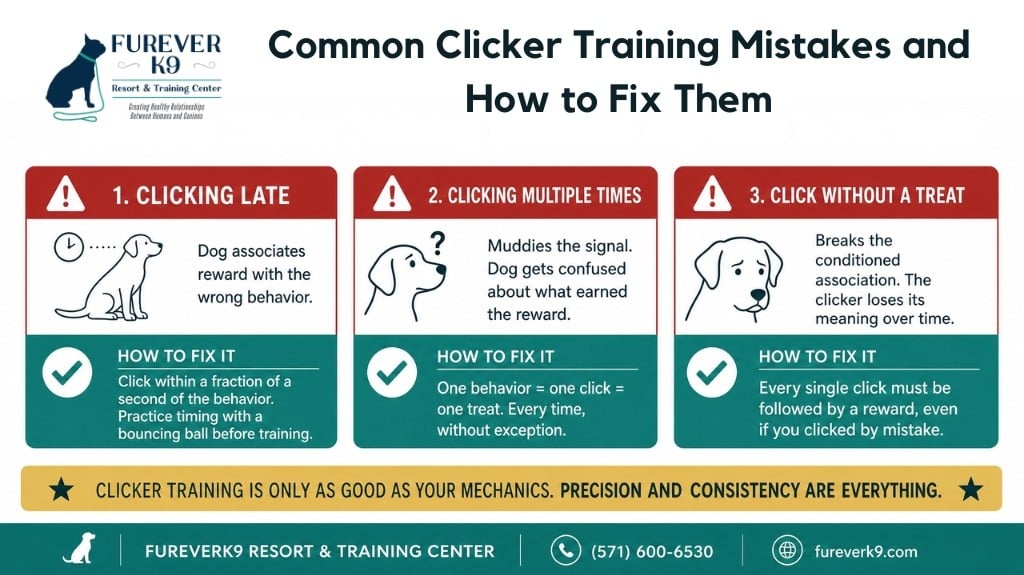
What Common Mistakes Undermine Clicker Training Progress?
Most clicker training frustration comes from a handful of predictable, fixable errors rather than any flaw in the method itself. Recognizing these patterns early can save weeks of confusion for both you and your dog.