

What Inconsistency Actually Does to Your Dog
How Inconsistent Training Creates Behavior Problems
Why Owners Are Inconsistent (It Is Not Your Fault)
How Inconsistency Cascades Into Bigger Problems
|
Stage
|
What Happens in the Home
|
What the Dog Learns
|
The Behavioral Result
|
|
1. Inconsistent Enforcement
|
Rules exist but enforcement is spotty. Dog gets corrected sometimes but gets away with it other times.
|
The rule might work today, or it might not. It is worth trying to see what happens.
|
Dog tests the rule frequently and becomes opportunistic, looking for patterns.
|
|
2. Boundary Testing
|
Dog consistently tests boundaries, searching for the actual rule and waiting for the weak link.
|
Rules are negotiable. Persistence pays off if you find the right person to ask.
|
Defiance seems to increase. Dog ignores commands and becomes manipulative.
|
|
3. Generalized Rule Violation
|
If one rule is inconsistent, the dog assumes all rules are inconsistent.
|
Humans are inconsistent about everything. Every boundary is worth testing.
|
Multiple behavior problems emerge. The house feels chaotic and unmanageable.
|
|
4. Learned Opportunism
|
Dog internalizes that rules are entirely negotiable and human responses are unpredictable.
|
Humans cannot be counted on. The dog must make their own decisions about behavior.
|
The dog runs the household. Owners feel defeated and may consider rehoming.
|
Why Consistency Actually Fixes Behavior Problems
How Consistency Enables Professional Training
How Board & Train Solves the Inconsistency Problem
How to Actually Create Family Consistency
The Consistency Protocol
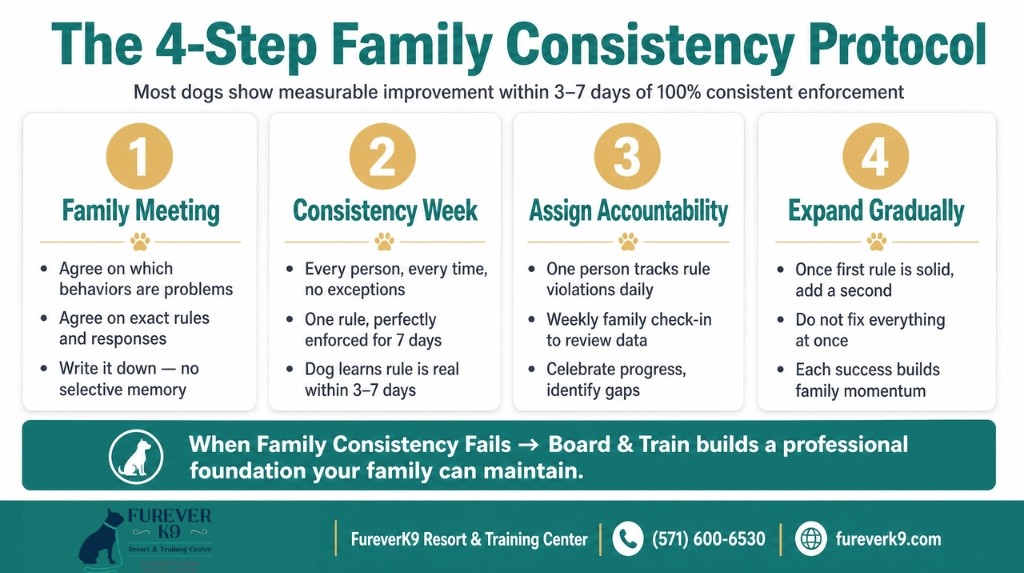
Step 1: The Family Meeting (No Dog Present)
Gather everyone in the household to agree on which behaviors are actual problems. Agree on what the rules are and the exact responses when a rule is broken. Write this down to prevent selective memory. Everyone must agree; if one person does not support the rule, you might need to compromise on which rules matter most.
Step 2: Launch Consistency Week
Commit to enforcing the rules identically, every person, every time, with no exceptions for one entire week. Dogs learn very quickly under these conditions, usually within 3 to 7 days. The dog will test less frequently as they realize the rule is real. This week proves to the family that consistency works, building momentum and confidence.
Step 3: Assign Accountability
Assign one person to track how many times the dog broke the rule, how it was enforced, and whether anyone broke protocol. Hold a weekly family check-in to review the data, celebrate improvements, and identify where inconsistency happened. Tracking makes inconsistency visible, prevents a gradual drift back to chaos, and creates accountability.
Step 4: Expand to Other Rules
Once the first rule is solid, pick a second rule and apply the same process. Do not try to fix everything at once. Consistency takes energy, so build gradually and let each success build momentum.
When Consistency Fails (And What to Do)
How Furever K9 Addresses Inconsistency
FAQs
Even small inconsistencies undermine learning. If you enforce a rule 90% of the time, your dog learns the rule works most times but might succeed the 10% of times it doesn’t. One family member not enforcing a rule can be enough to confuse a dog. Perfect consistency produces the fastest learning, while imperfect consistency produces slower, confused learning.
Partially, but with limitations. If you are the only one enforcing rules, the dog learns to listen to you but ignore your spouse or kids. This partial training often makes people think the training failed, when actually the partial training succeeded perfectly. For household-wide behavior change, you need household-wide consistency.
Show them the results. Try a “Consistency Week” where everyone commits to one rule perfectly for seven days. When the dog’s behavior improves dramatically in that short time, the family usually becomes believers. Nothing motivates a family like visible proof that their actions are changing the dog’s behavior.
No. Consider a Board & Train program where a professional builds the behavioral foundation under perfect consistency. When the dog comes home trained, your family’s job is simply maintenance, which is much easier than teaching a new behavior from scratch amidst household chaos.
Most dogs show measurable improvement within 3 to 7 days of 100% consistent enforcement. A behavior problem that seemed permanent for years often resolves in one week of perfect consistency. Slower improvement usually indicates that inconsistency is creeping back into the household.