
Why Place Command Dog Training Changes Everything
Author picture

Why Place Command Dog Training Changes Everything: Building Impulse Control From the Ground Up

Place command teaches impulse control and boundaries. Why it's transformational for jumping, anxiety, household behavior. Expert guide from FureverK9 Leesburg. (571) 600-6530.
The 5 Key Takeaways on Place Command
  1. Jumping, counter surfing, and departure anxiety are not separate problems; they are all symptoms of missing impulse control and unclear boundaries.
  2. The place command teaches your dog to pause, make a choice, and regulate their own nervous system, moving them from a high-arousal state to a calm state.
  3. Research confirms that self-control is context-specific; dogs must practice the place command in real-world scenarios (guest arrivals, meals) to generalize the behavior.
  4. Consistent enforcement of the place command establishes you as a stable, predictable pack leader, which makes your dog feel safe and reduces anxiety.
  5. Teaching the command requires a systematic 5-stage progression, starting with location preference and ending with real-world application, utilizing positive reinforcement throughout.
Your dog jumps on every guest who enters your home. They invade the kitchen counter during meals. They climb on furniture when you have visitors. They are anxious whenever you are getting ready to leave, pacing and whining. They do not respect any boundaries—not yours, not your guests’, not any physical space in the house. Your home feels chaotic. Your dog feels anxious and out of control. You feel like leadership is impossible.
 
You have tried telling them “no.” You have tried redirecting. You have tried separating them. Nothing sticks. You think the problems are separate: jumping is one issue, boundary violations are another, anxiety is something else entirely. You are trying to fix individual behaviors with individual solutions.
 
Here is what you are missing: These are not separate problems. They are all symptoms of the same root issue—your dog does not have impulse control, which means your dog does not have boundaries, which means your dog does not feel safe. And it all starts with one command: Place.
 
I am Lauren White, founder of FureverK9 Resort & Training Center in Leesburg, Virginia. Over the years, I have worked with hundreds of Loudoun County dogs exhibiting jumping problems, boundary violations, anxiety, and household chaos. When I teach the place command—and teach owners how to enforce it consistently—the transformation is profound. Dogs that were impossible become calm and respectful.
 
Owners that felt like they had lost control regain leadership. Homes that were chaotic become peaceful.
The place command is not just about teaching your dog to go to a bed. It is about building impulse control from the ground up. It is about teaching your dog that boundaries create safety. It is about showing your dog you are a stable, predictable leader. Once your dog understands place—really understands it—everything else becomes easier. Your dog’s boundary violations, jumping, anxiety, and household chaos are not unsolvable problems. They are symptoms of missing impulse control. The place command is how you build it.

What the Place Command Actually Teaches

Understanding the mechanism explains why it is transformational.
 

Place Command Is Impulse Control, Not Just Location

When you teach the place command, you are teaching much more than a physical location. You are teaching your dog to pause before acting, to make a choice between reacting to a stimulus and going to their place, and that their impulses can be managed. This impulse control in one context eventually transfers to other contexts.
 
Furthermore, your dog learns that physical boundaries matter and that their space has limits. They learn that respecting space equals safety. The command also teaches choice and consequence: your dog learns they have agency, that compliance creates reward, and that their choices directly affect outcomes.
 
Crucially, the place command aids in nervous system regulation. Your dog learns to move from an aroused state to a calm state. They learn that staying in one place settles their nervous system and that a calm state feels good. Ultimately, they learn they can control their own nervous system. When your dog learns to pause, respect boundaries, make good choices, and regulate their own nervous system, jumping stops, boundary violations stop, anxiety decreases, and household chaos ends. These are not separate problems requiring separate solutions; they are all manifestations of missing impulse control, and the place command builds that foundation.
 

How Place Command Connects to Pack Leadership

My training philosophy is simple: A dog will not follow an unstable pack leader. Instability in dogs looks like inconsistency, unclear boundaries, unpredictability, and a lack of structure. Stability looks like clear expectations, consistent enforcement, predictable structure, and defined boundaries.
 
When you establish the place command and enforce it consistently, you are communicating clear expectations. You show that you enforce those expectations consistently, that you can be trusted to be predictable, and that boundaries create safety, not restriction. Dogs are pack animals. In a stable pack, there is structure, boundaries, and predictable leadership. Dogs feel safe in that structure. When there is no structure, unclear boundaries, or inconsistent enforcement, dogs feel anxious and unsafe. They become reactive, boundary-violating, and chaotic.
 
The place command teaches your dog that you are a stable leader. You have expectations. You enforce them calmly. You are predictable. You are safe to follow. The result is that your dog learns to trust your leadership, feels safe, and stops trying to fill the leadership void with their own frantic behavior. They become calm and respectful. This is why the place command is so transformational; it establishes leadership.
 

Why Place Command Solves Multiple Behavior Problems

Jumping, boundary violations, anxiety, household chaos, door rushing, counter surfing, and furniture climbing look like different problems, but they are all rooted in the same issue: missing impulse control and unclear boundaries.
 
Behavior Problem
Root Cause
Place Command Solution
Result
Jumping on Guests
Dog has not learned to pause before greeting
Dog learns “when guest arrives, I go to place, I pause, I wait for permission”
No jumping; calm greeting
Invading Kitchen
Dog has not learned food boundary
Dog learns “food prep area has boundary, my place is away from it”
Dog respects kitchen boundary; waits calmly
Counter Surfing
Dog has not learned physical boundaries
Dog learns all furniture has boundaries; place command teaches respect
Dog no longer violates furniture boundaries
Departure Anxiety
Dog lacks safe, structured place when anxious
Dog has designated place that feels safe, predictable, structured
Dog has a container for anxiety; anxious behavior decreases
Door Rushing
Dog has not learned to pause before responding
Dog learns “when someone arrives, I go to place, pause, and wait”
No door rushing; calm arrival
One command solves multiple problems because the root is the same: impulse control.

How Impulse Control Works in Dogs’ Nervous Systems

Understanding the neuroscience explains why the place command is so powerful.
 

The Arousal-Calm Spectrum

Dogs operate on a spectrum from aroused to calm. In a high-arousal state, a dog is reactive, jumpy, and responds to stimuli without thinking. They are in “fight, flight, freeze” mode and cannot learn or think clearly. Jumping, pulling, and boundary violations happen in this state. In a moderate arousal state, a dog is engaged and interested, can still learn but with difficulty, and is responsive but not perfectly controlled. In a calm state, a dog is relaxed, thinking clearly, can learn best, make good choices, and respect boundaries. Impulse control happens in this state.
 
Most dogs with jumping, boundary violations, and anxiety are stuck in a high-arousal state. When a guest arrives, they jump. When food appears, they counter surf. When the owner leaves, they panic. The dog cannot regulate back to a calm state. The place command teaches the dog to move themselves from high arousal to a calm state by moving to a designated place. It is literally rewiring nervous system regulation.
 
The process is straightforward: The dog becomes aroused (a guest arrives), goes to their place, and lies down. Lying down in a safe, designated spot helps activate the parasympathetic nervous system (the rest and digest state). Within minutes, the dog’s nervous system shifts toward calm. Over time, the dog learns that they can regulate themselves by going to their place. It becomes automatic.

Why Impulse Control Generalizes

Once a dog learns impulse control in one context (going to place when aroused), it transfers to other contexts. They wait calmly during meals, greet guests without jumping, respect furniture boundaries, and handle departures with less anxiety. Impulse control is a skill, and skills transfer. Once a dog learns they can pause and make a good choice in one situation, they begin applying that skill across situations. This is why the place command is so transformational; it teaches a neural skill that generalizes across behavior.
 
However, recent research indicates that self-control is highly context-specific. A 2025 study published in Animals demonstrated that highly trained dogs do not uniformly demonstrate better self-control across all tasks compared to untrained dogs. This means that while impulse control is a transferable skill, it must be actively practiced in the specific contexts where you want to see results. You cannot expect a dog to automatically know how to handle a guest arrival just because they know how to stay on their place in an empty room.

How to Teach Place Command Step-by-Step
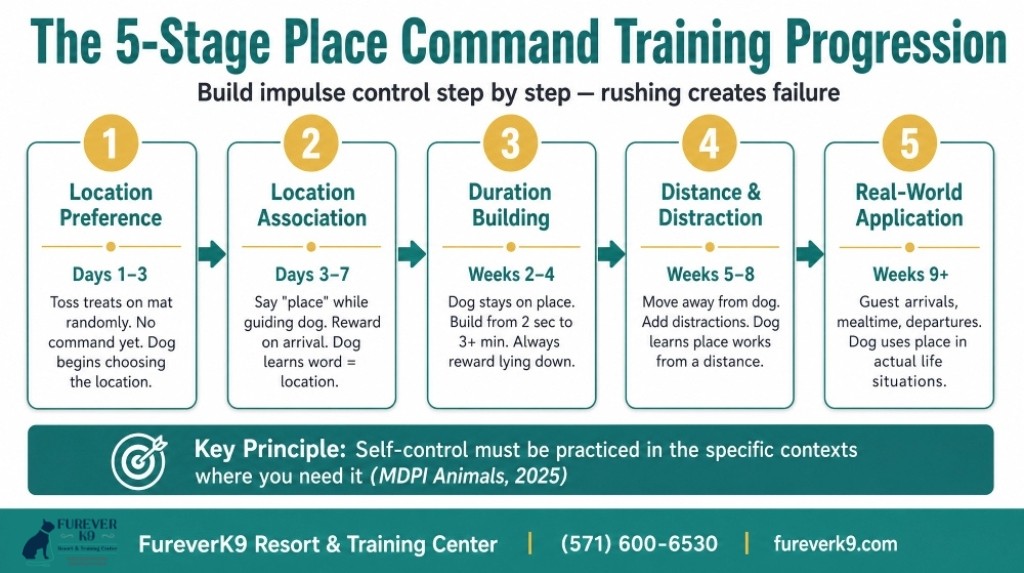
Understanding each step explains why progression matters.

Stage 1: Location Preference (Days 1-3)

The goal is for the dog to learn that the place is a great location to hang out. Choose a designated place (mat, bed, cushion) and place it in a low-traffic area where the dog can see you. Leave treats on it throughout the day. Do not start formal training yet; just allow exploration. Throughout the day, casually toss treats on the place. The dog naturally gravitates to it, learning that the place means treats appear randomly. Do not use a command word yet. The dog begins to choose the location independently.
 

Stage 2: Location Association (Days 3-7)

The goal is for the dog to learn that the word “place” means “go to that location.” With the dog on a leash in a training area without distractions, say “place” while lightly guiding the dog to the location. When the dog steps on the place, immediately reward with a treat and praise. The dog eats the treat and naturally leaves. Repeat this 5-10 times per session, 2-3 sessions daily. You are teaching clear cause and effect: the word “place” means go to the location, and going to the place means a reward comes. Success is when the dog goes to the place consistently when you say the word, without needing a lure.
 

Stage 3: Duration Building (Weeks 2-4)

The goal is for the dog to learn to stay on the place, not just go to it. With the dog lying down on the place, give a treat. Wait 2 seconds before rewarding again, saying “good place.” Gradually increase the duration: 2 seconds, then 5 seconds, then 10 seconds, then 30 seconds. It is critical that the dog is lying down, as this activates the calm nervous system. Always reward lying down, not just standing. Rushing creates failure; slow progression builds a solid foundation. Success is when the dog stays on the place for 3 or more minutes calmly and lies down without being asked.
 

Stage 4: Distance and Distraction (Weeks 5-8)

The goal is for the dog to learn that the command works even when the owner moves away and distractions exist. For distance, have the dog on place, step 1 foot away, wait 10 seconds, return, and reward. Gradually increase the distance over multiple sessions. For distractions, start with minor ones like gentle talking, then gradually increase to doors closing or opening a treat bag. Reward heavily for staying on place. The dog learns that staying on place is more rewarding than reacting to the stimulus.
 

Stage 5: Real-World Application (Weeks 9+)

The goal is for the dog to use the command in real situations, which research confirms is necessary for self-control to generalize.
 
  • Guest Arrival: Before the doorbell rings, send the dog to place. When the guest enters, reward the dog frequently for staying. Once the dog is calm for 2 minutes, release them to greet.
  • Mealtime: Before food prep begins, send the dog to place. Reward occasionally during the meal. Release after the meal is finished.
  • Anxiety Management: When you notice the dog starting to pace, send them to place. Reward for staying calm.
  • Door Management: Before opening the door for packages or mail, send the dog to place.

Real Scenarios: Place Command Changing Behavior

Understanding the transformation explains why consistency matters.
 

Scenario 1: Guest Jumping

Before the place command, a guest arrives, the dog jumps immediately, the guest is knocked backward, and the dog is overstimulated. The dog is in a high-arousal state and has not learned to pause. With consistent enforcement of the place command, you send the dog to place before the doorbell rings. The dog lies down, the guest enters, and you reinforce heavily. The guest gets 2 minutes of a calm dog greeting. The result is no jumping, no chaos, a positive guest experience, and a calm, respectful dog.
 

Scenario 2: Counter Surfing During Meals

Before the place command, you are cooking, and the dog is circling the kitchen, jumping up, and stealing food. Every meal is a battle because the dog has not learned the kitchen boundary. With consistent enforcement, you send the dog to place outside the kitchen before cooking. You cook with the dog on place, giving occasional treats there. The dog learns that the place equals rewards during mealtime. The result is no counter surfing, no food stealing, and structure during a high-arousal time.
 

Scenario 3: Anxiety During Departures

Before the place command, you are about to leave, and the dog starts pacing, panting, and whining. The dog’s nervous system is unregulated, and arousal escalates unchecked. With consistent enforcement, you send the dog to place with a high-value treat before you leave. You practice this repeatedly while still home so the place remains safe and positive. Over time, the place becomes a container for anxiety, and the dog’s nervous system learns to regulate. Departures become calm and structured, and anxiety decreases significantly.
 

Place Command at FureverK9

Whether it is , , or at FureverK9, the place command is foundational. I prioritize it because it teaches impulse control, establishes boundaries, solves multiple behavior problems simultaneously, and builds pack leadership. I can teach a dog to sit, down, or stay in isolation, but if the dog does not have impulse control, none of that matters in real life.
 
In our Board & Train program at 20690 Gleedsville Road, the command is built systematically through all 5 stages in a controlled environment. In Private Lessons, I coach you on progression in your home, addressing specific problems like jumping and anxiety. In Group Classes, dogs practice the command around other dogs and people, building proof in distracting environments.
 
Loudoun County is full of busy homes where boundaries matter. When owners in Leesburg and Northern Virginia commit to place command training, jumping stops, anxiety decreases, family life becomes peaceful, and owners feel leadership confidence.
 
Ready to build impulse control? Contact at (571) 600-6530 or visit us at 20690 Gleedsville Road, Leesburg, VA 20175. The place command changes everything, but only if you are consistent.

FAQs

With consistent daily practice (15-20 minutes per day), most dogs have a basic understanding within 2-3 weeks. However, “reliable” in all situations (with distractions, from a distance, real-world scenarios) typically takes 6-8 weeks. Some dogs take longer depending on their prior habits.

Adult dogs learn the place command just as well as puppies, sometimes better, due to better focus and longer attention spans. However, adult dogs may have more ingrained habits to overcome. The command itself is not harder for adults; consistent owner enforcement is the variable. Age is not the limiting factor; consistency is.

Your dog has not reached Stage 5 (real-world application). They need more Stage 4 practice (distance and distraction) before introducing real guests. Build duration and distance first. Once they are solid in Stage 4, introduce a very calm first guest and heavily reward the dog for staying. Do not rush real-world application.

Dogs do not generalize locations automatically. The place command learned in your living room does not automatically mean the place command in a park. You need to teach place in different locations gradually. Each new location is a new training location. Once solid in multiple locations, the dog understands the command transfers everywhere

True impulse control means the dog makes good choices even when you are not directing them. Early on, the dog obeys the command. True impulse control is when a guest arrives or the doorbell rings, and the dog independently goes to their place without being told. The goal is for the place command to become the dog’s chosen strategy during arousal.

Share this Success Story!

I know I need help!!!

Let Lauren know what you're struggling with!
She'll get in touch with you to discuss options!