


- The Problem: Your dog responds to “come” perfectly at home, but ignores you at the park. You assume they are being defiant, but they are actually responding to context-specific learning.
- The Reality: Knowing the command and reliably responding to the command are completely different things. Most owners inadvertently teach their dogs that recall is optional by calling when they cannot enforce compliance.
- The Solution: Never call a recall you cannot enforce. Every single call must result in compliance, building a history where the dog learns that “come” is a non-negotiable expectation.
- The Science: Professional trainers recognize “learned irrelevance”—when a cue becomes meaningless because it is overused without enforcement. Reliable recall requires 100% compliance across progressive stages of distraction.
- The Bottom Line: You teach reliability not through perfecting your training technique, but through perfect consistency in enforcement.
What Actually Makes Recall “Reliable”?
Why “Trained” Recall Isn’t the Same As “Reliable” Recall
Feature | Trained Recall | Reliable Recall |
Environment | Works at home, in quiet areas, with minimal distractions | Works across all contexts, including parks and high-distraction areas |
Arousal Level | Breaks down when the dog is highly aroused or excited | Works consistently regardless of the dog’s arousal level |
Consistency | Sometimes works, sometimes does not | Works consistently in unpredictable situations |
Dog’s Mindset | Dog makes a choice: “How interesting is what I’m doing vs. coming?” | Dog has learned: “Come” is non-negotiable and always happens |
Result | You hope they will come | You know they will come |
Why Context-Specific Learning Breaks Recall
What Teaches Unreliable Recall (Accidentally)
The Critical Principle: Never Call A Recall You Can’t Enforce
How Dogs Learn Reliable Recall
Why Repetition Alone Doesn’t Create Reliability
Building Recall Through Progression Stages
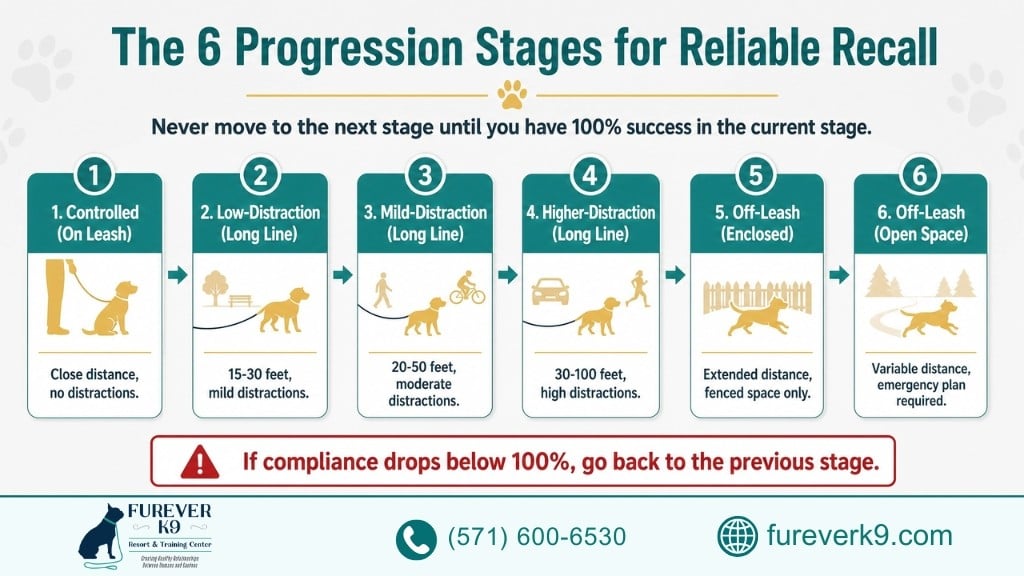
Stage 1: Training in a Controlled Environment (On Leash)
Begin with the dog on a leash at a close distance of just a few feet, with absolutely no distractions. The goal is for the dog to learn that “come” reliably results in treats and attention. You must maintain 100% success in this context before moving forward.
Stage 2: Training in a Low-Distraction Environment (Long Line)
Move to a moderate distance of 15 to 30 feet using a long line. Introduce mild distractions, such as normal household sounds or people being present. The dog learns that the command works across a distance, and you still enforce it if they hesitate.
Stage 3: Training in a Mild-Distraction Environment (Long Line)
Extend the distance to 20 to 50 feet, still utilizing the long line. Introduce moderate distractions, such as other dogs at a significant distance or activity happening nearby. The dog learns that recall is mandatory even when interesting things are happening nearby.
Stage 4: Training in a Higher-Distraction Environment (Long Line)
Extend the distance further, from 30 to 100 feet. Introduce moderate to high distractions, such as other dogs playing, activities, or interesting smells. The goal is for the dog to learn that reliability must increase despite their increased arousal levels. The long line remains attached for immediate enforcement.
Stage 5: Off-Leash Training (Enclosed Space)
Work at an extended distance with moderate distractions, but only within a completely enclosed, fenced space. If the dog does not come, you must be able to safely retrieve them. The dog learns that “come” means come, even without physical restraint.
Stage 6: Off-Leash Training (Open Space With Exit Management)
This final stage involves variable distances and high distractions. It requires strategic positioning and an emergency plan. The goal is for the dog to reliably come in real-world situations. This stage is only appropriate when reliability has been genuinely proven over months of practice.
What Happens When Your Dog Doesn’t Come
The Correct Response When Your Dog Ignores You
Why Punishment Doesn’t Create Reliability
Building True Off-Leash Reliability
When Is Recall Actually Reliable Enough for Off-Leash?
Red Flags: When Your Dog Should NOT Be Off-Leash
How Furever K9 Approaches Recall Training
Our Assessment-First Approach
Our Training Services for Recall
FAQs
Your dog has learned that “come” is optional because sometimes ignoring you works and sometimes it does not. This is context-specific learning; your dog is evaluating whether coming to you is worth more than staying where they are. To build reliability, you must teach that “come” is always non-negotiable by ensuring every single call results in compliance, requiring perfect consistency from you.
While a basic trained recall might take four to eight weeks, a truly reliable recall—where the dog comes 100% of the time across all contexts—typically takes three to six months minimum of perfect consistency. The timeline is determined by achieving a 100% compliance history; if you call, the dog ignores, and you do not enforce it, your training timer essentially resets.
If your dog is too distracted, they are not ready for that context, and you have moved through the progression stages too quickly. The solution is to go back to a lower-distraction context, rebuild the foundation, and progress more slowly using a long line for enforcement until reliability is proven.
Yes, high-value treats are essential, but the real reward is the freedom to continue their activity after compliance. The dog learns that they get a treat and get to continue enjoying what they were doing, reinforcing the expectation that “come” is a mandatory rule, not just an option weighed against the value of a treat.
This is context-specific learning; your dog has learned that “come” at home means compliance is enforced, while “come” at the park means it is open to negotiation. You must use the park as a training ground with a long line attached so you can enforce the command 100% of the time until the reliability transfers to the new environment.