The Bottom Line on Choosing a Dog Trainer
- The Problem: Many owners evaluate trainers based on methods, credentials, or promises of quick fixes, leading to short-term compliance but unresolved behavioral issues.
- The Reality: A trainer’s philosophy—their understanding of dog psychology, behavior causation, and the nervous system—matters significantly more than the specific techniques they use.
- The Solution: You need a psychology-based trainer who asks “Why is this behavior happening?” rather than a technique-focused trainer who asks “How do I stop this behavior?”
- The Science: The American Veterinary Society of Animal Behavior (AVSAB) and peer-reviewed research confirm that positive reinforcement training is safer, more effective, and less stressful than aversive methods.
- The Bottom Line: A good trainer does not just teach your dog commands; they help you understand your dog’s behavior and address the root causes of their actions. One client who has worked with Lauren on three very different dogs said she customizes her approach to each dog.
You have tried three different dog trainers. One taught your dog to sit on command but did not address the jumping on guests. Another used clicker training, and your dog learned tricks but still pulled on the leash and reacted to other dogs. A third promised quick fixes, and your dog momentarily improved, then reverted to old patterns. You are frustrated, confused, and starting to think your dog is “just difficult” or “broken.”
Here is what most dog owners do not understand about choosing a trainer: you are looking at the wrong things. You are evaluating training methods, credentials, certifications, and costs. You are asking, “Do they use clicker training?” and “How much do group classes cost?” But what you should be asking is: “Do they understand why my dog behaves this way?”
I am Lauren White, and at Furever K9 Resort & Training Center in Leesburg, Virginia, I have worked with frustrated owners who have cycled through multiple trainers without real results. The distinction they eventually realize is critical. Training methods are just tools. Training philosophy—understanding dog psychology, behavior, and the nervous system—is what actually creates lasting change.
The difference between a trainer who teaches commands and a trainer who actually solves behavioral problems is fundamental. One is mechanical. One is psychological. Most trainers focus on the first, but the best ones understand the second. You do not need a trainer who knows fancy techniques. You need a trainer who understands why your dog barks, why they pull, why they are anxious, and why they react. Once that understanding is established, the training method is simply the execution.
The transformation I see when owners find trainers who understand behavioral causation rather than just command-teaching is remarkable. Dogs that have been “trained” multiple times finally change because someone understood the actual problem. Owners are amazed that addressing the root cause works so much better than simply training skills. A good trainer does not fix dogs. A good trainer understands dogs. That is the difference.
What Most People Get Wrong About Choosing a Trainer
Understanding common misconceptions helps you evaluate trainers more effectively and avoid wasting time and money on approaches that will not yield long-term results.
Why Credentials Alone Don’t Guarantee Results
Many owners assume a certified trainer automatically equals a good trainer. Certification matters, but it is not the whole picture. A trainer can hold every credential and still not understand your specific dog’s psychology. Certifications typically verify a trainer’s knowledge of general training techniques, adherence to professional standards, and ethical commitments. However, they do not verify an understanding of individual dog psychology, the ability to identify root causes of behavior, or effectiveness with complex cases involving the nervous system.
A certified trainer following a standardized curriculum might teach your dog to “sit” beautifully but have no idea why your dog is anxious, reactive, or aggressive. They are teaching commands, not solving problems.
Why “Quick Fix” Methods Often Fail
When your dog is jumping on guests or pulling on the leash, you want it fixed immediately. You want a trainer promising, “Your dog will stop jumping in two weeks!” This is appealing but usually indicates a profound misunderstanding of behavior. Jumping on guests is not a command problem; it is an impulse control and excitement management problem. Training a “sit” command might make it look like the jumping is fixed for a few weeks, but it inevitably returns because you never addressed why the dog jumps—excitement, lack of impulse control, or arousal dysregulation.
Real behavioral change takes understanding the root cause, addressing that cause through impulse control training and arousal management, consistent practice, owner follow-through, and time for the behavior to actually change neurologically. If a trainer promises quick fixes, they do not understand behavior. Behavior change takes time because it is neurological and habitual. Quick fixes are often punishment-based, suppressing the behavior through fear rather than addressing the causation.
Why Training Method Matters Less Than Trainer Understanding
Owners often ask, “Do you use clicker training, marker training, or balanced training?” as if the method itself is the key. It is not. A great trainer using any reasonable, positive reinforcement-based method can achieve results. A poor trainer using the same method will not. The difference is not the tool; it is the person wielding it.
What actually matters is whether the trainer understands dog psychology, can identify why your dog behaves that way, addresses the root cause rather than suppressing symptoms, and adjusts their approach based on the individual dog. For example, two trainers might both use positive reinforcement.
One trains your reactive dog to sit when other dogs appear. Another works with your reactive dog on building confidence, desensitizing to distance, teaching calm responses, and addressing the underlying fear driving the reactivity. It is the same method, but vastly different understanding and results. The second trainer understands that reactivity is fear-based, not dominance-based, and that insight changes everything about the training approach and outcomes.
What Actually Makes a Dog Trainer Good
Understanding the distinction between technique-focused and psychology-based training explains why outcomes differ so dramatically.
Technique vs. Psychology-Based Training
At Furever K9, we start with understanding. Why is your dog jumping? Is it excitement indicating an impulse control issue? Is it anxiety pointing to nervous system dysregulation? Is it attention-seeking as a learned behavior? Each reason requires a fundamentally different training approach.
What Questions Actually Matter When Evaluating Trainers
Instead of asking what certifications they have, ask: “How do you assess why a dog has behavioral problems? What is your process for understanding the root cause?”
Instead of asking if they use clicker training, ask: “Can you explain your training philosophy? Why do you approach behavior the way you do? Can you give me an example of a dog with a specific problem and how you would address it?”
Instead of asking to see their credentials, ask: “Tell me about your experience with dogs like mine. How would you approach my dog’s specific issues, and why would that approach work?”
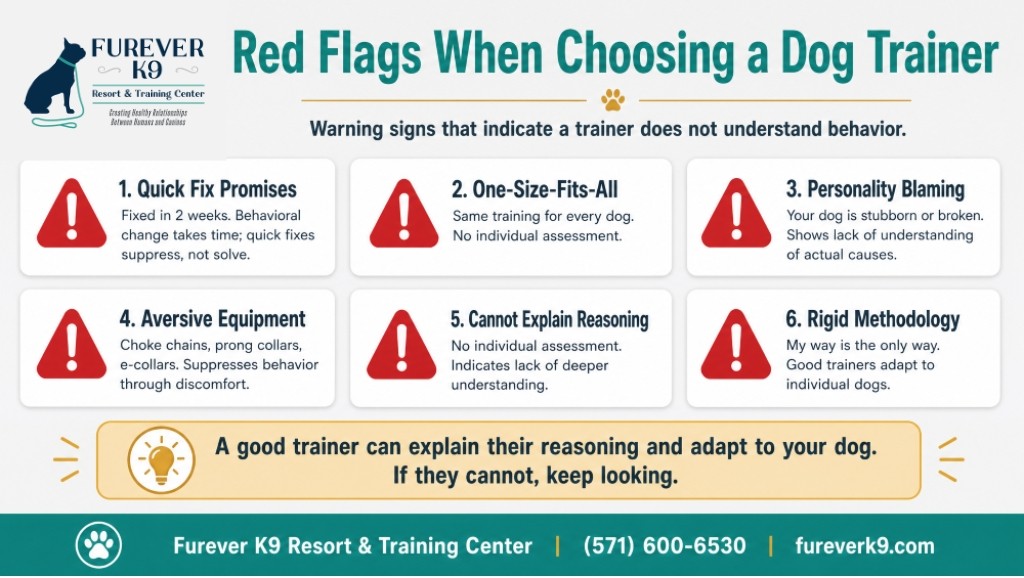
Good answers will involve the trainer explaining their reasoning, asking questions about your dog’s history and triggers, discussing individual differences, and explaining why behavior happens rather than just what to do about it. Red flags include trainers who use the same method for every dog, promise quick fixes, or talk about dog personality flaws—like calling a dog “stubborn”—without addressing causation.
Why Positive Reinforcement Philosophy Matters
Positive reinforcement means rewarding the behavior you want to increase. This approach is backed by decades of behavioral science. It works because dogs repeat behaviors that result in good outcomes, learning is faster and more reliable, the relationship stays positive, and the dog’s nervous system stays regulated.
When a trainer uses a positive reinforcement philosophy, your dog develops confidence rather than fear-based obedience. The dog actually understands what is expected, the training transfers to real-world situations, and the behavior is maintained because the dog understands, not because the dog is afraid.
Conversely, some trainers use aversive methods involving punishment, discomfort, or fear-based training. This might suppress behavior in the short term, but it causes dogs to become fearful or anxious. The behavior often returns when the consequence is not present, the owner-dog relationship deteriorates, and the underlying issues are never addressed.
The American Veterinary Society of Animal Behavior (AVSAB) explicitly recommends that only reward-based training methods be used for all dog training, including the treatment of behavior problems . Furthermore, peer-reviewed research published in PLOS ONE demonstrates that dogs trained with aversive stimuli display more stress behaviors, show higher elevations in cortisol levels, and are more “pessimistic” than dogs trained with reward methods .
At Furever K9 we use a balanced, relationship-based approach. We reward the behavior we want and give clear, fair guidance when a dog needs it, so dogs learn to trust and listen. We believe dogs learn best through understanding and reward, not fear.
How to Assess Trainer Compatibility With Your Dog’s Needs