What Your Dog’s Barking, Growling, and Whining Actually Mean
Author picture

What Your Dog’s Barking, Growling, and Whining Actually Mean

Understand what your dog's barks, growls, whines really mean. Expert guide to dog communication and training solutions. FureverK9 Leesburg. (571) 600-6530.
 
The Bottom Line on Dog Vocalizations
  • The Reality: Vocalizations are communication. Dogs use sounds to express emotional states, regulate arousal, seek attention, and warn of perceived threats.
  • The Solution: You must address the underlying reason for the sound. Anxiety requires management, attention-seeking requires consistent ignoring, and warnings require respect and space.
  • The Warning: Never punish a growl. A growl is a critical warning signal; punishing it teaches the dog to skip the warning and bite without notice.
  • The Bottom Line: Transforming your dog’s behavior requires shifting from “make my dog stop making sounds” to “understand what my dog is communicating and resolve the issue.”
 
Your dog barks relentlessly at the window. You tell them “quiet,” and they pause for two seconds before barking again. You wonder if they are hyperactive, anxious, territorial, or simply trying to tell you something important. The frustration mounts because you cannot seem to stop the noise. It is confusing because sometimes your dog barks when they are happy, sometimes when they are scared, and sometimes because they want to go outside. How are you supposed to know what your dog actually needs?
 
Here is what most owners do not understand about canine vocalizations: your dog is not making noise randomly. They are communicating something specific—excitement, anxiety, territory awareness, attention-seeking, or an actual physical need. The bark itself might sound identical, but the reason behind it and the appropriate response depend entirely on the context.
 
I am Lauren White, and at Furever K9 Resort & Training Center in Leesburg, Virginia, I help dog owners understand what their dogs are actually saying through barks, growls, and whines. True behavioral transformation happens when owners stop trying to suppress the sound and start understanding the reason for the sound.
 
Consider the dog barking obsessively at the window. This is usually a combination of excitement-arousal and barrier frustration. What about the dog growling when you approach their toy? This is not necessarily aggression; it could be resource guarding, fear, or even play. And the dog whining constantly? That is often attention-seeking (a learned behavior because it works), anxiety (nervous system dysregulation), or an actual need, such as needing to eliminate or experiencing pain.
 
Understanding what your dog is communicating changes everything about how you train and determines what solutions will actually work. Your dog’s vocalizations have distinct reasons. Finding those reasons is how you fix the problem.

What Is Your Dog Actually Saying?

Understanding dog communication requires listening to the context, not just the sound itself. Recent ethological studies have demonstrated that dogs have a broad and sophisticated vocal repertoire, and their barks carry specific, context-related acoustic features .
 

Why Do Dogs Vocalize?

Dogs vocalize for specific, identifiable purposes. They communicate their emotional state, expressing excitement, anxiety, fear, or joy. Different emotions produce different-sounding vocalizations, and your response teaches your dog whether that sound “works.”
 
Vocalization is also used for arousal regulation. Dogs use barking, whining, and growling to manage internal arousal levels, helping to discharge anxiety or excitement. Preventing the vocalization without addressing the underlying arousal only creates more dysregulation.
 
Attention acquisition is another major driver. A dog quickly learns the pattern: “I vocalize, and the human responds.” If barking gets you to look at them, feed them, play with them, or even yell at them, the barking has worked. Most “excessive” barking is actually learned attention-seeking behavior reinforced by the owner’s response.
 
Dogs also vocalize to communicate territory and safety. Barking alerts the pack to a perceived threat or boundary intrusion. This can be appropriate and protective, or it can be an anxious overreaction to normal stimuli. Similarly, growling communicates a clear boundary: “stay away from this resource or space.”
Finally, dogs vocalize to communicate actual needs. Whining often indicates an unmet need requiring owner action, such as needing to go outside, feeling uncomfortable, or experiencing pain. Barking at a door usually means they need something on the other side of that door.
 
The critical understanding is this: your response to your dog’s vocalization teaches your dog whether that vocalization is effective. If barking gets attention—whether positive or negative—the barking will increase. If barking is consistently ignored and not rewarded, it will decrease. The sound itself is not the problem; the reason for the sound and your reinforcement of it are the true issues.
 

What Different Barks Actually Mean

While context matters more than sound quality, knowing sound patterns helps identify the underlying emotion. Research shows that dogs can distinguish between different types of barks and the specific contexts in which they are produced .
Bark Type
Acoustic Characteristics
Typical Meaning
Context & Body Language
Excitement/Alert
Sharp, high-pitched, single or rapid
“Something interesting happened!”
Loose posture, play bow, wagging tail. Generally not threatening.
Warning/Territory
Deep, sustained, harsher tone
“This is my space; I am alerting to an intrusion.”
Stiff body, tense posture, defensive stance. Can escalate.
Anxiety/Frustration
Repetitive, rapid strings of barks
“I am aroused and cannot regulate my nervous system.”
Barrier frustration at a window or confinement anxiety in a crate.
Fear/Guarding
Lower-pitched, sustained growling barks
“Do not approach; I am uncomfortable.”
Requires careful assessment. Never use punishment-based training.
The same dog can produce a similar-sounding bark that carries entirely different meanings depending on the context. Barking at the window when you are leaving indicates anxiety arousal. Barking at the window when they are excited by outside activity is excitement arousal. Barking at the door when you are home is attention-seeking, but barking at the door when someone knocks is an alert or protection response.
 
Understanding the context—including body language, triggers, and subsequent events—matters far more than simply categorizing the sound.
 

How Does Your Response to Barking Teach Your Dog?

Understanding the reinforcement cycle explains why simply suppressing the sound without addressing the reason never works.
 

The Reinforcement Cycle

If you respond to barking with attention—even negative attention like yelling, telling them to stop, or just looking at them—your dog learns that barking works. The human responded. Therefore, barking increases because it is an effective strategy.
 
If you respond by granting access—opening a door, feeding, playing, or petting—your dog learns that barking gets them exactly what they want. Barking becomes their primary strategy for making requests, and the frequency increases because it succeeds.
 
However, if you respond by consistently ignoring the barking every single time, your dog learns that barking does not work. The behavior gradually decreases as it becomes ineffective. This requires an extinction burst—a brief, intense increase in barking before it finally decreases. Unfortunately, most owners quit ignoring the behavior before the extinction phase kicks in.
 
This is exactly why just telling your dog to be quiet fails. When a dog barks and the owner yells “quiet,” the dog might stop momentarily out of surprise. If the owner then praises them, the dog learns that barking leads to yelling, which leads to attention. Alternatively, if the owner just yells louder when the dog barks again, the dog learns that barking equals human yelling, which equals human attention. The barking persists or increases.
 
Anxiety-arousal barking, such as fear or window-watching, cannot be fixed by telling the dog to be quiet. Their nervous system is activated. Your dog is not choosing to bark; they are experiencing arousal they are trying to discharge through vocalization. Attention-seeking barking is fixed through consistent ignoring. Communication barking for an actual need is fixed by addressing the need, not by suppressing the vocalization.

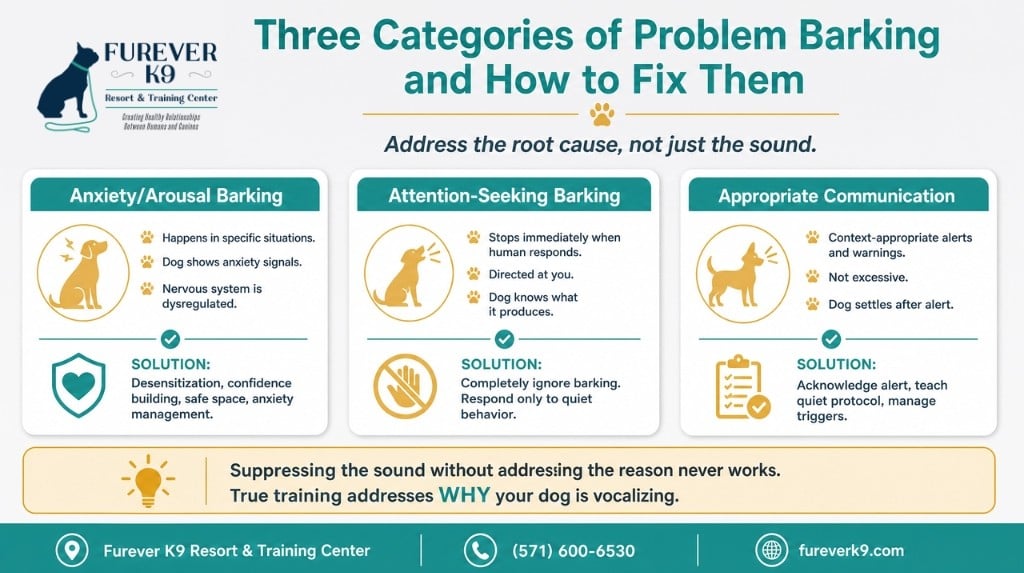
Distinguishing the Three Categories of Problem Barking

At Furever K9, we assess which category your dog’s barking falls into because the training approach depends entirely on the root cause.
infographics about dog barking and vocalizations

Category 1: Anxiety and Arousal-Driven Barking

This occurs in specific situations, such as watching out a window, being in a crate, being left alone, or during storms. The dog shows anxiety signals like panting, pacing, and an inability to settle. The barking is often repetitive and escalating, and the dog cannot stop even when told to because their nervous system is fully activated.
 
This happens because the nervous system is dysregulated by anxiety, fear, or excitement. Barking helps discharge that arousal. It is an involuntary nervous system response, not a chosen behavior.
The appropriate training involves addressing the underlying anxiety through desensitization, confidence building, and establishing a routine. You must create a calm environment and a safe space. Punishment or yelling will only increase the anxiety.
 

Category 2: Attention-Seeking Barking

This type of barking stops immediately when the human responds. It is often directed at you, with the dog making direct eye contact. It happens when the dog wants attention, wants to go outside, or wants their meal. The dog knows exactly what the barking produces.
 
This happens because the dog has learned that barking works. Human responses have taught them that barking is effective communication, so they continue because it succeeds.
 
The appropriate training requires completely ignoring the barking. Offer no eye contact, no talking, and no response whatsoever. You must respond only to quiet behavior, providing attention only when the dog is silent. Identify their actual needs and address them on your schedule, not on the dog’s barking schedule.
 

Category 3: Appropriate Communication Barking

This barking serves a communicative purpose, such as alerting, warning, or marking a boundary. It is context-appropriate, such as barking at an intruder or an unusual stimulus. It is not excessive or repetitive, and the dog settles once the alert is given or the stimulus passes.
 
This happens because it is normal dog communication and a protective instinct. They are alerting the family to something noteworthy.
 
The appropriate response is to acknowledge the alert. Allow brief barking, then redirect the dog. Teach a “thank you for the alert, now quiet” protocol. This is not a problem requiring elimination; it simply requires management.

What Does Growling Actually Mean?

Understanding growling prevents misinterpretation and dangerous responses. Growling is not always aggression; it is communication that can mean multiple things. Research indicates that dogs can accurately assess the size of another dog by listening to its growl, and they discriminate between growls produced in different contexts .
 

Types of Growling

Playful Growling: This occurs during play, wrestling, or tug-of-war. It is accompanied by play bows, a loose body, and a wagging tail. It is bidirectional, meaning both you and the dog are engaged. The context is fun, not a threat.
 
Resource Guarding: This occurs when a dog has a valued resource, like food, a toy, or a location. They are communicating, “Do not take this from me.” It is accompanied by a stiff body, a hard stare, and a forward posture. This can escalate if the warning is ignored.
 
Fear or Defensive Growling: The dog is uncomfortable and warning you before escalating. They are saying, “You are too close to something I am uncomfortable about.” It is accompanied by a tense body, pinned ears, and sometimes a lip curl. If the warning is ignored, it can escalate to a bite.
 
Territorial Growling: This is a warning about boundaries or protection. It is accompanied by stiff posture, forward orientation, and a sustained growl. It can escalate if provoked.
 
Pain Growling: A dog experiencing pain will growl when touched or moved. It is accompanied by tension and a reluctance to move. This requires immediate veterinary evaluation.
 

The Danger of Punishing a Growl

You must never punish a growl. Punishing a growl suppresses the warning, which drastically increases the risk of a bite. A growl is communication; the dog is saying, “I am uncomfortable, and I am warning you before I escalate.” Punishing that warning teaches the dog that warnings do not work, so they will skip straight to biting next time. You lose the critical signal that the dog is escalating. Instead, respect the growl as communication, move away from the trigger, and address the underlying issue through professional training.
 

What Does Whining Actually Indicate?

Understanding whining helps you respond to an actual need versus a learned behavior. Dogs whine to indicate physical needs (potty, hunger, water), pain or medical issues, anxiety and stress (such as separation anxiety), attention-seeking, or extreme excitement and arousal.
 
If the whining is based on an actual need, identify it and address it on your schedule, not immediately in response to the whine. If it is attention-seeking, ignore it completely and wait for silence before responding. If it is driven by anxiety, do not comfort the dog, as this reinforces the fear; instead, address the underlying anxiety through desensitization. If you suspect pain, seek immediate veterinary care.
 

Furever K9’s Approach to Vocalization Training

At Furever K9, our approach prioritizes understanding communication over suppressing sound. We begin with a comprehensive assessment to identify the type of vocalization, understand what the dog is communicating, rule out medical issues, and assess the context and triggers.
 
We then implement root-cause training. For anxiety barking, we focus on nervous system regulation and confidence building. For attention-seeking barking, we enforce consistent ignoring and teach alternative communication. For growling and resource guarding, we teach trade protocols and never use punishment.
Suppressing the sound without addressing the reason simply does not work. Our training addresses why your dog is vocalizing. The result is a dog who is calm because the underlying issue is resolved, not a dog who is quiet because they are afraid to make a sound.
 
Whether you need to coach you on specific protocols, in a controlled environment, an immersive program, or for socialization, we create customized training plans based on your dog’s specific needs.
 
Your dog’s vocalizations are not random noise. They are communicating. You just need to learn their language.

FAQs

Need-based barking is context-specific and stops when the need is met, such as barking at an empty food bowl. Attention-seeking barking is directed at you, stops immediately when you respond, and happens even when all physical needs are met.

Never punish a growl. Punishing a growl suppresses the warning signal, teaching the dog to skip the warning and bite without notice; instead, respect the communication and address the underlying issue.

Yelling “stop” provides attention, and even negative attention reinforces the behavior. Furthermore, your yelling increases their arousal, making their nervous system more dysregulated and increasing the barking.

It is usually a symptom of an underlying issue, such as anxiety, learned attention-seeking, or a lack of enrichment. Identifying and addressing the root cause, rather than just the barking itself, is the key to resolution.

Yes, through desensitization and teaching an “alert and quiet” protocol. You acknowledge the alert, then require the dog to settle, rather than allowing the doorbell to trigger chaos.

Share this Success Story!

I know I need help!!!

Let Lauren know what you're struggling with!
She'll get in touch with you to discuss options!