

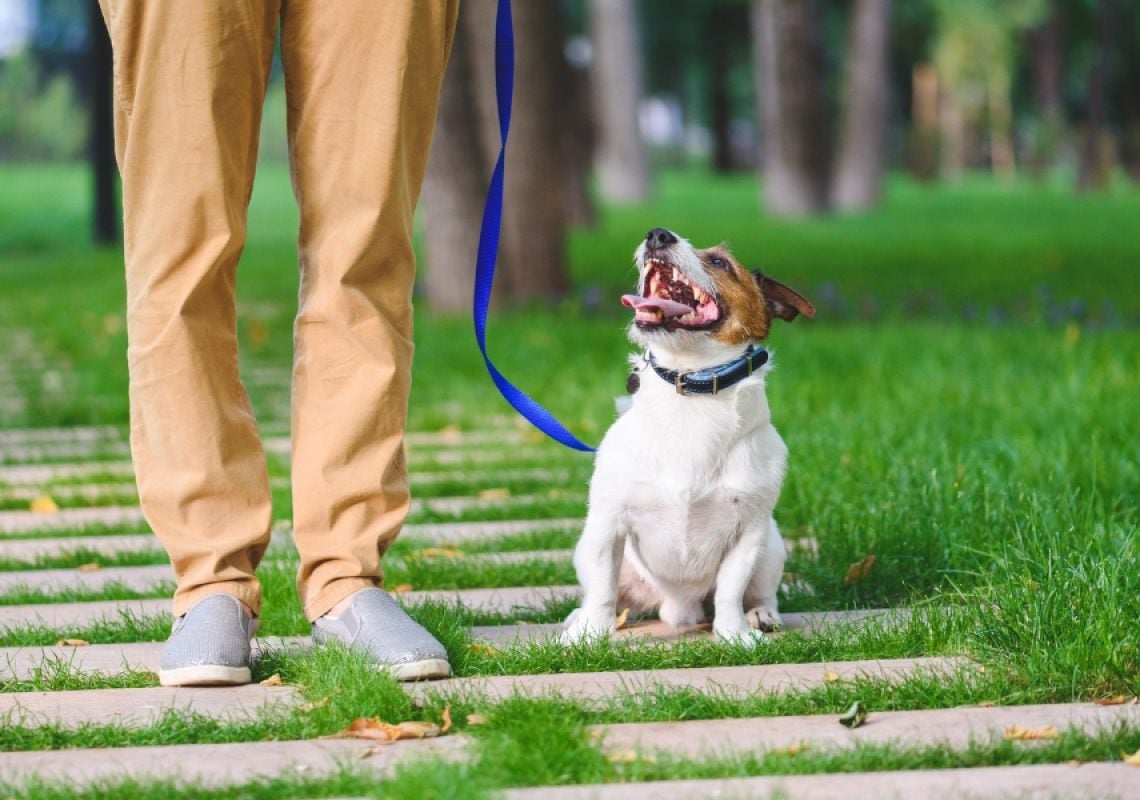
Small terrier sitting on a leash beside its owner in a park, barking and reacting to distractions during outdoor dog training.
Author picture

Why Your Dog Obeys at Home But Not in Public: The Truth About Training Generalization

Learn why your dog obeys perfectly at home but ignores you in public. Expert training generalization strategies from FureverK9 in Loudoun County. Call (571) 600-6530.
Your dog is perfect at home. They sit immediately when you ask. They stay for five minutes. They come every single time you call. You’re so proud of your training progress. Then you take them to the park, and they act like they’ve never heard the word “sit” in their entire life. They ignore you completely, pull on the leash, and won’t come when called. You’re mortified, frustrated, and starting to think your dog is deliberately making you look incompetent.
 
Here’s what confused dog owners don’t understand about training: Your dog isn’t being stubborn, rebellious, or trying to embarrass you. They genuinely don’t understand that “sit” in your living room means the same thing as “sit” at the park. Dogs don’t automatically generalize behaviors across environments—they learn context-specifically. What they’ve mastered in one location might be completely unknown in another.
 
I’m Lauren White, and at Furever K9 Resort & Training Center in Leesburg, Virginia, I watch Loudoun County families make this mistake constantly. They train extensively at home, then expect their dog to perform identically everywhere else without ever practicing in those environments. When the dog fails, owners blame the dog rather than recognizing they skipped the crucial step: proofing.
 
Proofing—teaching your dog to generalize trained behaviors across different locations, distractions, and contexts—is the most commonly skipped phase of training. It’s also the phase that determines whether your training works in real life or only in your living room.

Why Doesn’t Training at Home Transfer to Other Places?

Understanding how dogs learn helps you realize why home training doesn’t automatically work everywhere.
 

What Is Context-Specific Learning in Dogs?

According to , dogs associate behaviors with the entire context in which they learned them—location, time of day, your position, your clothing, environmental stimuli, everything. When you teach “sit” in your kitchen, your dog learns: “In the kitchen, when Mom stands in front of me wearing pajamas in the morning with treats in her hand and it’s quiet, sitting earns treats.”
 
They don’t learn the abstract concept “sit means sit everywhere always.” They learn the specific situational version. Take away any element—change location to the park, change time to the afternoon, add distractions like other dogs—and your dog might not recognize the situation as one where sitting is expected.
 
This isn’t stupidity or stubbornness. It’s how dogs’ brains work. They’re context-dependent learners who excel at pattern recognition within specific situations but struggle with abstraction and across different environments.
 
Why This Matters:
  • Your dog’s “perfect” sit at home isn’t really trained until it works everywhere.
  • Each new environment requires explicit training, not just expectation.
  • Difficulty level increases dramatically with environmental changes.
  • What seems like one behavior to you is many different behaviors to your dog.
At Furever K9, our explicitly teach generalization because we’ve learned that owners who skip proofing waste all their home training effort the moment they leave the house.
 

Why Do Distractions Destroy Trained Behaviors?
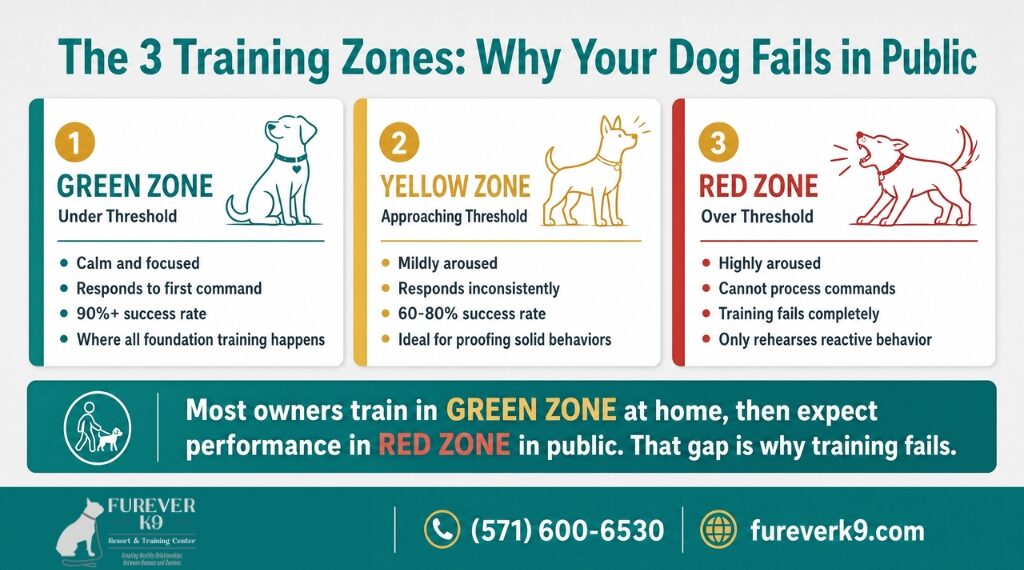
generalization infographics
At home during training, your dog’s arousal and distraction levels are minimal. They’re calm, focused, and able to think clearly. Commands work because your dog is mentally available to process and respond.
 
In public, arousal skyrockets from exciting stimuli—other dogs, people, squirrels, novel smells, unexpected sounds. High arousal reduces your dog’s ability to think, process commands, and control impulses. The trained behavior isn’t forgotten; it’s neurologically inaccessible when arousal exceeds your dog’s ability to function.
 

The Three-Zone Model of Dog Training

Training Zone
Dog’s Mental State
Training Effectiveness
What You Should Do
Green Zone (Under Threshold)
Calm, focused, able to think and learn
Trained behaviors work reliably
Do all initial foundation training here
Yellow Zone (Approaching Threshold)
Mildly aroused but still able to respond with effort
Trained behaviors work inconsistently
Good zone for proofing once behaviors are solid in green
Red Zone (Over Threshold)
Highly aroused, reactive, unable to think clearly
Trained behaviors fail completely
Leave immediately. No learning happens here—only rehearsal of reactive behaviors
Most owners train in the green zone at home, then expect performance in the red zone at the park. When it fails, they blame the dog. The problem: you never trained in yellow zone conditions and attempted the red zone before your dog was ready.
 

What Role Does Handler Anxiety Play?

Your anxiety travels down the leash directly to your dog. When you anticipate your dog failing in public, you tense up. Your breathing changes. Your body language broadcasts “something bad is about to happen.” Your dog, who reads you constantly, absorbs your anxiety and becomes more aroused themselves.
 
This creates a self-fulfilling prophecy. You expect failure → you become anxious → your anxiety increases your dog’s arousal → arousal reduces their ability to respond → they fail → your expectation is confirmed. Breaking this cycle requires managing your own emotional state as carefully as you manage your dog’s training progression.
 

How Do You Actually Proof Training to Work Everywhere?

Effective proofing requires from easy to difficult across multiple variables.
 

The Correct Progression for Proofing Behaviors

1. Master at Home First: The behavior must be extremely reliable in a low-distraction home environment. The dog should respond immediately with a single cue. The success rate should be 90%+ before moving on.
2. Easy Outdoor Location: Choose a quiet outdoor space with minimal distractions (your backyard, an empty parking lot, a quiet neighborhood street). Practice all trained behaviors here. Expect regression—behaviors will be less reliable initially. Stay in the green zone.
 
3. Moderate Distraction Environment: Move to a slightly busier outdoor location (a neighborhood park during quiet times, a residential street with occasional people/dogs). Practice behaviors while managing arousal in the yellow zone. Increase reward value and frequency. Keep sessions short.
 
4. Challenging Environment: Only attempt busy locations (a busy park, downtown sidewalks, pet stores) after success in Steps 1-3. Use extremely high-value rewards and very short sessions focusing on success, not duration.
 
5. Maintenance Across All Environments: Continue practicing in various locations regularly. Don’t assume is permanent. Refresh in new locations throughout your dog’s life.
 
Critical Rule: Never skip steps. Each step must show 80%+ success before progressing to the next. Rushing through progression creates failures that undermine confidence.
 
Our teach you the exact progression for your specific dog and goals, preventing the common mistake of advancing too quickly through proofing stages.
 

How Do You Proof Against Specific Distractions?

Use the “Three D’s” of proofing:
 
  • Distance: Start with increased distance from distractions. A dog who can’t sit when another dog is 5 feet away might succeed at 50 feet. Gradually decrease distance as reliability improves.
  • Duration: Start with very short durations. A sit-stay might work for 3 seconds before working for 30. Build duration slowly.
  • Distraction Level: Start with mild distractions and progressively increase intensity (e.g., stationary person 30 feet away → walking person 20 feet away → running dog 10 feet away).
Critical Principle: Change only ONE variable at a time. If you increase the distraction level, decrease the duration and increase the distance. Changing multiple variables simultaneously sets your dog up for failure.
 

What Rewards Work for High-Distraction Environments?

 
Home training treats don’t work in high-distraction environments. Your dog’s regular kibble or basic biscuits can’t compete with the smell of another dog or the excitement of a squirrel. According to on training methods, using high-value rewards is crucial for learning efficiency.
 
Reward Value Hierarchy:
  • Low value: Kibble, basic dog treats, verbal praise
  • Medium value: Slightly better treats, cheese, hot dogs
  • High value: Real meat (chicken, steak, liver), string cheese
  • Highest value: Whatever YOUR specific dog values most (some dogs prefer play/toys over any food)
Use the highest-value rewards during initial proofing in new environments. The reward frequency should be very high (every correct response). As behavior becomes reliable in that environment, gradually reduce reward frequency.
 

What Are the Most Common Proofing Mistakes?

Understanding what doesn’t work prevents wasted time and frustration.
 

Why Does Repeating Commands Make Training Worse?

When your dog doesn’t respond to your first “sit” command at the park, what do you do? Most owners say “sit” again. Then “sit” again louder. Then “SIT!” with frustration. By the fifth “sit,” you’re angry, and your dog has learned they don’t actually need to respond to the first command.
 
The Command Inflation Problem:
  • Each repeated command without response trains your dog that commands are optional.
  • Dogs learn to wait for the “serious” version (the loud, frustrated one).
  • You’ve accidentally taught that five commands equal one actual command.
The Solution:
  • Give the command once in a calm, clear voice.
  • If there is no response within 2-3 seconds, physically help the dog into position (gently).
  • Reward the assisted position (less enthusiastically than a voluntary response).
  • If the dog can’t succeed even with help, the environment is too difficult—reduce the difficulty.
 

What Happens When You Skip Progression Steps?

Owners often jump from perfect kitchen performance to expecting reliability at the busy dog park. This massive difficulty leap sets up failure that damages both training and confidence.
 
The Confidence Erosion Cycle: Skip steps → dog fails → owner frustrated → dog anxious → performance worsens → owner more frustrated → relationship damaged.
 
The Success Building Cycle: Proper progression → dog succeeds → owner pleased → dog confident → performance improves → owner more consistent → relationship strengthened.
 
Every training session should end with success. If you’re failing repeatedly, you’ve progressed too quickly or the environment is too difficult. Go back to easier environments and rebuild success before advancing.
 

How Do You Know When Training Is Truly Proofed?

Recognizing genuine reliability prevents premature advancement and false confidence.
True Reliability Criteria:
 
  • Dog responds to the first command 90%+ of the time.
  • Response time is consistent (not slower with each difficulty increase).
  • Dog can perform in multiple different locations, not just one “trained” public space.
  • Performance holds under various weather conditions, times of day, and handler moods.
  • Dog recovers quickly from occasional failures without a complete breakdown.
Not Yet Reliable:
  • Dog responds “sometimes” or “usually but not always.”
  • Requires multiple commands or a louder/firmer voice.
  • Only works in specific practiced locations.
  • Falls apart in slightly novel or more difficult situations.
If you’re not confident your dog will respond, your dog isn’t confident they should respond. That lack of confidence indicates insufficient proofing.

When Should You Seek Professional Help with Proofing?

Some proofing challenges indicate you need expert guidance rather than more DIY attempts.
 
Signs You Need Professional Training Help:
  • Proofing Isn’t Working: You’ve followed the progression systematically for weeks, but the dog isn’t improving or is regressing.
  • Dog Shows Anxiety: Anxiety prevents learning. If your dog can’t get under threshold even in relatively easy environments, you need help.
  • You Can’t Identify Difficulty Levels: You’re unsure whether an environment is too easy, too hard, or appropriate, and you can’t read your dog’s body language.
  • You’re Reinforcing Wrong Behaviors: You don’t recognize subtle command inflation or other training errors.
Professional trainers help you identify appropriate progression, read your dog accurately, troubleshoot failures, and avoid common errors that undermine training.
 
At Furever K9, our establish foundation behaviors and begin the proofing process, but owners must continue proofing after handoff to maintain reliability in their specific environments and lifestyle contexts.
 
Your dog’s perfect home obedience that falls apart in public isn’t a training failure or a stubborn dog. It’s context-specific learning without generalization—the most common training gap owners don’t realize they have.
 
Understanding that dogs don’t automatically transfer learned behaviors across environments transforms how you approach training. You stop expecting miracles and start implementing systematic proofing that actually creates reliable real-world obedience.
 
At Furever K9, I help Loudoun County families bridge the gap between home training and real-world reliability through proper proofing progression. Your dog can be as reliable in public as they are at home—but only if you explicitly teach that generalization using .
 
Ready to stop making excuses for your dog’s public behavior and start creating actual reliability? Resort & Training Center at (571) 600-6530 or visit us at 20690 Gleedsville Road, Leesburg, VA 20175. Let’s proof your training so it actually works everywhere.

FAQs

Dogs are context-specific learners who associate behaviors with the exact environment where they learned them. They don’t automatically understand that “sit” at home means the same thing at the park. You must explicitly teach generalization through systematic proofing in progressively more difficult environments.

Basic commands in moderately distracting environments take 4-8 weeks of systematic proofing. Reliable obedience in highly distracting environments takes 3-6 months of progressive work, and rock-solid reliability everywhere requires 6-12 months of varied practice plus lifetime maintenance.

The biggest mistakes are jumping from home to highly distracting environments without intermediate steps and repeating commands when the dog doesn’t respond. Owners also frequently fail to use high-value rewards that can compete with environmental distractions.

No. If your dog doesn’t respond in public, the environment is too difficult or their arousal is too high to process commands. Corrections punish the dog for failing in situations where they weren’t properly prepared to succeed; instead, reduce the difficulty and rebuild success.

Train in the “green zone” where your dog is calm and responds within 2-3 seconds, and proof in the “yellow zone” where they are mildly aroused but can still respond with effort. Avoid the “red zone” where your dog cannot take treats or process commands entirely.

Share this Success Story!

I know I need help!!!

Let Lauren know what you're struggling with!
She'll get in touch with you to discuss options!