



Your dog never stops moving. They’re up at 5 AM demanding play. They sprint around the house for no reason. They can’t hold a sit for more than three seconds. They jump on everyone. After two hours at the dog park, they’re still bouncing off the walls. You’re exhausted just watching them, convinced something must be wrong. Everyone keeps telling you “it’s just a puppy” or “that’s the breed,” but you’re starting to wonder if your dog has canine ADHD.
Here’s what desperate owners of high-energy dogs don’t understand. True hyperactivity in dogs—actual ADHD-like disorder—is extremely rare. What most owners call “hyperactive” is actually a high-energy dog getting insufficient exercise, inadequate mental stimulation, inconsistent training, or a combination of all three. Your Border Collie isn’t hyperactive; they’re a working dog with working-dog energy being kept like a pet.
I’m Lauren White, and at Furever K9 Resort & Training Center in Leesburg, Virginia, I help Loudoun County families distinguish between dogs who genuinely have behavioral disorders and dogs who simply need appropriate outlets for normal breed-typical energy. The difference matters tremendously because the solutions are completely different.
True hyperactivity requires professional behavioral intervention, sometimes including medication. Normal high energy requires exercise, mental stimulation, training, and realistic expectations about what your specific breed needs. Treating a normal high-energy dog as if they have a disorder creates problems, while treating an actually hyperactive dog as if they just need more walks wastes time.
The transformation when owners finally understand what they’re actually dealing with is remarkable. Families who thought they had “impossible” dogs discovering their dog just needed three daily training sessions and two hours of exercise. Owners of truly hyperactive dogs getting appropriate help and seeing actual improvement instead of just feeling guilty for not doing enough.
What Actually Is Hyperactivity in Dogs?
Understanding the clinical definition prevents misdiagnosis and ensures appropriate intervention.
How Is True Canine Hyperactivity Different from High Energy?
True hyperactivity (ADHD-like disorder in dogs) involves neurological dysfunction affecting impulse control, attention, and arousal regulation. This condition is linked to disruptions in neurotransmitters like serotonin and dopamine, similar to ADHD in humans .
Clinical Hyperactivity Characteristics:
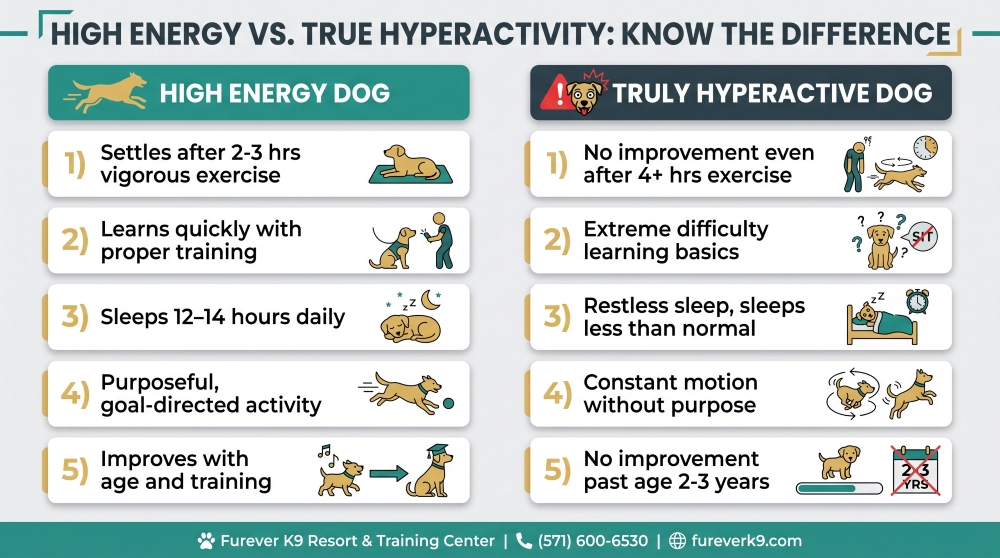
- Inability to settle even after extreme exercise (4+ hours of intense activity produces no fatigue)
- Paradoxical response to stimulants (calming effect rather than increased energy)
- Constant motion without purpose or goal-directed behavior
- Extreme difficulty learning even simple behaviors despite proper training
- Heart rate and breathing that never slow down, even during rest
- Sleep disturbances or inability to sleep normally
- Present from puppyhood without improvement as dog matures
High-energy dogs, in contrast, show normal responses to appropriate exercise and mental stimulation. They can learn, they do settle after adequate activity, and they sleep normally. They’re just dogs with energy levels most owners underestimate and under-meet.
Normal High Energy Characteristics:
- Settles after appropriate exercise (breed-appropriate amounts, not what you think is enough)
- Learns readily with proper training methods
- Sleeps normally and deeply after activity
- Shows goal-directed behavior (wants to play, wants attention, wants food—not random activity)
- Improves with age and training
- Energy level matches breed expectations (herding dog has herding-dog energy)
The distinction is critical. If you have a 9-month-old Border Collie who’s energetic after a 30-minute walk, you don’t have a hyperactive dog—you have a normal Border Collie getting about 20% of their exercise needs met.
Which Dogs Are Most Likely to Be Misidentified as Hyperactive?
Working and herding breeds including Border Collies, Australian Shepherds, Belgian Malinois, and German Shepherds are constantly mislabeled as hyperactive when they’re actually just under-exercised and under-stimulated working dogs living pet lifestyles.
Sporting breeds like Labrador Retrievers, Golden Retrievers, and Springer Spaniels bred for all-day field work appear “hyperactive” to owners who exercise them 30 minutes daily when they need 2+ hours.
Terriers bred for independent, intense work (Jack Russell Terriers, Fox Terriers, Airedale Terriers) seem hyperactive to owners expecting calm lap-dog behavior from breeds designed for ratting and hunting.
Young dogs of any breed, especially during adolescence (6-18 months), show high energy and poor impulse control that looks like hyperactivity but is normal developmental behavior that improves with age and training.
Rescue dogs with unknown backgrounds sometimes show hyperactive-appearing behavior from anxiety, lack of training, or kennelization effects rather than true neurological hyperactivity.
At Furever K9, our training programs start with assessment distinguishing actual behavioral disorders from management and training issues, because the interventions differ completely.
Why Do So Many Dogs Seem Hyperactive?
Understanding common causes of apparent hyperactivity prevents misdiagnosis and inappropriate treatment.
What Creates the Appearance of Hyperactivity?
Insufficient exercise for breed and age is the number one cause of dogs appearing hyperactive. A Labrador Retriever walked 20 minutes daily isn’t hyperactive—they’re desperately under-exercised. Sporting and working breeds need 1.5-3 hours of vigorous exercise daily.
Lack of mental stimulation leaves intelligent dogs creating their own entertainment through hyperactive-appearing behavior. A bored Border Collie isn’t hyperactive; they’re intellectually starved and using physical activity to cope.
Inconsistent training creates dogs who don’t know how to settle, control impulses, or respond to commands. This looks like hyperactivity but is actually lack of training teaching calmness and impulse control.
Reinforcement of excited behavior by owners unknowingly rewards hyperactive-appearing actions. If your dog bounces around and you pet them, play with them, or even yell at them, you’ve reinforced bouncing. They’ll bounce more.
Anxiety and stress can manifest as constant activity, scanning, and inability to settle. Anxious dogs in motion appear hyperactive but treating anxiety rather than “hyperactivity” addresses the actual problem.
Medical issues including thyroid problems, pain, or other health conditions can cause apparent hyperactivity. Dogs don’t suddenly become hyperactive at age 5—if behavior changes suddenly, veterinary examination rules out medical causes.
How Do Owner Expectations Create Perceived Hyperactivity?
Breed mismatches between owner lifestyle and dog needs create countless “hyperactive” diagnoses. If you work 10 hours, come home exhausted, and have a 1-year-old Belgian Malinois, your dog isn’t hyperactive—you chose a working breed for a sedentary lifestyle.
Unrealistic expectations about puppy behavior label normal developmental stages as hyperactivity. Puppies are energetic, have poor impulse control, and don’t settle easily. This is normal, not hyperactive.
Comparison to previous dogs creates false standards. If your last dog was a 12-year-old Basset Hound and your current dog is a 1-year-old Springer Spaniel, the difference isn’t hyperactivity—it’s comparing completely different dogs at different life stages.
Social media and movies show calm, obedient dogs making owners think all dogs should behave that way without training. The reality: those dogs had extensive training, are mature adults, or you’re seeing 30 seconds of a multi-hour session.
How Do You Actually Manage a High-Energy (Not Hyperactive) Dog?
For the vast majority of dogs labeled “hyperactive,” proper management eliminates the problem.
What Exercise Do High-Energy Dogs Actually Need?
Breed Category | Minimum Daily Vigorous Exercise | Mental Stimulation | Notes |
Working/Herding (Border Collie, Malinois, GSD) | 2-3 hours | 45-60 minutes | These dogs were bred to work all day. Walking doesn’t cut it. |
Sporting (Labs, Goldens, Spaniels) | 1.5-2 hours | 30-45 minutes | Retrieving, swimming, running—not leash walking. |
Terriers (Jack Russell, Fox Terrier) | 1-1.5 hours | 30 minutes | High intensity exercise, not slow walks. |
Hounds (Beagles, Coonhounds) | 1-1.5 hours | 20-30 minutes | Need to use their noses during exercise. |
Young dogs (under 2 years) | +30-60 minutes beyond breed baseline | +15-30 minutes | Adolescents need more than adults. |
“Vigorous exercise” means running, swimming, fetch, agility, bike-riding alongside—activities that genuinely tire your dog. A gentle 30-minute leash walk counts as maybe 10 minutes of vigorous exercise.
Most owners dramatically underestimate their dog’s exercise needs. “We walk an hour daily” sounds like a lot until you realize your Border Collie needs triple that in actual vigorous activity.
How Do You Provide Adequate Mental Stimulation?
Daily training sessions teaching new behaviors or practicing known ones provide mental exhaustion that complements physical exercise. 15-20 minutes of focused training can tire a dog as much as an hour of walking.
Effective Mental Stimulation Activities:
- Scent work and nose games engaging natural hunting/tracking instincts
- Puzzle toys and food-dispensing toys requiring problem-solving
- Training new tricks and complex behavior chains
- Hide and seek games with toys or family members
- Novel experiences (new walking routes, new environments, new activities)
Our daycare program incorporates structured mental enrichment throughout the day because we’ve learned physical play alone doesn’t satisfy intelligent, high-energy breeds.
What Training Prevents Hyperactive-Appearing Behavior?
Teaching “settle” or “place” command gives dogs a job during times you need them calm. This isn’t suppressing energy—it’s channeling it into appropriate behavior.
Reward-based training methods are strongly recommended for all behavior modification, as supported by major veterinary behavior organizations .
Impulse Control Exercises:
- Wait at doors until released
- Leave it (food, toys, triggers)
- Stay with increasing duration and distractions
- Eye contact/focus games
- Waiting for permission before engaging in desired activities
Consistent daily routine including feeding, exercise, training, and rest times helps high-energy dogs regulate themselves. Predictability reduces anxiety that can manifest as hyperactivity.
Rewarding calm behavior rather than excited behavior teaches dogs that calmness earns attention and rewards. If you only interact with your dog when they’re bouncing around, you’ve taught them to bounce.
Never rewarding demand behaviors (barking for attention, pawing at you, bringing toys incessantly) prevents inadvertently reinforcing behaviors that look hyperactive.
When Is It Actually Clinical Hyperactivity Requiring Professional Help?
Some dogs genuinely have neurological issues requiring different intervention than management and training.
What Signs Indicate True Hyperactivity vs Normal High Energy?
True Hyperactivity Requires Veterinary Help:
- No improvement with age past 2 years despite appropriate exercise, training, and mental stimulation
- Inability to sleep normally (sleeps less than 8-10 hours daily, restless sleep, wakes frequently)
- Cannot settle even after 3-4 hours of vigorous exercise and mental work
- Extreme difficulty learning even the simplest behaviors despite professional training
- Heart rate and respiratory rate that remain elevated even during rest periods
- Constant motion without apparent purpose or goal
- Paradoxical calming response to stimulants (if tested under veterinary supervision)
Normal High Energy (Management Issue):
- Improves with appropriate exercise, mental stimulation, and training
- Settles after adequate activity
- Sleeps normally (12-14 hours daily for adult dogs)
- Can learn behaviors with proper training
- Normal heart rate and breathing when resting
- Purposeful activity (seeking play, attention, food, stimulation)
- Young dog or breed with known high energy levels
If your dog checks multiple boxes in the “True Hyperactivity” column, veterinary behavioral consultation is appropriate. Your veterinarian can assess whether medication alongside behavior modification might help.
What Medical Issues Mimic Hyperactivity?
Hyperthyroidism can cause increased activity, restlessness, weight loss despite increased appetite, and inability to settle. This is medical, not behavioral.
Pain from orthopedic issues, dental problems, or internal conditions can manifest as restlessness, inability to settle, and constant position changes that look hyperactive.
Neurological conditions including seizure disorders or brain abnormalities can cause abnormal activity levels and behavior changes.
Anxiety disorders create constant motion, hypervigilance, and inability to settle that appears hyperactive but requires anxiety treatment, not hyperactivity management.
If your dog’s behavior changed suddenly or worsened significantly, veterinary examination rules out medical causes before assuming behavioral issues.
How Does Furever K9 Address Truly Hyperactive Dogs?
Comprehensive Behavioral Assessment:
- Distinguish clinical hyperactivity from high energy/management issues
- Evaluate exercise levels, mental stimulation, training history
- Assess for anxiety, medical issues, environmental stressors
- Determine appropriate intervention level
For Management Issues (Most Cases):
- Create realistic exercise and mental stimulation plans matching breed and age needs
- Teach impulse control and calmness through structured training
- Implement routine and environmental management
- Private Lessons coaching owners through implementation
For True Hyperactivity:
- Referral to veterinary behaviorist for medical evaluation and potential medication
- Behavior modification program alongside medical management
- Environmental management reducing stimulation and stress
- Owner support and education about realistic expectations
Our Approach:
- Start with management and training interventions
- If no improvement after 8-12 weeks of proper implementation, consider medical evaluation
- Work with veterinarians when medication might be appropriate
- Realistic assessment of what’s achievable vs. unrealistic expectations
At our facility at 20690 Gleedsville Road in Leesburg, we can assess your dog’s actual behavior, watch them interact with other dogs in our daycare, and determine whether you’re dealing with a management issue or something requiring more intensive intervention.
Your “hyperactive” dog probably isn’t hyperactive. They’re probably a high-energy breed getting insufficient exercise, a young dog with normal adolescent energy, an intelligent dog lacking mental stimulation, or a dog who’s never been taught to settle and control impulses.
True clinical hyperactivity exists but is rare. The vast majority of dogs labeled hyperactive are actually normal dogs in situations that don’t meet their needs or with owners who have unrealistic expectations about what their specific dog requires.
Understanding the difference prevents years of frustration trying to “fix” a dog who isn’t broken—just under-met. A Border Collie needs 2-3 hours of vigorous exercise daily plus extensive mental work. That’s not hyperactivity—that’s normal for the breed. If you can’t provide that, you have a breed mismatch, not a hyperactive dog.
The transformation possible when owners finally meet their dog’s actual needs instead of treating them as problematic continues to amaze me. Dogs who seemed impossible becoming calm, focused, and biddable once given appropriate outlets. Families who considered rehoming their “hyperactive” dog discovering they just needed realistic expectations and proper exercise.
These changes don’t require medication or special interventions for most dogs. They require honest assessment of whether you’re meeting your specific dog’s exercise, mental stimulation, and training needs. They require realistic expectations about what your breed typically requires. They require teaching calmness through training, not expecting it to happen naturally.
At Furever K9, I help Loudoun County families figure out what they actually have—a management issue or a medical issue—then create appropriate solutions. Most “hyperactive” dogs need better management. The few truly hyperactive dogs need different help entirely.
Ready to figure out whether your dog is actually hyperactive or just high-energy and under-met? Contact Furever K9 Resort & Training Center at (571) 600-6530 or visit us at 20690 Gleedsville Road, Leesburg, VA 20175. Let’s assess what you’re actually dealing with and create solutions that work.
Your dog probably isn’t broken. They probably just need more than you’re currently providing.