



Why Does Your Home Environment Matter So Much for Dog Behavior?
How Does Environmental Chaos Affect Your Dog’s Nervous System?
What Environmental Factors Create Anxiety in Dogs?
- Constant Stimulation Without Downtime: Just like you need quiet time after a busy day, dogs need periods where nothing happens. Homes where something is always happening create chronically overstimulated dogs.
- Lack of Safe Spaces: Even confident dogs need quiet areas where they can remove themselves from household activity when overwhelmed. Without these spaces, stress compounds with no relief.
- Conflicting Social Signals: If Dad allows jumping but Mom corrects it, the dog never knows what’s expected. This inconsistency is an environmental problem, not a training failure.
- High-Traffic Sleeping Areas: Dogs sleeping in family rooms where people pass constantly never achieve deep, restorative sleep. Chronic sleep deprivation severely affects emotional regulation.
- Unmanaged Triggers: The dog barking at window activity all day has practiced reactive behavior hundreds of times before you even start training alternative responses.
How Do Different Dogs Respond Differently to the Same Environment?
What Environmental Changes Actually Improve Dog Behavior?
How Does Creating Routine Change Your Dog’s Behavior?
- Predictable Responses: If jumping always results in being ignored, your dog learns what to expect.
- Strategic Exercise Timing: A dog who walks at 7 AM daily is calmer by 8 AM than a dog whose walks happen randomly. The predictability itself calms them.
- Established Bedtimes: Consistent bedtime rituals teach anxious or overstimulated dogs when it is time to stop being vigilant and finally relax.
What Physical Environmental Modifications Help Most?
- Manage Window Access: Closing curtains in rooms where your dog practices window-barking reduces daily practice of unwanted behaviors by hundreds of repetitions.
- Create Dedicated Safe Spaces: A crate or quiet room where nothing bad ever happens provides essential escape options. Forcing dogs out of safe spaces defeats their purpose.
- Reduce Household Chaos During Training: If you’re working on calm greetings, having family members arrive home one at a time during initial training supports behavior change.
- Strategic Furniture Placement: If your dog obsessively watches out front windows, moving their bed away from that window removes the opportunity for constant rehearsal of alert behaviors.
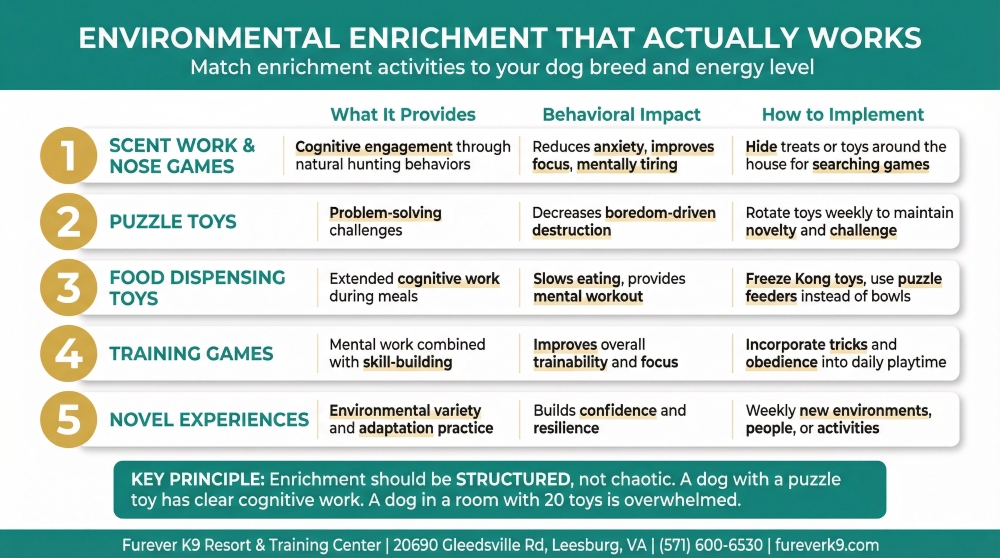
How Does Environmental Enrichment Affect Training Success?
Enrichment Type | What It Provides | Behavioral Impact | Implementation |
Scent Work | Cognitive engagement through natural hunting behaviors | Reduces anxiety, improves focus, tires mentally | Hide treats/toys for searching games |
Puzzle Toys | Problem-solving challenges | Decreases boredom-driven destruction | Rotate toys to maintain novelty |
Food Dispensing Toys | Extended cognitive work during meals | Slows eating, provides mental workout | Freeze Kong toys, use puzzle feeders |
Training Games | Mental work combined with skill-building | Improves overall trainability | Incorporate tricks into daily routine |
Novel Experiences | Environmental variety and adaptation practice | Builds confidence and resilience | Weekly new environments/activities |
Why Is Early Environment So Critical for Long-Term Behavior?
What Happens During Critical Socialization Periods?
What Can You Do About Poor Early Socialization?
How Does Training Environment Affect Learning Success?
Why Do Behaviors Learned at Training Facilities Sometimes Fail at Home?
Conclusion
Tiira, K., & Lohi, H. (2015). Early Life Experiences and Exercise Associate with Canine Anxieties. PLOS ONE, 10(11), e0141907.
FAQs
Environmental modifications alone rarely fix everything, but they create breakthrough improvements that training alone couldn’t achieve. Addressing factors like overstimulation and lack of routine alongside training produces significantly better results.
More than most owners realize. While some stable dogs adapt to irregular schedules, anxious or sensitive dogs require predictable daily patterns for meals, exercise, and sleep to reduce vigilance and feel secure.
This is due to context-specific learning. Your dog learned the behavior in a calm, controlled environment, but hasn’t generalized it to the chaotic, highly stimulating environment of your home.
It depends on the dog. For calm dogs, it provides enrichment; for reactive dogs, it creates hundreds of daily rehearsals of unwanted barking and arousal, which sabotages training efforts.
Choose a quiet area away from household traffic, add comfortable bedding, and ensure nothing scary ever happens there. Never force your dog out of this space—it only works if they have total autonomy over it.