
What Are Board & Train and Private Training Really Like?
How Does Board & Train Actually Work?
- Intensive Immersion: Professional trainers work with your dog in controlled environments, practicing commands and behaviors repeatedly throughout each day. This immersion allows rapid skill development because training happens in short, frequent sessions optimized for canine learning.
- Consistent Environment: The dogs live in comfortable 4×6 suites during their stay, receiving exercise, socialization with appropriate dogs, and mental stimulation beyond formal training sessions. The facility environment provides consistency impossible to replicate at home with normal family schedules.
- Owner Handoff: Board & Train concludes with owner education sessions where you learn to maintain and continue the progress made during your dog’s stay. Without proper owner follow-through, even excellent training results can fade quickly once the dog returns home.
What Do Private Lessons Involve?
Private Lessons at Furever K9 involve one-on-one sessions with professional trainers, either at our facility or through in-home visits within Loudoun County and parts of Fairfax County. Sessions typically last 45 minutes to one hour.
- Hands-On Coaching: The trainer works with both you and your dog, teaching you how to communicate effectively, apply techniques correctly, and read your dog’s responses. You’re learning as much as your dog during these sessions.
- Context-Specific Work: Training happens in your actual environment where problems occur. If your dog pulls on neighborhood walks, you train on those exact streets. If they’re reactive at your front door, you practice there. This addresses real-world challenges directly.
- Owner Responsibility: You implement techniques between sessions, practicing daily what you learned. Progress depends heavily on your consistency and follow-through. The trainer provides guidance, but you do the majority of the work.
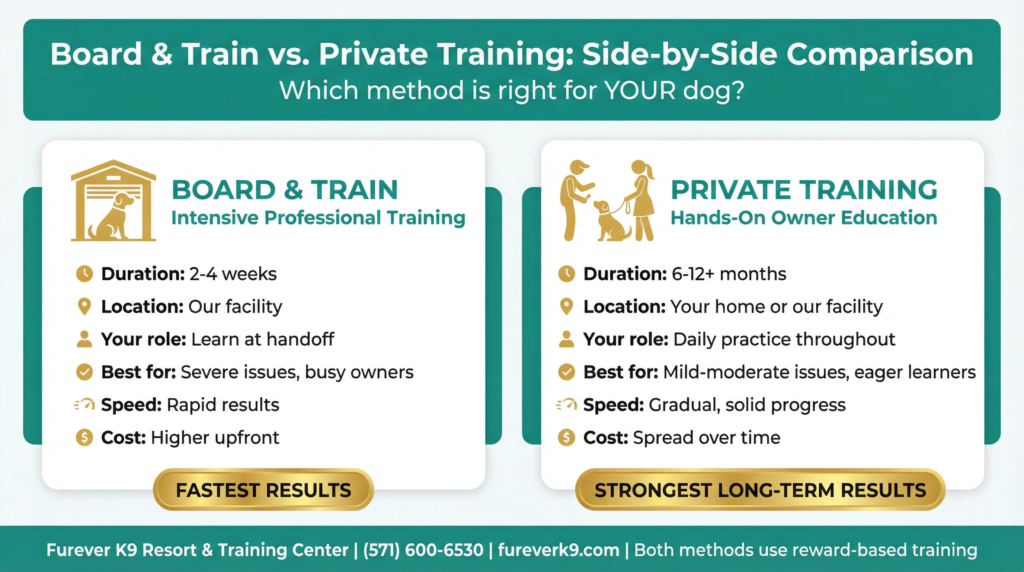
How Do These Training Methods Compare Side-by-Side?
|
Consideration
|
Board & Train
|
Private Lessons
|
|
Basic format
|
Your dog stays with a training provider while agreed goals are worked on. Confirm the current program details.
|
You and your dog work with a trainer. Confirm the available lesson format and location.
|
|
Owner’s role
|
Share your goals, ask what owner education is included, and continue practice at home.
|
Take part in lessons and ask what practice is expected between sessions.
|
|
Training setting
|
Practice takes place in the provider’s setting; ask how the plan addresses your home routines.
|
The trainer coaches you and your dog; ask whether the current lesson setting can address the situations that matter to you.
|
|
Time and schedule
|
Ask about current program length and daily routine.
|
Ask about current lesson length, frequency, and schedule.
|
|
Cost
|
Request a current quote and a list of inclusions/exclusions.
|
Request the current lesson or package pricing and any additional costs.
|
|
Fit questions
|
Is your dog comfortable staying away from home? Are you ready to continue practice afterward?
|
Do you want to learn hands-on with your dog? Can the available setting address your goals?
|
|
Follow-up
|
Ask exactly what handoff or follow-up is included.
|
Ask what guidance is available between or after lessons.
|
What Are the Real Advantages of Board & Train?
Why Might a Focused Training Setting Be Helpful?
- Agreed Goals: A Board & Train program may give a trainer time to work on goals discussed with the owner. Ask which skills are included and how progress will be shared.
- A Different Setting: Training at a facility can offer a different environment from home. Ask how your dog will practice skills in settings that matter to your family, too.
- A Clear Training Approach: Before choosing a program, ask which methods will be used, how they’ll be tailored to your dog, and what you’ll need to do when your dog comes home.
Who Might Consider Board & Train?
- Owners with Specific Goals: If there are particular skills or routines you’d like to work on, discuss whether the current program can address them.
- Busy Households: A facility-based stay may fit some schedules better than attending frequent lessons. It doesn’t remove your role, though—you’ll still need to learn how to practice with your dog at home.
- Owners Ready to Continue the Work: Ask what owner guidance or handoff is included so you know what to practice after your dog returns.
- Dogs with Individual Needs: If your dog has serious behavior or safety concerns, share the details with the trainer and ask whether Board & Train is an appropriate option. Don’t assume that a particular behavior automatically makes a dog a good fit.
What Are Board & Train’s Limitations?
- Training Transfer: A skill practiced in one setting may not happen automatically in another. Your home, family routines, and neighborhood are different, so your practice with your dog matters.
- Owner Involvement: Board & Train changes where some of the training happens; it doesn’t take you out of the process. Ask what you’ll learn before your dog comes home and what practice will be expected.
- Cost: Program prices and inclusions vary. Ask for current pricing and a clear explanation of what’s included before comparing options.
- Time Away from Home: Some dogs may not be comfortable staying away from their family. Talk with the provider about your dog’s needs and whether the current program is a good fit.
What Are the Potential Benefits of Private Lessons?
How Does Hands-On Learning Help Dog Owners?
- Practice Together: You can work on skills with your dog while the trainer provides guidance. Ask what practice is recommended between lessons.
- Feedback During Lessons: A trainer may be able to observe how you and your dog respond to a skill and offer guidance during the session.
- Everyday Routines: If the lesson format and service area allow, you can discuss how training goals relate to situations in your home or daily routine.
- Shared Learning: Taking part in practice can help you feel more prepared to work with your dog. Progress still takes follow-through after the lesson.
How Can Private Lessons Support Owner Involvement?
When Might Private Lessons Be Worth Discussing?
- Owners Who Want to Participate: If you’d like to learn and practice alongside your dog, talk with a trainer about whether private lessons fit your goals.
- Household-Specific Challenges: If the issue happens at home or during a routine, ask whether the current lesson format can address it in that setting.
- Schedule and Cost Questions: Compare current lesson availability, pricing, and expected practice with other options. Don’t assume private lessons will always cost less or offer more flexibility.
- Dogs Uneasy in New Settings: If your dog seems uncomfortable away from home, share that with the trainer. Discuss which available format may be appropriate rather than assuming one option is best for every anxious dog.
How Do You Actually Choose Between These Methods?
What Should You Consider About Your Dog?
- Severity of Issues: Minor nuisance behaviors differ from dangerous aggression.
- Temperament: Some dogs thrive in new environments; others become anxious away from familiar settings.
- Age: Young puppies often do well with Private Lessons. Adolescent dogs may need Board & Train. Senior dogs depend on habit severity.
- Health: Dogs with severe separation anxiety or health conditions needing close monitoring may not be Board & Train candidates.
What Should You Consider About Yourself?
- Available Time: If you can’t practice 10-15 minutes daily, Private Lessons won’t work well.
- Learning Preferences: Do you thrive learning hands-on, or prefer seeing the finished result first?
- Budget Structure: Can you allocate a larger sum now, or does weekly payment work better?
- Involvement Level: Do you want to be hands-on throughout, or prefer professionals handle the intensive work?
How Do Your Goals Influence the Decision?
- Timeline Urgency: If you’re moving in 6 weeks, Board & Train’s speed suits your timeline. If you have months, Private Lessons work fine.
- Specific Behaviors: Basic obedience responds well to either. Severe aggression often needs Board & Train. Household-specific issues benefit from Private Training.
- Long-Term Goals: If you want a well-trained dog right now, Board & Train delivers faster. If you want to become a skilled trainer yourself, Private Lessons teach you more.
How Does Furever K9 Help You Make This Decision?
What Does the Initial Evaluation Reveal?
Why Does Furever K9 Offer Both Methods?
What Support Continues After Training?
- Board & Train Graduates: Receive follow-up support as you implement techniques at home, preventing backsliding.
- Private Lesson Clients: Receive ongoing support between sessions via text or email for quick questions.
- Fluid Transition: Both programs can transition into the other if needed. Your training path can adapt as needs change.
Conclusion
FAQs
Yes. Many families start with Private Lessons, then transition to Board & Train for intensive work on specific issues that emerge or prove more challenging than expected. We also see families do Board & Train first for foundation behaviors, then Private Lessons for maintenance and advanced training. Your training path can adapt as needs change.
Board & Train programs typically cost more upfront but may be comparable or even less expensive than equivalent Private Lesson hours when calculated per training hour. Private Lessons offer payment flexibility spread over months. The cost-effectiveness depends on how many sessions your dog ultimately needs and which method produces faster results for your specific situation.
Not if you implement proper follow-through. Board & Train establishes behaviors; owner education and consistent application maintain them. Furever K9’s programs include comprehensive handoff sessions teaching you to maintain progress. Dogs don’t “forget” training—they respond differently to different handlers without proper transfer protocols.
Commitment duration varies based on your dog’s issues and your consistency with practice. Basic obedience may require 6-8 sessions over 2-3 months. Moderate behavioral issues often need 10-15 sessions over 3-6 months. Severe issues may require ongoing support for 6-12 months. Your trainer assesses progress and adjusts recommendations.
Properly matched Board & Train programs produce significant improvement when followed by appropriate owner implementation. If issues persist, it often indicates the need for continued Private Lessons for maintenance, environmental management adjustments, or addressing issues that emerged during home transition. No training method “solves” all problems permanently without ongoing management.