

If you’ve been researching dog training options in Northern Virginia, you’ve probably noticed something interesting: more and more trainers are moving away from single-session “quick fixes” and toward comprehensive structured programs. This isn’t just a trend—it’s backed by fascinating new research that’s changing how we understand dog training.
As a dog owner in Loudoun County dealing with leash pulling, jumping, barking, or other behavioral challenges, understanding this shift could make all the difference in finally achieving the calm, well-behaved companion you’ve been hoping for.
What Virginia Tech Just Discovered About Dog Training
Right here in our backyard, Virginia Tech researchers published an eye-opening study in September 2025. They analyzed data from over 47,000 dogs across four years, and what they found has huge implications for dog owners.
Here’s the surprising part: dogs who received structured training before 2020 maintained better trainability scores throughout the pandemic and beyond. Meanwhile, dogs adopted or enrolled after 2020—many of whom missed early professional training—showed noticeably lower trainability scores.
What does this tell us? Early, structured training creates a foundation that lasts. It’s not just about teaching commands—it’s about building your dog’s ability to learn throughout their life.
The Science Behind Structured Training
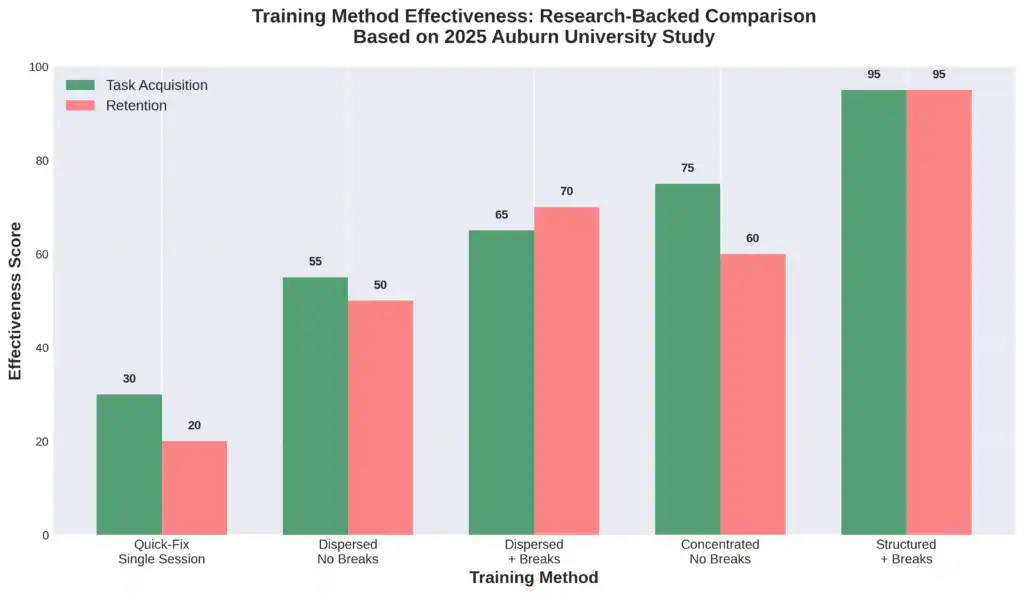
A brand-new study published in January 2025 in Applied Animal Behaviour Science looked at exactly how training schedules affect learning. Researchers studied 48 dogs learning detection tasks and discovered something important:
Structured training with strategic breaks improved both how quickly dogs learned AND how well they remembered what they learned.
Think about it like studying for a test. Cramming the night before might help you pass, but you’ll forget everything by next week. Spaced-out study sessions with breaks? That’s when real learning happens. Dogs work the same way.
The study concluded that “training schedules may be structured to promote both task acquisition and training efficiency.” In plain English: the way you structure training matters just as much as what you teach.
Why Quick-Fix Sessions Often Fall Short
We get it, single-session training sounds appealing. It’s less expensive upfront, takes less time, and promises fast results. But here’s what research shows happens:
The Repetition Problem: Dog learning happens through repetition that builds neural pathways in the brain. One or two sessions simply can’t provide enough repetition for behaviors to become reliable and automatic.
The Memory Challenge: Learning something once doesn’t mean your dog will remember it next week. The 2025 research showed that strategic breaks between sessions actually improve retention—something single sessions can’t provide.
The Real-World Gap: Your dog might perform perfectly in a training facility but completely ignore you at home or on walks. Dogs need practice in multiple environments to generalize behaviors, which takes time and multiple sessions.
The Root Cause Issue: Most behavioral problems have underlying causes. Is your dog’s leash reactivity from fear, frustration, or over-excitement? Quick fixes address symptoms without diagnosing the real problem.

How Structured Programs Work Better
At Furever K9 Resort & Training Center here in Leesburg, we’ve built our approach around what research shows actually works. Here’s how structured programs make the difference:
Our Board & Train Program
When your dog stays with us for Board & Train, they’re not just learning commands—they’re building a foundation for lifelong learning. Here’s what makes it effective:
Customized Plans: Every dog is different. We tailor programs based on your dog’s temperament, age, and specific challenges. This individualization is what research identifies as critical for success.
Daily Structured Sessions: Your dog receives multiple training sessions each day with strategic breaks in between. This matches the training schedule structure that research shows optimizes both learning and retention.
Professional Monitoring: We watch for stress signals and adjust our approach to ensure your dog is confident and happy, not just compliant. Research shows this matters for long-term success.
Comfortable Environment: Between sessions, dogs relax in comfortable 4×6 suites with Kuranda beds, enjoy group play, and have access to outdoor areas. These breaks aren’t just rest—they’re when learning consolidates in your dog’s brain.
Private Lessons & Day Training
Prefer to keep your dog at home? Our private lessons provide structured, progressive training that builds systematically over multiple sessions:
Real-World Training: We teach you how to practice in the places where you actually need good behavior, like your neighborhood, local parks, or wherever your dog struggles.
Owner Education: You learn alongside your dog, understanding not just what to do but why it works. This knowledge helps you maintain progress long-term.
Flexible Scheduling: We work with your schedule while maintaining the consistency that research shows dogs need for effective learning.
Group Classes
Our group classes offer structured learning in a social environment, teaching dogs to focus around distractions while building confidence through positive experiences with other dogs.
The Real Cost Comparison
Here’s something many dog owners discover the hard way: quick fixes often cost more in the long run.
Let’s say you try three different trainers offering single sessions at $150 each. That’s $450 spent with minimal lasting results. Meanwhile, the behavioral problems continue, causing stress, potential damage to your home, and limiting where you can take your dog.
A structured program requires a higher upfront investment, but it addresses root causes and creates lasting change. When you factor in the cost of repeated failed attempts, structured programs often cost less per successful outcome.
Common Behavioral Issues We Address
Our structured programs effectively help with:
- Leash reactivity and pulling
- Jumping on people and furniture
- Excessive barking (at people, dogs, doorbells, etc.)
- Potty training challenges at any age
- Crate anxiety or resistance
- Fearful or anxious behaviors
- Puppy foundation training
- Basic manners and obedience
The key is that each of these issues requires time, consistency, and systematic progression—exactly what structured programs provide.
Is Structured Training Right for Your Dog?
Consider structured training if:
✓ You’ve tried training on your own without lasting success
✓ Previous single-session trainers didn’t create the change you hoped for
✓ You’re dealing with challenging behaviors that affect your daily life
✓ You want to prevent problems by starting your puppy off right
✓ You’re busy and need professional help to get your dog on track
✓ You want a calm, well-behaved dog you can take anywhere well-behaved dog
The 2025 Shift in Virginia
The trend toward structured programs reflects a broader shift in how Virginians approach dog training. Pet owners are becoming more educated, asking better questions, and recognizing that their dogs deserve comprehensive solutions—not quick fixes that don’t last.
The pet training industry is projected to grow from $4.1 billion in 2024 to $7.4 billion by 2034—an 80% increase that reflects how seriously Americans take their dogs’ training and behavioral health.
Right here in Northern Virginia, dog owners are choosing trainers who offer science-based, structured approaches that create real, lasting change.
Ready to Experience the Difference?
At Furever K9 Resort & Training Center, we’re proud to offer the structured, relationship-based training that Northern Virginia dog owners are increasingly seeking. Whether you choose our Board & Train program, Private Lessons, or Group Classes, you’ll receive the systematic, individualized approach that research validates and real-world results prove.
Don’t spend more time and money on approaches that don’t work. Let’s create a customized program that addresses your dog’s unique needs and transforms your relationship with your canine companion.
References
- Virginia Tech & University of Washington Dog Behavior Study (2025)
A large-scale analysis of more than 47,000 dogs from the Dog Aging Project that examined long-term behavior patterns and training outcomes in family dogs. The study highlighted how environment, communication, and handling style significantly influence a dog’s behavioral development over time. Published in PLOS One. - Training Schedule Impact Study (2025)
A controlled study evaluating how variations in training frequency affect a dog’s ability to learn and retain new tasks, including scent detection. Findings showed that structured, consistent training schedules support stronger long-term retention. Published in Applied Animal Behaviour Science. - Training Method Effectiveness Study (2021)
Research comparing reward-based and mixed-method training approaches, measuring both learning efficiency and behavioral stress indicators. Results underscored the importance of clarity, consistency, and humane methods in producing reliable obedience. Published in PLOS One and referenced widely in subsequent studies. - Pet Training Industry Market Insights (IBISWorld, 2025)
Industry projections show continued growth in the dog training sector, rising from an estimated $4.1 billion in 2024 to a projected $7.4 billion by 2034. Insights emphasize increased demand for professional training, behavior support, and owner education.