
It’s 9 PM, and your dog is tearing through the house like they’ve been possessed. Another pillow has been de-stuffed. The neighbor just texted about the barking — again. You walked them this morning, gave them time in the yard, and even tossed a ball for a few minutes before dinner. So why are they acting like they haven’t moved all day?
Here’s the truth that most exhausted dog owners don’t realize: that 20-minute walk around the block is not enough. What looks like misbehavior, defiance, or hyperactivity is often your dog’s desperate, frantic attempt to burn off a full day’s worth of stored physical and mental energy. They are not acting out to spite you. They are communicating the only way they know how.
At Furever K9 in Leesburg, Virginia, we help Loudoun County families move beyond the generic, one-size-fits-all advice flooding the internet and create customized exercise plans grounded in their dog’s specific breed, age, and temperament. In our experience working with hundreds of Northern Virginia families, the difference between a destructive, anxious dog and a calm, well-behaved companion often comes down to one overlooked factor: whether their true exercise requirements are actually being met.
The answer depends entirely on your individual dog. Generic advice like “30 minutes a day” fails most owners because it ignores the three critical variables that determine a dog’s real energy needs: breed genetics, life stage, and individual personality. Understanding each of these factors is the foundation of any effective exercise plan.
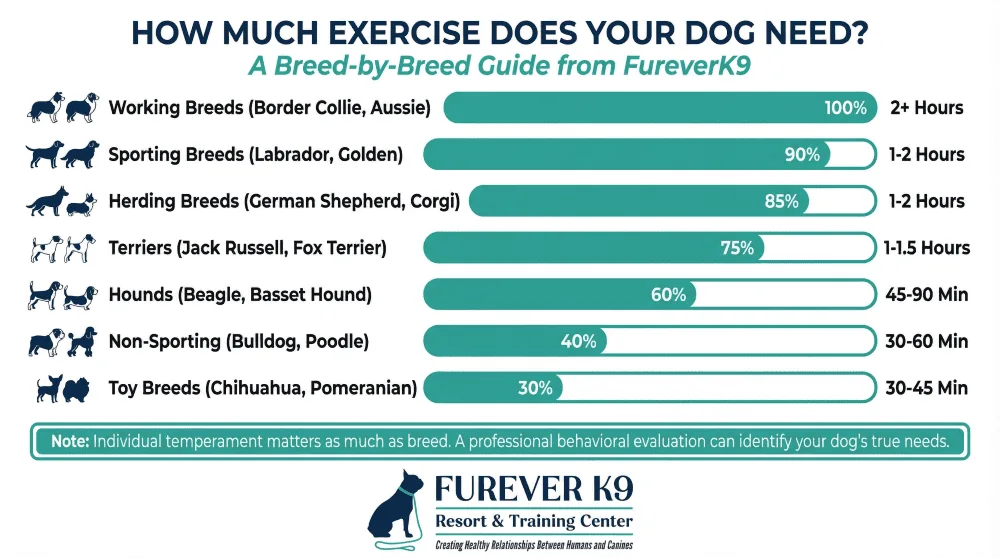
Breed is the single biggest predictor of exercise needs, and the range is enormous. High-energy working breeds like Border Collies, Australian Shepherds, and Belgian Malinois were selectively bred over generations to work alongside humans for 8-10 hours a day. Without a job or a meaningful outlet, they don’t simply relax — they redirect that energy into behaviors that drive their owners to the brink. These dogs need 2 or more hours of vigorous activity daily just to maintain basic mental and physical equilibrium.
Sporting breeds, including Labrador Retrievers, Golden Retrievers, and German Shorthaired Pointers, were bred to run fields and retrieve game all day. They thrive on 1 to 2 hours of active exercise, and a leisurely stroll around the neighborhood barely scratches the surface of what their genetics are wired for. Herding breeds like German Shepherds and Corgis fall into a similar category, requiring structured, purposeful activity that challenges both their bodies and their minds.
On the other end of the spectrum, Bulldogs, Basset Hounds, and many Toy breeds are genuinely lower-energy dogs that do well with 30 to 60 minutes of moderate daily activity. That said, “lower energy” does not mean “no exercise.” Even the most laid-back breed needs consistent daily movement for physical health and mental well-being.
| Breed | Exercise Duration | Activity Type |
|---|---|---|
| Labrador | 1-2 hours | Fetch, running |
| Bulldog | 30-60 minutes | Short walks, playtime |
| Dachshund | 30 minutes to 1 hour | Walks, gentle play |
This table illustrates the varying exercise needs of different dog breeds, highlighting the importance of tailoring exercise routines to meet individual requirements.
A dog’s exercise needs evolve significantly throughout their life, and adjusting your approach to match their current stage is just as important as understanding their breed.
Puppies (0–1 year) are bundles of energy, but their growing bones and joints are not yet equipped for sustained, high-impact activity. The rule of thumb is five minutes of exercise per month of age, up to twice a day. So a four-month-old puppy is well-served by two 20-minute sessions of gentle play and exploration. The focus at this stage should be on mental stimulation, socialization, and building positive associations with movement — not distance or intensity.
Young adults (1–7 years) represent peak exercise demand. This is when breed characteristics are most pronounced and when unmet exercise needs are most likely to manifest as behavioral problems. A two-year-old Border Collie and a two-year-old Bulldog have almost nothing in common in terms of what their bodies and minds require each day.
Senior dogs (7+ years) still need and benefit greatly from daily activity, but the nature of that activity should shift. Arthritis, reduced stamina, and other age-related changes call for shorter, gentler sessions. The key is consistency over intensity — a daily 20-minute walk does far more for a senior dog’s physical and cognitive health than a once-a-week long hike.
Here is something many dog owners don’t expect to hear: not every Labrador wants to swim for two hours, and not every Border Collie is obsessed with fetch. Breed guidelines are a starting point, not a prescription. Individual personality plays a significant role in shaping a dog’s actual energy levels and preferred activities.
Some dogs within typically high-energy breeds are naturally calmer and satisfied with less intense activity. Others from lower-energy breeds have unusually high drive and need far more stimulation than their breed standard suggests. Observing your specific dog’s behavior is the most reliable indicator of whether their needs are being met. Signs of insufficient exercise — destructive behavior, difficulty settling, hyperactivity that intensifies as the day goes on — tell you everything you need to know.

Not all activity delivers equal benefits. The most effective exercise plans combine physical exertion with mental stimulation, because it is the combination of both that produces a truly calm, satisfied dog.
This is where many well-meaning dog owners leave significant results on the table. Mental exhaustion is just as real and just as effective as physical tiredness — and for many dogs, it is even more so. A focused 20-minute training session can tire a dog more completely than a 60-minute walk, because cognitive work burns significant energy and satisfies the need for purposeful engagement.
Puzzle toys and food-dispensing games challenge your dog’s problem-solving instincts while keeping them occupied and mentally engaged. Scent work — even something as simple as hiding treats around the yard for your dog to find — taps into their most powerful natural ability and provides enrichment that physical exercise alone cannot replicate. Incorporating obedience practice and new command training into your daily routine adds a mental dimension to every interaction, building focus and calm over time.
At Furever K9, our training programs are designed with this dual approach in mind. Whether through private lessons, day training, or our board and train program, we teach owners how to combine physical activity and mental engagement in ways that create genuinely well-balanced dogs.
At our Leesburg facility, we see the same patterns week after week. Insufficient exercise is one of the most common — and most overlooked — root causes of the behavioral issues that bring Loudoun County families to our door.
Destructive chewing, digging, and shredding are textbook signs of a dog with pent-up energy and no appropriate outlet. The energy does not disappear simply because your dog lacks the opportunity to release it. It manifests in the behaviors you find most frustrating, because from your dog’s perspective, those behaviors work. They burn energy. They provide stimulation. They fill the void.
Excessive barking is frequently a boredom and frustration response. A dog who is under-stimulated will bark at passing cars, rustling leaves, and shadows on the wall — not because they are poorly trained, but because they are desperately seeking engagement. Alert barking also escalates in under-exercised dogs because excess mental energy makes them hypervigilant, reacting to every minor stimulus with the intensity of a perceived threat.
Anxiety and restlessness are perhaps the most misunderstood consequences of inadequate exercise. Physical activity is a natural, biochemical anxiety-reducer. It burns off stress hormones like cortisol and promotes the production of calming neurotransmitters. A dog who does not receive adequate exercise is physiologically primed for anxiety — not because of their temperament or their history, but because of their chemistry.
Creating a sustainable exercise plan does not require a complete overhaul of your schedule. It requires honesty, consistency, and a willingness to think about your dog’s needs rather than just their behavior.
Start by tracking your dog’s current activity for one week. Note the duration, type, and intensity of exercise each day, and observe your dog’s energy levels and behavior patterns in the hours that follow. This baseline will reveal the gap between what your dog is currently getting and what they actually need.
Choose activities that fit your real life, not an idealized version of it. A plan that requires two hours of hiking every day is not sustainable for most working families in Loudoun County. The best exercise plan is the one you can actually maintain. Consistency over time produces far better results than sporadic bursts of intense activity.
Increase gradually to prevent injury. Adding no more than 10 to 15 percent more activity per week gives your dog’s body time to adapt. Watch for signs of overexertion — excessive panting that persists more than 10 minutes after exercise, limping, or extreme fatigue — and pull back if needed.
Finally, integrate mental stimulation into every session. Practice a few obedience commands during your walk. Add a scent game before dinner. Swap one meal a week for a puzzle feeder. These small additions compound over time into a significantly more satisfied, calmer dog.
Your dog is not broken, and their behavior problems are not permanent character flaws. They are signals — clear, consistent signals that something in their daily life is not being met. Before assuming your dog needs more discipline, consider whether they simply need more of the right kind of activity.
If you’re ready to stop the destruction and finally enjoy the calm, connected relationship with your dog that you’ve always wanted? Contact Furever K9 at (571) 600-6530 to schedule a behavioral evaluation with our founder, Lauren White, and get a customized plan built around your dog’s true exercise needs.
A well-exercised dog is calm, settles easily at home, and sleeps soundly. A dog that is hyperactive, destructive, or constantly demanding attention is telling you they need more.
Yes. Over-exercising can cause joint damage, heat stroke, and exhaustion, particularly in puppies and senior dogs. Always increase activity gradually and watch for signs like persistent limping, excessive panting, or reluctance to move the following day.
Any activity that requires your dog to think and problem-solve counts — puzzle toys, scent work, learning new commands, and food-dispensing games all qualify. Our training programs are built around this principle.
Doggy daycare, a midday dog walker, or our Day Training program are excellent solutions. Even 15 minutes of focused training and a puzzle toy before you leave can meaningfully reduce daytime restlessness.
Not necessarily — breed matters far more than size. A Jack Russell Terrier needs significantly more exercise than a Great Dane. Always assess your dog based on their breed’s original working purpose, not their physical stature.
Let Lauren know what you're struggling with!
She'll get in touch with you to discuss options!